
Personnel for the 13th term: Overcoming "lobbying" for appointments and obtaining votes through connections.
Personnel planning for the 13th Party Congress is one of the important topics to be discussed at the 9th meeting of the 12th Central Committee, scheduled to open on December 25th.
Deputy Head of the Standing Committee of the Central Organization Department, Nguyen Thanh Binh, affirmed: "The nomination of personnel for the 13th Party Congress has basically met the requirements set forth so far, initially contributing to overcoming the phenomenon of lobbying for nominations or campaigning for nomination votes through personal connections."
Do not lower standards for the sake of quantity.
How is the personnel planning for the 13th Party Congress being prepared, sir?
From the beginning of the 12th National Congress term to the present, the Central Organizing Committee has advised the Central Committee, the Politburo, and the Secretariat to focus on leading the development, amendment, supplementation, and promulgation of many policies, resolutions, regulations, and rules related to personnel work and personnel management, such as Central Resolutions 4, 6, and 7 of the 12th Party Congress.
For example, the Politburo's regulations on the decentralization of personnel management and the appointment and nomination of candidates; regulations on job title standards and criteria for evaluating officials; on internal political security and personnel rotation; on the responsibility of Party members and officials, especially high-ranking leaders, to set an example; and many other guidelines and regulations.
The resolutions, regulations, and rules issued have contributed to strong, synchronized, comprehensive, and interconnected reforms across all stages of personnel management.
Specifically, it ensures the direct and comprehensive leadership of the Central Committee, the Politburo, and the Secretariat, based on fully utilizing the authority and responsibility of Party committees, Party organizations, and leaders at all levels in personnel work and personnel planning.
The process involves standardizing personnel standards, criteria, procedures, and practices step by step, in a way that is rigorous, democratic, transparent, fair, impartial, and objective.
At the same time, we must strengthen decentralization to the grassroots level, create a mechanism and environment that promotes and encourages innovation and creativity, and protect officials who dare to think outside the box, make breakthroughs, and take responsibility for the common good.
Compared to previous terms, what are the differences in the planning and preparation of personnel for the next term?
The Politburo has issued Plan No. 11, which includes several fundamental reforms.
First and foremost, the development of strategic planning at the Party Central Committee level must be closely linked to the situation, political tasks, and personnel work requirements of each term of the Party's national congress.
In this context, the Politburo determined that it is necessary to focus on leading the development of strategic-level planning for the 2021-2026 term according to the motto "do it step by step, ensuring certainty at each stage" with a specific roadmap: Planning for the Central Committee to be submitted to the 9th Central Committee meeting, followed by planning for the Politburo and the Secretariat according to the plan.
Secondly, innovation should be carried out in a process and manner based on further expanding democracy, clearly defining the authority and direct responsibility of Party committees, Party organizations, and leaders at all levels in considering, identifying, and recommending personnel from their localities, agencies, and units for strategic-level planning.
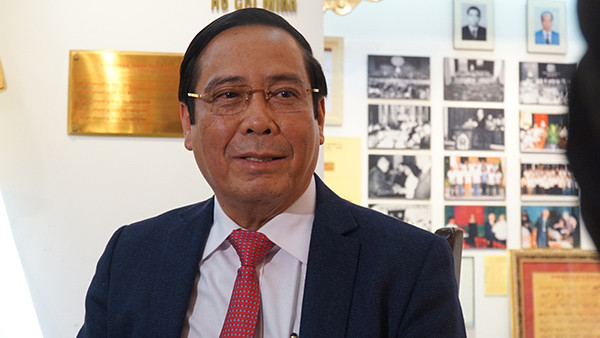 |
| Deputy Head of the Standing Committee of the Central Organization Department Nguyen Thanh Binh: In planning, standards should not be lowered for the sake of quantity. |
Thirdly, it involves specifying the standards and conditions for planned positions according to Regulation 90 of the XII Political Bureau. Simultaneously, it supplements regulations on the structure, number, target groups, process, and methods in a unified, synchronized, comprehensive, and interconnected manner.
The process of identifying and recommending personnel for planning at the local level, agencies, and units follows four steps. The process of reviewing, verifying, and approving planning at the central level follows five steps.
Fourth, it is essential to prioritize standards of political integrity, moral character, lifestyle, organizational discipline, exemplary conduct of oneself and one's family, work capacity linked to work results and specific products in the assigned field and area, and to have ambition and a desire for innovation, for the development of the country, and for the happiness of the people.
Emphasize the responsibility of Party committees, Party organizations, and advisory agencies in coordinating efforts to improve the quality of personnel vetting for planning purposes. Uphold principles and promote democracy in considering and deciding on personnel planning, without lowering standards for the sake of quantity.
We must prevent political opportunists and sycophants from infiltrating the Central Committee.
General Secretary and President Nguyen Phu Trong once noted: "Absolutely do not include in the planning those who show signs of ideological and political degeneration, lack of unity, internal disruption, corruption, and political opportunism like 'eels' or 'mudfish'." According to him, what solutions are needed to select the right people and prevent unworthy individuals from entering the Central Committee?
We must strengthen guidance, inspection, standardization, and tighten Party discipline and order to overcome shortcomings, limitations, weaknesses, and deficiencies in personnel work and personnel planning, and gradually push back against the practice of "buying positions, power, transfers, appointments, and personnel planning."
Wherever mistakes or problems arise, they must be rectified promptly. Party organizations and Party committees at all levels should conduct regular inspections so that errors and violations are dealt with in a timely manner, building trust and credibility. At the same time, there must be a mechanism for superiors to listen to subordinates, in order to build a reputable team capable of fulfilling its tasks.
Along with that, there must be mechanisms for inspection and control to prevent those who are ideologically and politically corrupt, morally and lifestyle-wise degenerate, self-transforming; those who are politically opportunistic, sycophantic, seek positions and power through illicit means, have personal ambitions, or lack integrity; and those whose themselves and their families do not set a good example in complying with the Party's guidelines and policies and the laws of the State... from entering the Central Committee.
The titles, standards, and criteria for cadres stipulated by the Politburo must be strictly implemented. Any place that acts dishonestly or improperly must be investigated and dealt with.
To date, Party committees, Party organizations, and collective leadership bodies of agencies and units have basically implemented the Politburo's Plan 11 strictly. In general, the results of personnel nominations have basically met the requirements set forth, initially contributing to overcoming the phenomenon of lobbying for nominations or soliciting nomination votes through personal connections.


