
Japan reduces public debt, increases defense spending.
On January 29, the government of Japanese Prime Minister Shinzo Abe decided to expand the country's defense budget for fiscal year 2013 to more than 4.7 trillion yen (equivalent to 52 billion USD).
This marks the first time Japan has increased its defense spending in 11 years.
According to Japanese government officials, the country's defense budget for fiscal year 2013, which begins on April 1st, will be 4.753 trillion yen, an increase of 40 billion yen compared to the previous fiscal year.
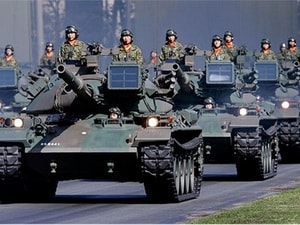
Illustrative image.
This decision indicates that Prime Minister Abe's government will place particular emphasis on strengthening the Japan Self-Defense Forces (SDF), amid ongoing disputes between Japan and several countries over territorial sovereignty in the East China Sea.
Specifically, in the draft budget for fiscal year 2013, the Japanese government will allocate 13.5 billion yen for the cost of purchasing fuel, maintenance, and data transfer for the Early Warning and Control System for aircraft of the country's Air Self-Defense Force; and the cost of purchasing other military equipment such as amphibious vehicles and F-35 fighter jets.
According to the new decision, the SDF will receive an additional 287 soldiers, compared to its current strength of approximately 228,000. This is the first personnel reinforcement for the SDF in eight years, and is seen as an effort to enhance its intelligence gathering capabilities and defensive capabilities against security threats.
Prime Minister Shinzo Abe, who took office at the end of December last year, has pledged to absolutely protect Japan's territorial sovereignty and strengthen the warning and surveillance capabilities of its self-defense forces. Abe's statement came after Chinese ships repeatedly entered the waters around the Senkaku Islands, currently administered by Japan but also claimed by China, which calls them the Diaoyu Islands.
This decision to increase defense spending is part of Tokyo's policies to implement medium- and long-term defense programs aimed at protecting national sovereignty and strengthening military relations with its ally, the United States.
Japan's defense spending has been steadily cut over the past 10 years after reaching a record high of 4.956 trillion yen in 2002.
On the same day, according to an announcement by the Japanese government, the country's public debt for fiscal year 2013 will be 170 trillion yen (equivalent to 1.9 trillion USD), including both new government bonds and reinvestment bonds.
This marks the first time Japan's public debt has decreased in five years, falling by 2.1% compared to last year, and is seen as a positive sign indicating that the Japanese government's efforts to improve the economy have been effective.
However, outstanding debt to central and local governments is projected to increase by approximately 4% to 977 trillion yen by the end of March 2014, double the value of Japan's GDP of 480 trillion yen.
As of March 2014, Japan's government bond balance was projected to be 749 trillion yen, while per capita debt would be 5.89 million yen.
The Japanese government has approved the initial national budget draft for fiscal year 2013 with a total budget of 92.61 trillion yen (approximately 1.2 trillion USD). This budget is lower than the initial budget of 92.9 trillion yen for fiscal year 2012.
According to (VNA) - DT


