
The feelings of migrant workers celebrating Tet (Lunar New Year) far from home.
(Baonghean) - According to Vietnamese tradition, Tet (Lunar New Year) is a time for family reunions, so being away from home during Tet is something no one wishes for. However, for families with relatives working abroad, they have become accustomed to celebrating Tet in their absence for many years. Suppressing their feelings, they work diligently so that in the not-too-distant future they can celebrate Tet together in a warmer, more joyful atmosphere.
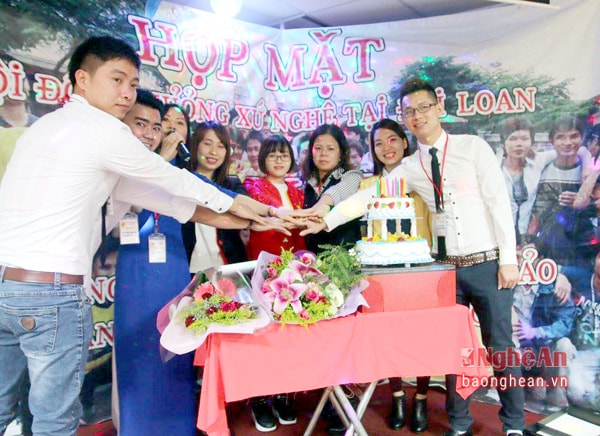 |
| The Nghe An expatriate association in Taiwan organized a reunion for the Lunar New Year of the Monkey 2016. |
Van Dien commune is one of the localities in Nam Dan district with the highest number of people working abroad. Currently, the commune has over 500 workers employed overseas, mainly in South Korea, Japan, Taiwan, and Malaysia. Thanks to overseas employment, the lives of Van Dien residents have improved, with many families becoming wealthy from the remittances sent back by overseas workers.
Like the family of Mr. Nguyen Van Son in Nhat Quang hamlet, who previously only worked in agriculture, Mr. Son's life was difficult. Hoping to earn some capital to improve his family's economic situation, in 2012, he decided to go to South Korea for overseas employment. In South Korea, he worked as a mechanic, initially earning 10-12 million VND per month as an apprentice. After gaining experience, his salary increased to 25-30 million VND per month. Through hard work, he soon saved enough money to pay off debts and build a spacious three-story house. After four years of celebrating Tet (Lunar New Year) away from home, Mr. Son is eagerly awaiting the Year of the Rooster, hoping for a joyful reunion with his family.
| Recalling Tet holidays spent away from home, Nguyen Van Son shared: "Working in a foreign land, every Tet holiday, Vietnamese workers gather to buy banh chung (traditional rice cakes), peach blossoms, and prepare traditional dishes from their hometowns to create a festive atmosphere. Even so, everyone still feels a sense of emptiness, a longing for the warmth of family." |
However, not every family can enjoy a warm and joyful Tet holiday like Mr. Son's family. As the traditional Tet holiday of the Year of the Rooster 2017 approaches, the atmosphere in families with relatives working abroad seems more subdued. Ms. Nguyen Thi Thao's family (born in 1975) has a husband, Mr. Le Khac Binh, who has been working abroad in Taiwan for three years. Every month, Mr. Binh regularly sends money home, so the lives of Ms. Thao and her three children are not too difficult, and they even have a little extra to save.
However, Thao confided that she didn't care much about how much money Binh sent home; she only missed him and worried about his health. Every time Tet (Lunar New Year) came around, that longing became even more intense.
She shared: “When he left, our two children were still young, but now the eldest is in first grade, and the second is over three years old. They often mention their father. As for him, every time Tet (Lunar New Year) comes around, he calls home and says that the traditional Tet in Taiwan coincides with Vietnam, so people here are also bustling with preparations for the holiday. Seeing people gathering with their families makes me feel sad and miss the three of us terribly. Hearing that, I can only hold back my tears. Once, I asked him to arrange to come home for Tet with the family, but he said a round-trip plane ticket from Taiwan would cost over ten million dong. If he came home, there wouldn't be much money left for the family to prepare for Tet, so he accepted celebrating Tet away from home to save money for the children's education in the future.”
For families with relatives working abroad, the atmosphere is somber, while those celebrating Tet (Lunar New Year) in a foreign land are burdened with mixed emotions. For Ms. Le Thi Thuy from Hamlet 6, Hung Tan Commune (Hung Nguyen District), this is her 10th Tet in Malaysia. In 2007, her family borrowed money from the bank so she could work abroad. Thanks to her diligence and hard work, from a supermarket employee arranging goods, after a few years, Ms. Thuy was "promoted" to team leader, and her income improved significantly.
Thanks to that, the family was able to build a spacious house and buy all the necessary household items. Every Lunar New Year, she always worried about her husband, Nguyen Van Truong, and their two young children having to single-handedly prepare, visit, and give gifts to both sides of the family, wrap sticky rice cakes for ancestral worship... tasks that she usually handles at home.
"As a woman, leaving my husband and children behind in my hometown while I struggle in a foreign land is something no one wants, but for the sake of making a living and the future of my two children, I have to accept it. Luckily, both of my children are well-behaved and hardworking, so I'm less worried. In the first few years, not being able to celebrate Tet with my family was very sad, but now I'm used to it," Thuy confided.
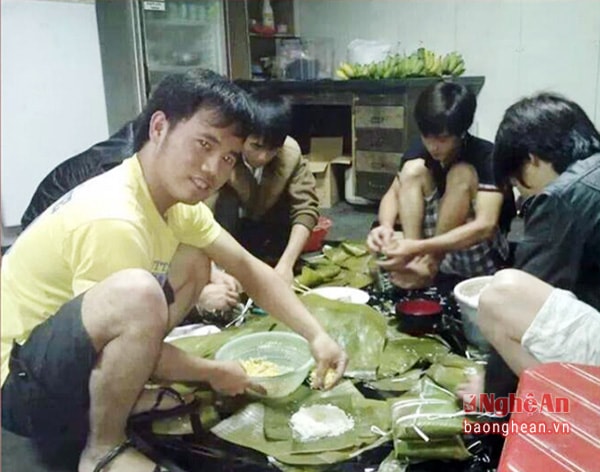 |
| The Nghe An expatriate association in Japan organized a rice cake-making event for the Lunar New Year. |
Nguyen Huu Bac, 24 years old, from Thuan Son commune, Do Luong district, is working in Shizuoka, Japan. This is his third Tet (Lunar New Year) away from home. He still remembers the feeling of the first year not celebrating Tet at home. "That was probably the saddest Tet because I still had to work, my first Tet in a foreign land, without family, without relatives, without the taste of home."
"Every year, my colleagues and I organize a Tet celebration together. We have sticky rice cakes, pork sausage, spring rolls, jellied meat, pickled onions, etc. We sit together to ease our homesickness and share our feelings about being far from home. Every Tet, I call home to my family. My parents at home feel sorry for me celebrating Tet alone. It's sad and lonely here, and heartbreaking at home, but because of my family circumstances, I still have to try my best. It's the same for anyone who works far from home," Mr. Bac shared.
| According to statistics from the Department of Labor, War Invalids and Social Affairs, in 2016, the entire province had more than 12,300 people working abroad, and currently there are approximately over 45,000 Nghe An workers working overseas, mainly in Malaysia, Taiwan, South Korea, Japan, and the Middle East. In countries like South Korea, Japan, and Taiwan, because they also celebrate Lunar New Year like Vietnam, workers in these countries also get time off for the holiday. |
Due to the short Tet holiday (only 3-4 days) and the high cost of round-trip airfare, very few Vietnamese workers can return home to celebrate Tet with their families. Therefore, for most families with relatives working abroad, a feeling of emptiness and longing is unavoidable during the Tet season. Those far from home and those at home try to encourage each other to have a happy and peaceful Tet, and to strive in their work and lives while waiting for the reunion.
Minh Quan


