
Meat counter with ration coupons: The 'meeting point' in the Quang Trung high-rise building.
(Baonghean.vn) - To this day, the address of room 1 in building A3 still holds many memories for "us apartment dwellers." Simply put, it was the food store for the entire Quang Trung area - where we kids would line up from midnight, a meeting place for teenage boys and girls in the apartment building back then.
In the late 1970s, when more than 1,000 households lived in the multi-story building, the People's Council of Quang Trung sub-district petitioned the city to establish a food store there.
Not long after, the first food store was set up in rooms 1 and 3 of building A3, right near the playground. We – the first children of the "apartment building residents" – got to taste baked goods costing 20 cents each, and we were only allowed to buy a maximum of 5 at a time while queuing.
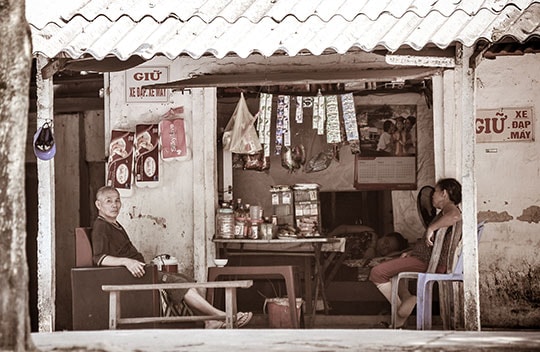 |
| The grocery store in the afternoon light. Photo: Thanh Cuong. |
During the subsidy period, this food store sold everything: salt, fish sauce, water spinach, fish, meat... Each household in the multi-story building was given a purchase booklet, and every time a sale was made, it was recorded to prevent fraud. Water spinach was sold by weight, and each household was not allowed to buy more than 2 kilograms a day – quite amusing.
Water spinach is sourced from the fields of Vinh Tan, transported to the store by three-wheeled carts—only two carts a day. The spinach doesn't arrive until almost noon, but we have to get up and queue from 5 a.m.
They sold all sorts of things here, but perhaps the most memorable experience was queuing up to buy pork, so we used to call it "A3 Meat Shop." Queuing up to buy meat was both a "torture" and a source of joy for the kids at Quang Trung High School back then.
Usually, people would start lining up around 3 or 4 in the morning. Sometimes, if the shop ran out of meat after a long wait, and they heard that meat would arrive the next day, everyone would get up in the middle of the night. Those who lined up first usually got the freshest and tastiest cuts of meat, while those who lined up later weren't guaranteed a share and had to accept the scraps, so arguments and even fights happened every day.
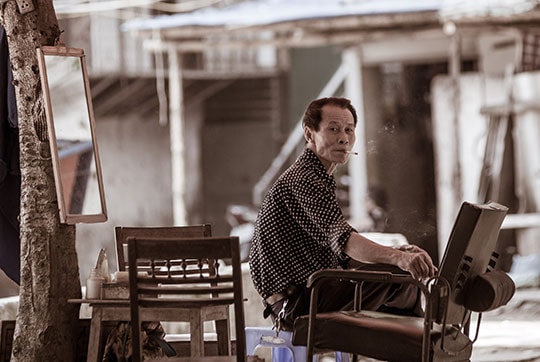 |
| The barbershop is located in the Quang Trung apartment building. Photo: Thanh Cuong. |
Back then, families with war veteran cards or those of fallen soldiers were given priority. Initially, people lined up, but sitting for too long made their legs tired and caused mosquito bites, so instead of people lining up, they used baskets, sieves, and then stones. The queuing area was pitch black; it took a lot of pleading before they finally installed an electric pole. With the light, the old men would set up chess boards, the teachers would pull out newspapers to read, and we children would play marbles and hopscotch.
Usually, at the beginning of the day, the plump saleswoman would come to open the doors, and everyone would rush to ask her questions:
- Is there a lot of meat?
- Do you have any fat, miss? Do you have any heart or kidneys, ma'am?
- How many kilograms can each person buy?
- Please remember to save a pork leg for me to make porridge for my sick mother.
As the noisy three-wheeled vehicle approached the store, everyone became agitated, all activity ceased, and people scrambled to line up. The sounds of people fighting for space, shouting, and yelling filled the corner of building A3. The children, running quickly home, shouted loudly:
- Mom, the meat's here...the meat's here!
The women slipped on their sandals, hastily grabbed their stacks of ration coupons, and walked along, shouting and passing them to each other:
- Hey everyone, the meat's here, the meat's here...
Each time, the shops in my neighborhood would be allocated three or four pigs. There were plenty of heads, intestines, and trotters… but what everyone liked best was getting some fat. The fat was separated, rendered, cooled, and stored in glass jars to be used for stir-frying and cooking vegetables. After rendering the fat, the remaining pieces of meat were often braised in a savory sauce for a feast during a major event of the month, and usually the parents would set aside chopsticks for their children.
Occasionally, especially during Tet (Vietnamese New Year), the shop would sell freshwater fish from Ke Go Lake or saltwater fish. Carp weighing tens of kilograms, often with their brains removed, were brought in to be sold as a substitute for pork; on lucky days, the shop would even sell beef.
The grocery store was also a popular meeting place for young couples. Waiting in line to buy meat allowed them time to chat, do housework, and avoid supervision – killing two or three birds with one stone. I had a boyfriend, not from a high-rise, but he'd always follow me whenever he saw me queuing. Those casual conversations at the A3 butcher shop stayed with him throughout his years studying abroad. If he knew over there that the A3 building was being demolished, he'd be heartbroken, because that butcher shop was where we used to meet. Oh, A3, I miss you so much!
Phan Hao


