
There will be no second high school graduation exam despite the decrease in pass rates.
Will the new national high school graduation exam format reduce the high school graduation rate? If the graduation rate is low, will the Ministry of Education and Training (MOET) organize a second exam? In response to this question, the MOET affirmed that it does not set a specific graduation rate and will not organize a second graduation exam.
The Ministry believes that exam results will accurately reflect the true situation and are determined by academic performance. The distribution of scores in the 2014 high school graduation exam for all subjects closely followed a normal distribution (bell-shaped), accurately reflecting academic results. Therefore, it can be predicted that the graduation rate in the 2015 national high school exam will not fluctuate significantly, unlike the results of the 2007 graduation exam.
The Ministry will publicly release the score distribution so that the public can see the quality of the exam questions and the exam results of the candidates, and universities and colleges will use this information for admissions.
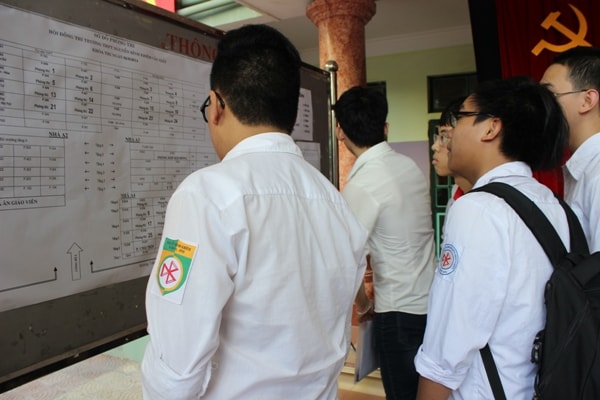 |
| Illustrative image. Source: VA |
Three new points related to the admissions process of higher education institutions:
Regarding the changes in the National High School Graduation Examination and how they relate to the admissions process of universities and colleges, the Ministry of Education and Training stated that the National High School Graduation Examination has three new points related to the admissions process of higher education institutions:
The exam results are used both for recognizing high school graduation and as a basis for universities and colleges to use in admissions; candidates register for admission to universities and colleges after receiving their exam results; universities and colleges have autonomy and flexibility in both admitting students based on the previous exam blocks and proposing new exam blocks that suit the admission requirements for their training programs.
Centralized exam result management reduces the number of fraudulent candidates.
The Ministry of Education and Training stated that, for candidates, registering for admission after receiving exam results will help them avoid the risk of achieving high scores but still failing to get into university, as in previous years; it will allow them to choose universities and colleges that match their abilities, better meeting the diversity of professions in higher education; and it will enable universities to recruit candidates whose abilities are more closely aligned with the training programs. With the new admission method, candidates will have more flexibility in choosing suitable exam subjects.
The fact that candidates register for admission after receiving their exam results is a challenge but also an opportunity for universities to develop. Universities that want to recruit high-quality students must build their brand through the quality of their education. This is an internal motivation for higher education institutions to find solutions to improve the quality of education to meet the needs of society.
How many preferences can each candidate register for?
According to the Ministry of Education and Training, in the past, students registered their preferences before the exam results were available, leading to a large number of "phantom" candidates (candidates who register but do not intend to enroll). In 2015, based on the exam results and the admission requirements of the universities, the Ministry will develop software to manage exam data to support exam registration and university admissions registration, with the aim of overcoming the shortcomings of previous years' admissions, including the problem of "phantom" candidates.
Universities and colleges that use the exam results for admissions will conduct the selection process in 2 to 3 rounds; in each round, each candidate will be allowed to register for a number of preferences (as specifically stipulated in the Regulations on Admission to Universities and Colleges for Regular Programs).
The Ministry of Education and Training will specify the dates for separate entrance exams in the admissions regulations (not coinciding with the National High School Graduation Examination). Schools will announce the time for organizing the entrance exams in their individual admissions plans.
One of the two purposes of the exam is to use the exam results as a basis for higher education and vocational education institutions to use in admissions. Whether or not to use the results of the National High School Graduation Exam with other conditions is up to each university or college, with each institution choosing the most optimal option for itself.
Therefore, the Ministry of Education and Training does not restrict the number of schools organizing supplementary exams; universities and colleges with their own requirements can organize additional aptitude tests such as interviews, essay writing, etc., to select candidates suitable for their training programs.
According to the Communist Party of Vietnam


