
Teacher training students: Concerns on the eve of reform.
Many education experts assert that, in order to fundamentally and comprehensively reform education, teacher training colleges must be at the forefront. Recognizing their role and responsibility on the eve of reform, with the crucial milestone being the reform of the overall general education curriculum, on November 4th, the Youth Union and Student Association of Hanoi University of Education organized a seminar entitled "Reforming the Curriculum and Textbooks".
Don't worry too much about History.
During the discussion, many students expressed concerns about their future as they embark on the new general education program, especially those in the History department.
According to Associate Professor Dr. Nghiem Dinh Vy - former Deputy Head of the Central Committee for Science and Education, currently Director of the Institute of Social Sciences (Hanoi University of Education): Recently, many professors, teachers, and students have petitioned the drafting committee and the Ministry of Education and Training to make History a compulsory subject. Some professors said that if students don't want to study it, it must be compulsory, or we must educate them about patriotism.
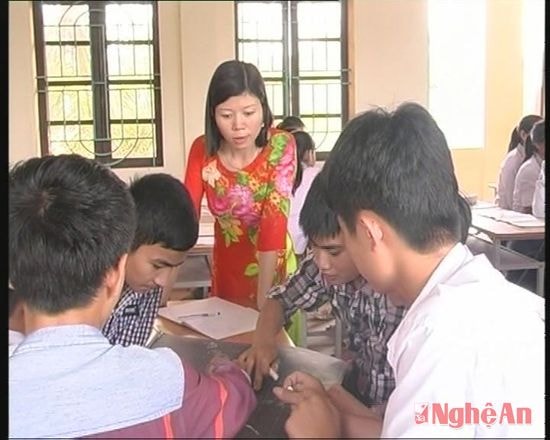 |
| The teacher guided the students in group discussions. |
Mr. Vy shared: Social sciences are very important, crucial in educating the character and personality of people in general and for the younger generation in particular. Around the world, as well as in Vietnam, people say that social sciences are in a very low position, or in other words, they somewhat disregard the subject of social sciences.
Now, how do we understand integration in the Social Sciences subject? In primary school, we won't be teaching History as before, meaning we won't be learning from the Hung Kings, Van Lang, Au Lac... and it will continue that way in higher grades. Now, History, Geography, and other knowledge will be combined into a Social Studies subject in grades 4 and 5. We plan to teach through storytelling based on themes, making it light, engaging, and easy to understand...
But the question that concerns many people the most is whether History and Geography will be elective or compulsory subjects in high school?
Regarding this, Associate Professor Dr. Mai Sy Tuan, Head of the Biology Department (Hanoi Pedagogical University), shared: "It's true that some subjects should be compulsory, and some should be elective. This depends on the specific circumstances and period; History might not be compulsory now, but it could be later."
However, it's important to have a clear perspective: if we pursue comprehensive reform, we must provide comprehensive education. All subjects should be treated equally; there should be no core or elective subjects. Similarly, there should be no separate core or extracurricular activities; all should be important educational activities that we call creative experiences. All subjects should involve creativity, and schools should also offer creative experiential learning activities.
“So, history teachers have nothing to worry about. If they were worried, would biology teachers be worried? If biology isn't valued, would it be possible to treat diseases without biotechnology? Would it still be important? Our country is developing to become an industrialized and modernized nation, so physics and chemistry are also important, aren't they? Whether a subject is compulsory or not depends on the circumstances, not on a perception of underestimating one subject and valuing another. All subjects are equally important,” Mr. Tuan explained.
Similarly, Associate Professor Dr. Do Ngoc Thong, Deputy Director of the Department of Secondary Education (Ministry of Education and Training), stated: "Up to today, the most tense discussion has only been about the name of the subject, but of course, History is a compulsory subject at all three levels. The most 'tense' issue is whether History should have its own separate subject at the high school level."
Innovating methods is very important.
In response to the issues raised, Associate Professor Nghiem Dinh Vy affirmed: Innovating teaching methods is crucial. And the teacher is the most important person.
| Illustrative image. |
Accordingly, Associate Professor Vy proposed: With the new curriculum, History at the high school level will no longer be a repetition of what it was in junior high school, but will be taught thematically, across all grades but divided into themes. In addition to themes following the Ministry's approach, we believe we need to strive to come up with truly engaging themes, for example, the theme "War and Peace in History," which includes sub-themes such as "An Unpeaceful Past" teaching about world wars, or the theme "The Sound of Peace" discussing the United Nations and calling for peace…
Associate Professor Dr. Mai Sy Tuan shares the same view, stating that integration encompasses intra-disciplinary, interdisciplinary, and multi-disciplinary approaches, meaning that integrated teaching is a teaching method. And it's not just the subjects already established by the Ministry of Education and Training that can be integrated. All subjects can be integrated to contribute to competency development. For example, Literature has many forms of integration, as can History, Geography, and vice versa.
Regarding foreign languages, experts emphasize that among the many subjects requiring reform, foreign languages need the most. However, we will achieve nothing if we do not reform the curriculum and textbooks.
According to Dai Doan Ket
| RELATED NEWS |
|---|


