
Enhancing the competitiveness of Nghe An's agricultural products.
(Baonghean) - With its unique advantages, Nghe An has a rich and diverse source of agricultural products. Facing the trend of integration, how to improve the quality and value of agricultural products and increase competitiveness in the market is a major concern for the province as well as its farmers.
Small-scale production, fragmented products.
With a closed-loop process, starting with cows imported from world-renowned dairy farming countries such as New Zealand and Australia, advanced farming formulas, and modern processing lines, TH milk is one of the superior products, produced in a modern, closed-loop production chain.
Mr. Ngo Huy Han, Director of Communications at TH Dairy Factory, stated: "From the very first stage, which is feed, the cows are classified into groups to ensure appropriate feeding regimens. The barns adhere to the most advanced livestock farming standards and specifications in the world. In addition, TH applies a software system for herd management and uses microchips on cows to closely monitor all health parameters, comfort levels, and milk production. TH also employs modern applications to support the production of clean milk, such as milk measuring machines, automatic milk quality testing, and the classification of substandard milk for immediate disposal."
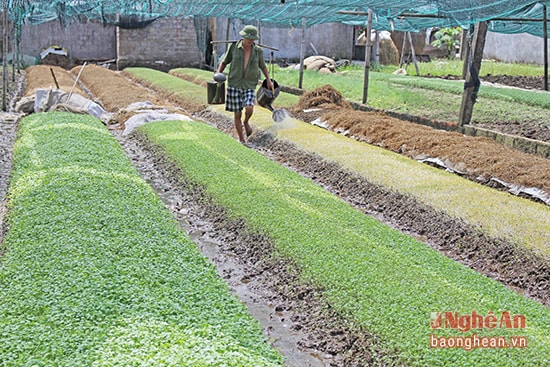 |
| Growing winter vegetables in greenhouses in Hung Dong commune (Vinh city). |
However, closed-loop, chain-based production lines like this are not yet widespread in our province. Once a key export product to Eastern European markets, enhancing the value of tea remains a major concern for those in charge. With over 4,300 hectares of industrial tea plantations, Thanh Chuong district is a concentrated area of good, disease-free, and safe raw materials; however, besides domestic consumption, tea is only exported to less demanding markets such as Pakistan, China, and India in "packaged" form, and there are no refined products yet for export to more demanding markets.
Mr. Le Dinh Thanh, Vice Chairman of the Thanh Chuong District People's Committee, expressed his concern: Not only do the 54 private tea processing workshops have outdated and small-scale equipment, but even the production lines of the two tea factories of Nghe An Tea Company still produce simple, crude, and monotonous tea products. Several businesses have surveyed the area to invest in modern production lines to create high-quality products that meet export standards for demanding markets like Japan and South Korea... but these are all private enterprises, not large in scale, and do not meet the expectations of the locality or the practical demands of modern production.
Facing the integration process, it can be said that Nghe An's agricultural products still have many shortcomings. Only a few products, such as milk and sugar, are produced in a chain from production to market. Due to fragmented and mainly manual production, the cost is high, and the quantity of each product type is small and not concentrated, which is a disadvantage when participating in the market. Meanwhile, the quality of products is not competitive enough with foreign countries and even other localities due to both production and processing/preservation issues; the number of businesses investing in the agricultural sector is still small, with limited competitiveness and low efficiency.
Increase competitive advantage
In recent years, by identifying and developing key crops and gradually promoting production linkages along the value chain of the province's advantageous products such as rice, corn, peanuts, tea, sugarcane, etc., the quality and prices of many products have been improved, and many crops have brought in incomes of over 1 billion VND/hectare/year, such as oranges and tangerines.
According to Mr. Nguyen Van Lap, Deputy Director of the Department of Agriculture and Rural Development: In order to enhance the value and competitiveness of Nghe An's agricultural products in both domestic and export markets, it is first necessary to review all agricultural products in the province, classifying them according to their intended use and consumption market. This will provide guidance on production and solutions to ensure quality that meets market demands.
“We categorize and clearly identify each type of export product such as tea, peanuts, rubber, cassava starch, etc., to determine which market it will be exported to; specifically, Nghe An rice is not a production area for export, but rather a production area for domestic consumption, so we must clearly identify the needs and preferences of domestic consumers regarding sugar content, aroma, and stickiness, and from there, come up with appropriate solutions in terms of varieties, techniques, and market access,” said the Deputy Director of the Department of Agriculture and Rural Development.
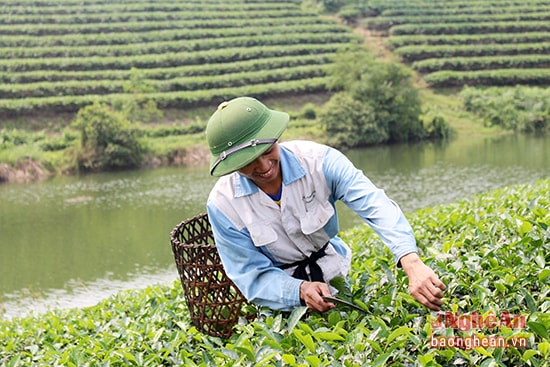 |
| Tea harvesting in Thanh Chuong. |
In particular, given the limited investment resources of the province and the involvement of businesses, the sector has advised the province to select a number of key products with strengths such as peanuts, oranges, tea, etc., to focus investment on, creating a clear growth momentum for Nghe An's agriculture. At the same time, it is reviewing the processing stage for products that require processing, such as tea and rubber, to find solutions to improve processing capacity in a modern direction. It is expected that this year, the province will have additional advanced rubber processing lines invested and built by the Nghe An Rubber Development Investment Company on existing rubber raw material areas. The province and localities are also focusing on attracting businesses with real potential to invest in building modern processing lines for other products such as tea and sugarcane.
In agricultural production, there are currently two trends: leasing land to businesses for large-scale, concentrated production, and the trend of linking businesses with farmers. Given its conditions, Nghe An province must pursue both approaches: allocating sufficient land for businesses to proactively secure a portion of their raw materials, thereby acting as a center for applying high technology and transferring techniques to farmers; and focusing on improving the capacity of cooperatives and production groups to represent farmers in cooperation with businesses in production and product consumption.
Phu Huong


