
South Korean President in the midst of turmoil.
(Baonghean) - Images of a woman at the pinnacle of South Korean politics sadly apologizing to the public were widely circulated on various mass media outlets inside and outside South Korea on November 4th.
Amidst the political scandal weighing heavily on President Park Geun-hye's administration, the politician's commitment to cooperate with prosecutors in a thorough investigation of the case is an attempt to quell the waves of public outrage that have swept through the country in recent weeks.
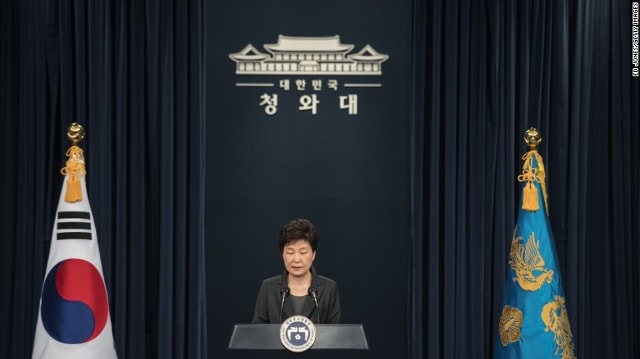 |
| The South Korean president speaking at the Blue House on November 4. Photo: CNN. |
2 weeks - 2 apologies
If there were a poll, the most prominent figure on the world political stage this past week would undoubtedly be South Korean President Park Geun-hye. It's even fair to say that the scandal unfolding in Seoul is just as intense as the developments in the US election race, with frequent headlines in the news.
In the latest development, with a televised address on November 4th, President Park took personal responsibility for the abuse of power scandal that is casting a dark shadow over her administration, and promised to cooperate closely with the investigation. “Everything that is happening is my fault,” she said – her second apology in two weeks since the scandal involving the head of state was uncovered.
South Korea's number one woman further asserted that she is not under anyone's control or influence, a statement aimed at quelling the numerous conflicting rumors spreading rapidly in public opinion.
To relatively gauge the extent of the recent political upheaval caused by the scandal, Gallup conducted a quick poll and released the results on November 4th. According to the poll, the female president's approval rating dropped by 12 percentage points compared to the previous week, falling to a mere 5% – a record low in the history of such polls since 1988.
Perhaps aware of the severity of the looming crisis, Park told reporters that prosecutors needed to thoroughly investigate the matter, and that all individuals involved, including herself, needed to take responsibility if they had made mistakes. The 64-year-old leader couldn't contain her emotions: "I find it hard to forgive myself, and I can't sleep at night because I'm so heavy with sadness."
Skeptical
According to Reuters, South Korean prosecutors declined to comment when asked whether Park would be questioned by investigators – something unprecedented for a sitting South Korean president.
However, opposition party leaders have voiced concerns that Park's apology lacked sincerity. Choo Mi-ae, chairwoman of the Democratic Party of Korea, in a recent statement, while not explicitly demanding Park's resignation, bluntly stated: "The president should stop interfering in national affairs."
Throughout South Korean history, no president has ever been forced to resign midway through their five-year term. However, this possibility is not impossible, as President Park is currently struggling to cope with numerous demands from the public and political opponents for her resignation. The circle of President Park's close advisors is also showing cracks, with a second member of her team being arrested this week on suspicion of leaking classified information.
The scandal's impact is not limited to the political sphere; it's demonstrating its "expansion" by affecting the financial markets as well, causing the won and stock prices to fall compared to last week, leaving investors feeling uncertain due to concerns about the political situation.
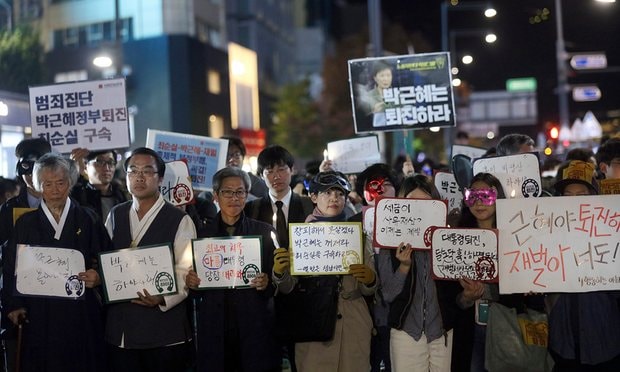 |
| South Koreans took to the streets to protest against the president following the scandal. |
Mentioning old friends
A longtime friend of President Park, 60-year-old Choi Soon-sil, is at the center of the scandal. She is accused of using her close relationship with the South Korean leader to interfere in national affairs. Her lawyer recently stated that they are awaiting a thorough investigation by the prosecution into whether Choi received inappropriate classified documents and the veracity of rumors that she illegally profited from two non-profit organizations.
Meanwhile, referring to her close friend, Ms. Park said, "It is regrettable that an individual is accused of self-serving behavior and violating certain laws, while we are cooperating with the hope of helping the national economy and the lives of the people."
That was all; the South Korean president concluded her speech, bowed, and turned to the reporters, reiterating her apology. She offered absolutely no further questions. Park had previously admitted that in her relationship with Choi, she had “lowered her guard” with someone who had helped her through the most difficult periods of her life.
The beginning of such a complicated friendship was when Park had to assume the duties of First Lady, after her mother died shielding her father, former President Park Chung-hee, from an assassination attempt. Kim Man-heum, head of the Korea Institute for Political and Leadership Studies, commented, "I think the President will try to regain the sympathy of those who once loved her, but her recent speech is not enough to rectify the crisis immediately."
According to South Korean news agency Yonhap, approximately 12,000 people have protested, demanding their president's resignation, arguing that she is no longer fit to lead the nation. Particularly among young people, those under 40, President Park's approval rating has dropped to just 1%. Will she weather the storm, or will she have to accept an unfinished presidential term? This is no longer a question that only the South Korean people want answered.
Phu Binh
(According to Reuters and CNN)


