
Will the Philippine president use China to provoke the US?
Philippine President Duterte may be acting pro-China and tough on the US to force Washington to make concessions and provide them with more benefits.
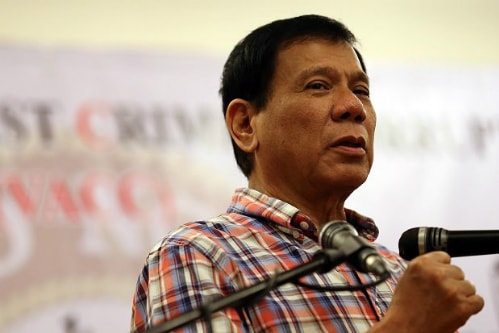 |
| Philippine President Rodrigo Duterte. Photo: Inquirer |
Philippine President Rodrigo Duterte has increasingly taken a tough stance toward the US, declaring last week that Washington and Manila would end joint military exercises (the Philippine military later said the defense minister would discuss the matter further with the president). Duterte also surprised many by using vulgar language to insult the US ambassador to the Philippines and President Obama, while simultaneously attempting to warm relations with China and Russia.
Lauro Baja, the former permanent representative of the Philippines to the United Nations, doubts that President Duterte will completely abandon the country's alliance with the United States, according to SCMP.
"I don't think so," Baja said. "I think he's more level-headed than that; he should know which side of the bread has butter." According to Baja, Duterte is using the prospect of closer ties with China and Russia as a bargaining chip with the U.S.
He said the military would likely try to dissuade Duterte from doing so "because the Philippine armed forces are too dependent on the U.S. for military equipment and support. They have established networks with the U.S. that they don't have with China or Russia."
Teodoro Locsin, Jr., the newly appointed permanent representative of the Philippines to the United Nations, is optimistic that the U.S. won't be too bothered by the harsh language because "Americans aren't irrational. They always do their research."
The U.S. responded mildly to Duterte's comments by saying they "have no objection if he wants to strengthen diplomatic relations with Russia and China," Locsin said.
A stock market analyst commented that Duterte is "setting up a chessboard" for one superpower to fight against the other. By irritating Washington, Manila could persuade Beijing to negotiate and provide them with infrastructure projects such as railways in the south. Then, Duterte "will turn back to the U.S. and ask: what can you offer me?", the analyst said.
He described the situation as "a lovers' quarrel" and commented, "I don't believe he will switch sides. He's just playing games with the US." He added that the driving force of the Philippine economy is American companies that hire workers there.
However, in California, lawyer Rodel Rodis, who holds both Philippine and American citizenship, considers Duterte's actions "very concerning because the Philippines' pivot towards China is becoming very clear."
"I think his actions were sincere," Rodis said, citing "unjustified attacks on the American ambassador, and repeated references to American crimes from over 100 years ago."
"He blames the US for every problem in the Philippines, but he's very polite to Chinese President Xi Jinping and China," he said. "He has never insulted Xi in the way he has insulted US President Barack Obama, Pope Francis, and the European Union."
According to VNE


