
Vinh City: The saying "Every inch of land is worth its weight in gold" creates significant pressure in land management.
(Baonghean) - One of the thorny issues facing Vinh City is the inadequate land management, with slow progress in issuing and renewing land use right certificates, affecting the city's development.
Nghe An Newspaper had an interview with Comrade Vo Viet Thanh - Member of the Standing Committee of the Provincial Party Committee, Secretary of the Vinh City Party Committee - on a number of related issues.
PV:The city has identified land management and the issuance of land use right certificates as a challenging task. So, how has the city's Party committee and government led and directed this work in the past, Comrade?
Comrade Vo Viet Thanh:Vinh City is undergoing development; in addition to the inner city area, the urban space is expanding with the merger of several communes from Nghi Loc and Hung Nguyen districts, resulting in an increase in the number of households involved in land-related issues.
Urban planning and attracting numerous investment projects to the area, coupled with changing land-related policies; land in the city is highly valuable, "every inch of land is worth its weight in gold,"... all of which place significant pressure on land management.
Recognizing that failure to properly lead and direct this work would lead to many negative consequences, the City Party Committee has recently focused intensely on and rigorously directed the management of land and the issuance of land use right certificates; the City People's Committee has also strengthened state management, especially in rectifying the encroachment on public land and agricultural land through inspections and audits, promptly detecting and strictly handling violations.
At the same time, the city has taken timely and strict measures to handle violations related to land by officials, holding the heads of departments, primarily the chairmen of the People's Committees of wards and communes, accountable. To date, two chairmen of ward People's Committees and three land and urban planning officials have been disciplined for their involvement in land management.
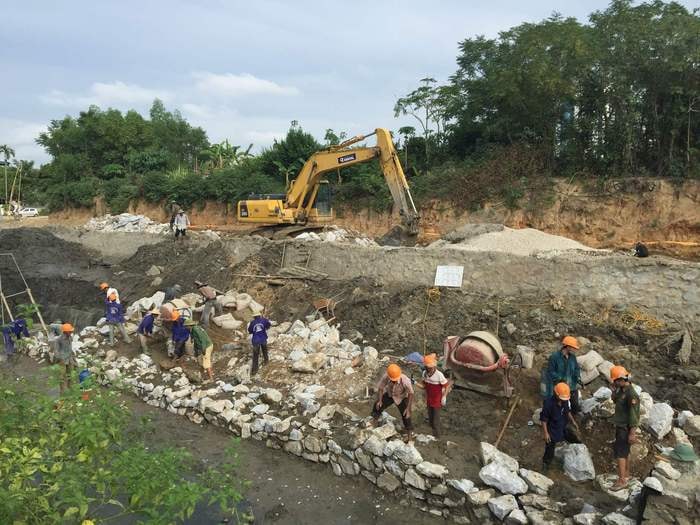 |
| Construction of the Vinh ancient citadel lake. Photo: Mai Hoa |
The issuance and renewal of land use right certificates have also been a top priority for the city's Party committees and authorities. As of July 15, 2017, the city had issued new land use right certificates for 83,700 out of 85,348 plots, reaching 98.06%.
The allocation of agricultural land was also centrally directed, with the rate of land allocation to individual households exceeding 80% of the total leased area (unlike the districts, the city previously did not implement the policy of allocating land to individual households according to Government Decree 64-CP of 1993, but only allocated it to cooperatives and associations, and only started the policy of allocating agricultural land to individual households in 2015), and the total number of agricultural land use right certificates issued was 11,105.
Regarding the issuance and renewal of land use right certificates for residential and agricultural land in the communes merged in 2008, the city has also directed a vigorous effort to ensure the rights of the people. To date, the rate of issuance and renewal of land use right certificates for residential land has reached 63% and for agricultural land is over 95%.
PV:At the 4th session of the 21st City People's Council, term 2016-2021, held on July 19th and 20th, many City People's Council delegates, as well as invited guests including leaders from several communes and wards, reflected on the lax and inadequate land management; and the slow progress in issuing land use right certificates to families, especially in merged communes and wards. Could you elaborate on this issue?
Comrade Vo Viet Thanh:It must be acknowledged that, despite efforts, the state management of land in Vinh City still has shortcomings and limitations.
In some areas, state management of land is lax, leading to encroachment on public land and agricultural land, and when detected, the issue is not resolved completely. Meanwhile, inspection and monitoring work is not timely; and the awareness of land law compliance among a segment of the population is still low.
The city has yet to establish a land data system, affecting the management process. As mentioned above, previously, Vinh City did not allocate land to individual households according to Government Decree 64-CP, but only to cooperatives and associations. Meanwhile, according to the 2013 Land Law, a condition for households to receive compensation from investment projects is to have a land use right certificate, leading to obstacles in land clearance and affecting the progress of investment projects...
Regarding the issuance of land use right certificates, overall, the results mentioned above cannot be considered slow. However, currently, the issuance or renewal of land use right certificates for residential and agricultural land, although the percentage of those yet to be issued is still small, faces many obstacles that affect the rights of the people.
Currently, the city still has 1,648 plots of land that need to be issued land use right certificates but have not yet been granted. The reasons include disputes, absence of owners, failure to divide inherited property, or failure to fulfill financial obligations (some policy beneficiary families are no longer eligible for tax exemptions or reductions when splitting land titles or changing land use purposes as before).
The most pressing issue currently is the issuance and renewal of land use right certificates for residential and agricultural land in the communes merged in 2008. This is due to lax land management in these areas, incomplete records, and significant increases and changes in land area on the ground.
Since the issuance of land use right certificates began in 1996, the current renewal process involves changes in the distribution of inherited property. While the renewal process should not redefine the land limit, residents are now requesting that the land limit from before 1980 be re-recognized simultaneously with the renewal. Therefore, the time required to gather public opinion and verify the land's origin is taking considerable time.
Furthermore, the land use right certificates are often altered, especially regarding incorrect locations; the land is shown as agricultural land on the map, but the certificate states it as residential land, and in reality, the land is abandoned and has not been marked with boundary markers.
In some areas, land records are incomplete, such as Vinh Tan ward, which only approved and completed the cadastral mapping at the end of 2016, started issuing replacement land use right certificates in 2017, and has issued replacement certificates for 35% of residential land; or Nghi An commune, which has reached 39%.
Meanwhile, the sense of responsibility and focus on this work at the commune and ward levels is not high; the sense of responsibility of city-level professional staff is not truly rooted in the grassroots, and they have not provided decisive direction. The land administration staff in some communes and wards is still small, while the workload is large, so processing is not timely.
Currently, there are 400 applications received by wards and communes that have not yet been processed and forwarded to the city's Land Use Rights Registration Office for issuance...
PV:In Vinh City, every inch of land is considered precious; especially as the city is developing with many projects attracting investment, the requirement is to effectively manage and complete the issuance and renewal of land use right certificates. To better fulfill this task, could you please outline solutions to address the difficulties and obstacles currently facing the city?
Comrade Vo Viet Thanh:Party committees and authorities from the city level to the grassroots continue to provide decisive direction, striving to complete the issuance of new and replacement land use right certificates in 2018. The city is strengthening the dissemination of land policies, clarifying the responsibilities of citizens and local authorities, especially in coordinating with neighborhoods and hamlets to clearly identify the origin and ownership of land.
The City People's Committee directed the city to strengthen the staff in city departments and offices to closely monitor the grassroots level, focusing on directing, guiding, and handling dossiers at the ward and commune levels. Simultaneously, it emphasized strengthening the inspection and supervision role of the City Party Committee's Inspection Committee, the City People's Council, and the City Fatherland Front Committee to ensure the correct and timely implementation of land policies for the people; assigning responsibility to the heads of the People's Committees of wards and communes; and establishing inspection teams to directly resolve land-related complaints, land use right certificate issuance, land clearance, and disputes between neighboring households.
For cases where the resolution has been reached but the people are not satisfied, if the cause is correctly identified, the role of public relations should be promoted to explain the situation, while strengthening mediation at the grassroots level; increasing exchange and dialogue to resolve the obstacles and difficulties, in order to satisfactorily address the people's demands in accordance with the law.
Along with the above solutions, the city also requested the province's support in the early implementation of the land data development project to better serve long-term management.
PV:Thank you, comrade!
Mai Hoa
(Perform)


