
Vinh City lacks equipment for testing food safety.
(Baonghean.vn) - Mr. Tran Van Son, Vice Chairman of the People's Committee of Vinh City, pointed out the current situation: the city lacks machinery and equipment for rapid detection when taking food samples for testing.
 |
| Mr. Tran Van Son, Vice Chairman of the Vinh City People's Committee, explained many issues regarding food safety and hygiene. Photo: Nam Phuc |
This issue was discussed by Mr. Son at the 5th session of the 21st term of the Vinh City People's Council. Prior to that, delegates at the session questioned the Vice Chairman of the Vinh City People's Committee on many "hot" issues such as: checking the origin of food before it reaches consumers, whether the penalties and post-penalty inspections of establishments violating food safety and hygiene regulations are strict enough, and the widespread sale of snacks in front of schools and food vendors in alleyways throughout the city.
The delegates also suggested that the city should publicly disclose the list of establishments producing "unsafe" food and those selling safe food so that people can monitor and feel confident in consuming it.
In his report explaining the above content, Mr. Son stated that currently, Vinh City has more than 32,000 establishments involved in farming, livestock breeding, food production, processing, and catering services, as well as 14 stores selling safe food. Regarding veterinary quarantine, slaughterhouses are handling 200 pigs per day/night per slaughterhouse (achieving an 80% rate) and 35 cattle per day/night per slaughterhouse (achieving an 85% rate).
In the two years from 2016 to 2017, inter-agency teams from the city and communes/wards inspected more than 1,000 establishments, imposing fines on 270 establishments totaling nearly 400 million VND.
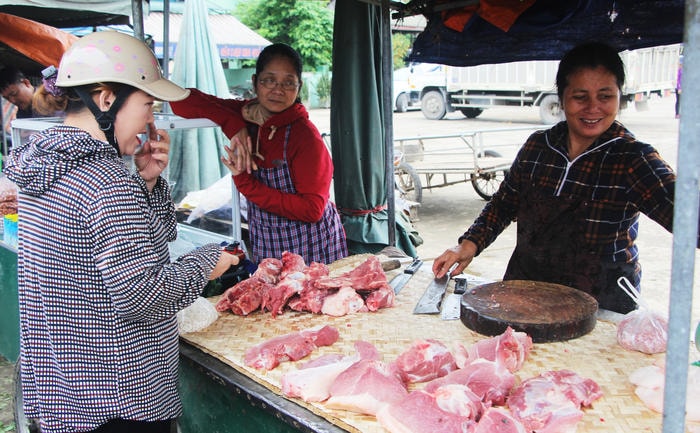 |
| Vinh City's veterinary inspection at slaughterhouses reached 200 pigs per day/night per slaughterhouse (achieving an 80% rate). The photo shows a pork vendor at Vinh market. Photo: Nam Phuc |
Mr. Son acknowledged that post-licensing inspection and supervision (post-inspection) has not been regular, is weak, and is seasonal; the situation of selling fresh food on sidewalks and roads has not been thoroughly addressed. In addition, the awareness of some establishments, households, and individuals involved in food production, processing, and trading is still limited in complying with food safety and hygiene laws.
According to Mr. Son, one of the "force majeure" reasons why not only Vinh City but also the entire province is facing difficulties in managing and inspecting the origin of food is the lack of equipment and machinery for testing food safety.
“Food inspections at processing businesses are primarily administrative, based on their business registration documents. Vinh City is aiming to become a Class 1 urban area, but for many years we have been requesting the province to build a regional-scale food inspection center, yet this has not been done. We lack the equipment and machinery to quickly detect results when taking food samples, forcing us to send samples to central centers, which is costly and time-consuming,” Mr. Son said.
Referring to some solutions for managing food hygiene and safety in the coming time, Mr. Son said that the city will continue to strengthen penalties for establishments violating food safety and hygiene regulations, with fines increasing tenfold according to the commitment if establishments re-offend; if necessary, criminalization may be considered to be a sufficient deterrent; and concentrated production planning areas will be developed. In particular, the consumer community and businesses also need to raise awareness and "say no to unsafe food".
Nam Phuc


