
For reforestation, people are provided with acacia seedlings and fertilizer.
(Baonghean) - In recent years, our province has attracted many hydropower, transportation, irrigation, and public works projects, resulting in the reclamation of a large area of forest for these projects. To compensate for this lost forest area, our province is implementing a reforestation project.
After decades of working in the forestry sector in the remote district of Tuong Duong, immediately after retiring and returning to his hometown in Hamlet 2, Hoa Son Commune (Do Luong District), Mr. Thai Dinh Hanh received 1.7 hectares of forest land near his house to plant acacia trees as part of a reforestation project. With the desire to prosper from the forest, starting in January 2015, his family invested in planting trees using seedlings and fertilizers provided by the Do Luong Forestry Company Limited. The family invested 23 million VND in clearing the undergrowth, digging 3,750 holes for planting acacia trees, and purchasing an additional 1.2 tons of NPK fertilizer... to support the reforestation efforts.
With proper investment and care, over 1.7 hectares of acacia trees have developed well after more than 10 months, now reaching a height of nearly 2 meters and becoming one of the model projects of the reforestation project in Hoa Son. In addition, many households in Hoa Son commune (Do Luong district) have actively completed the reforestation project with an area of over 12 hectares, and most of the acacia trees are developing well due to proper investment and care.
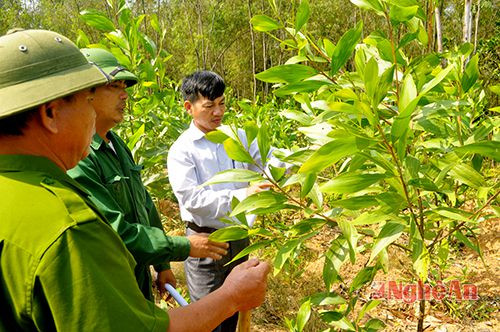 |
| People in Hoa Son commune (Do Luong district) are implementing a reforestation project. |
The 2015 reforestation project was implemented in many localities, with Yen Thanh being one of the districts that implemented it very effectively. Mr. Phan Van Sy, Head of the Yen Thanh Protective Forest Management Board, said: “Currently, the board is assigned the task of managing 7,811 hectares of forest in Yen Thanh, and in 2015, implementing the reforestation project, the Protective Forest Management Board implemented two types of forest planting: timber forests and protective forests. The policies supporting people in planting forests were implemented by the Management Board in accordance with regulations, transparently and promptly, creating trust among the people, thus speeding up the reforestation process.” Benefiting from this project, people in Yen Thanh received support in the form of acacia seedlings, fertilizers, and planting techniques for 100 hectares of timber forests. Many households in 8 communes of the district received guidance on acacia tree planting techniques from technical staff of the Protective Forest Management Board starting in early August 2015 and completed planting 100 hectares of forest by September 2015.
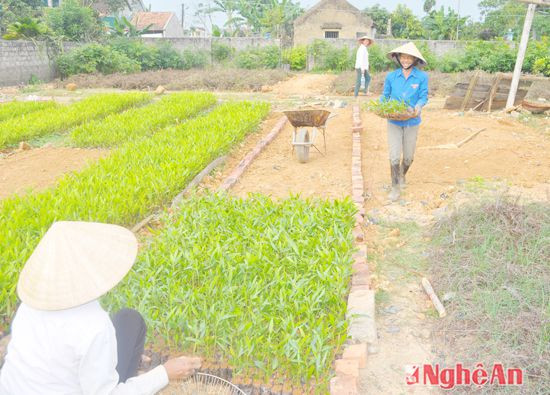 |
| Supplying acacia seedlings to local people for reforestation. (Photo by HV) |
Mr. Dang Xuan Minh, Head of the Forestry Sub-Department, stated: “The total area of forest land converted for other purposes requiring reforestation in our province has reached over 3,586 hectares. This includes 100% of the area converted for hydropower projects (over 2,113 hectares) being reforested; 100% of the area converted for public works (nearly 575 hectares) being reforested; and hundreds of hectares of forest converted for other purposes. During the implementation of the reforestation project, several difficulties and obstacles remain, including insufficient funding, difficulties faced by forest owners and local people in carrying out the reforestation project, and delays and challenges in collecting reforestation fees (mostly for purposes other than hydropower) for land converted before 2012 in some units, projects, and enterprises.”
Along with investing in reforestation projects, through funding from the Forest Protection and Development Fund, Nghe An province continues to support localities, forest owners, and people in protecting and cultivating nearly 200,000 hectares of forest in hydropower basins. Notable examples of this work include Ky Son (protecting and cultivating nearly 60,000 hectares of forest), Tuong Duong (over 60,000 hectares), and Que Phong (40,000 hectares).
Hoang Vinh
| RELATED NEWS |
|---|


