
The thousand-year-old tradition of Dien Chau
(Baonghean) - Dien Chau is an ancient land; it belonged to the Hoai Hoan region since the time of the Hung Kings, but the name Dien Chau officially appeared in 627. Over 1390 years, the name Dien Chau has been closely associated with the development of the country.
Comrade Chu The Huyen - Deputy Secretary of the District Party Committee and Chairman of the Dien Chau District People's Committee - gave an interview to Nghe An Newspaper on the occasion of the 1390th anniversary of the name Dien Chau.
PV:Could you give us a brief overview of the 1,390-year history of the name Dien Chau?
Comrade Chu The Huyen:The book "Dai Viet Dia Du Toan Bien" compiled by Phuong Dinh Nguyen Van Sieu records: "Dien Chau Long Tri district, formerly Trung Nghia district, also called Dien Thuy district. In the Trinh Quan year, Quang Duc was abolished, Hoan Chau land was cut off and Dien Chau was established... it had 7 districts: Trung Nghia, Long Tri, Vu Lang, Vu Kim, Hoai Hoan, Tu Nong, Vu Dung." Combining with national and private histories: "Kham Dinh Viet Su Thong Giam Cuong Muc", "Dai Nam Nhat Thong Chi", "Lich Trieu Hien Chuong Loai Chi", "Nghe An Ky", scientists at the scientific seminar on September 11, 2005 agreed that there is sufficient scientific basis to definitively determine that the name Dien Chau appeared in the first year of Trinh Quan during the reign of Emperor Tang Thai Tong (627).
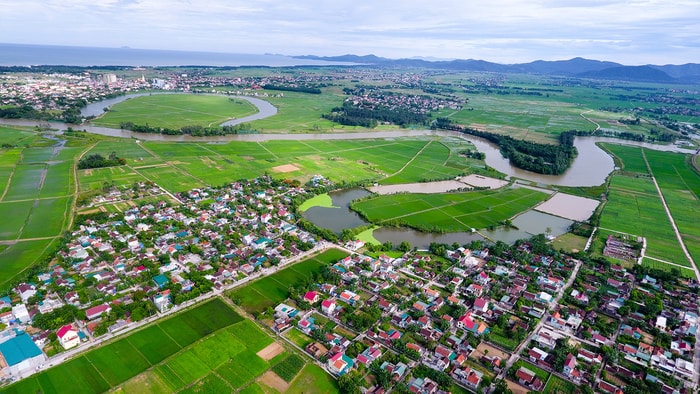 |
| A view of the center of Dien Chau district. Photo: Sach Nguyen |
Dien Chau is an ancient land; it belonged to the Hoai Hoan region since the time of the Hung Kings, but the name Dien Chau officially appeared in the country's history in 627. Its territory fluctuated in size, but from its appearance in 627, Dien Chau played the role of an administrative unit at the district level. Throughout many successive dynasties, from the Tang period to independent dynasties such as Khuc (905-923), Duong (931-938), Ngo (93-965), Dinh (9680-980), and Early Le (98-1009), Dien Chau remained an independent district.
Thus, the place name Diễn Châu dates back to 627, although its geographical area changed over time, it remained closely associated with Hoan Châu. Hoan Châu was derived from Đức Châu. Đức Châu existed during the Liang Dynasty (502-507), separated from Cửu Đức. Cửu Đức was originally established during the Wu Dynasty (220-280), separated from Cửu Chân district during the Han Dynasty. During the Han Dynasty, Diễn Châu was the land of Hàm Hoan district; during the Tang Dynasty, it was Phủ Diễn and An Nhân districts, then changed to Diễn Châu; during the Lý and Trần Dynasties, it was Diễn Châu province; during the reign of Lê Quang Thuận (Thánh Tông), it was changed to Diễn Châu prefecture, belonging to Nghệ An province, encompassing Đông Thành and Quỳnh Lưu districts; in the 18th year of Minh Mạng, Yên Thành district was added (encompassing three districts: Đông Thành, Quỳnh Lưu, and Yên Thành).
After the August Revolution, specifically after the resistance war against the French, in 1954, the administrative center of Dien Chau, then a district, was moved to the Dien Chau intersection. Initially called the district capital, on February 23, 1977, according to Decision No. 619 VP/CP of the Minister and Head of the Prime Minister's Office, it was renamed a town. Dien Chau town, which includes the Dien Chau administrative offices, is expanding and developing. As the political center of Dien Chau, it is also located near National Highway 1, the North-South railway, the junction of National Highway 7 to Laos, and is close to the sea with the Bung River flowing through it… thus possessing the potential to become a prosperous economic and cultural center.
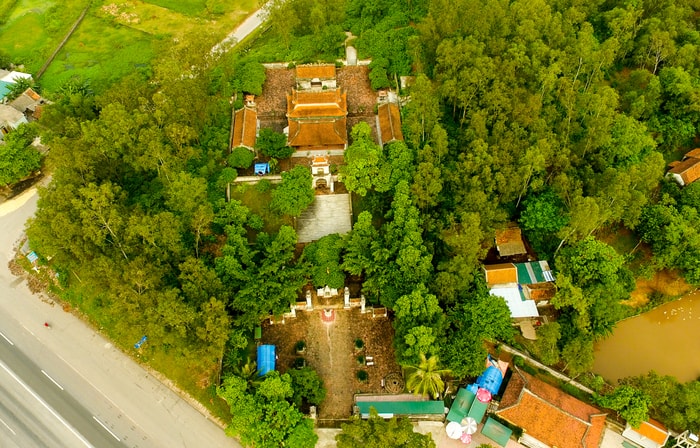 |
| Panoramic view of Cuong Temple. Photo: Sach Nguyen |
PV:Building upon its 1,390-year tradition, Dien Chau has changed a great deal. Especially after 30 years of reform, the district has made significant breakthroughs in all fields, isn't that right, sir?
Comrade Chu The Huyen:Dien Chau is a land blessed with many natural advantages, including the sea, rivers, and fertile soil. The people of Dien Chau are hardworking, resilient, and indomitable in their struggles, along with a renowned tradition of studiousness and academic achievement throughout the region...
All these advantages have contributed to changing the face of the former Hoan Chau region, now Dien Chau: always at the forefront of applying scientific and technological advancements towards industrialization and modernization, promoting and preserving traditional crafts. At the same time, it has leveraged internal strengths and taken advantage of external forces to create a favorable mechanism to attract investment projects in production and business. The economic structure has shifted towards increasing the proportion of industry, construction, and services. Several small industrial zones have emerged, creating a growth spurt in economic development, such as the Dien Hong Small Industrial Zone, the Thap-Hong-Ky Industrial Zone, Loc-Tho Industrial Zone, the garment factory in Dien Phong, the fishmeal factory in Dien Hung, Dien Ngoc, etc.
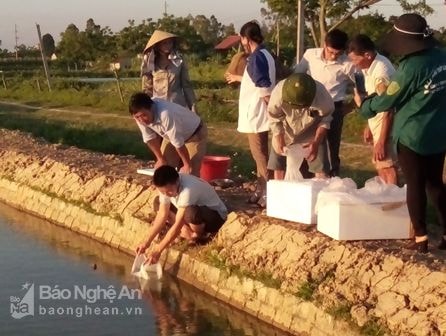 |
| Giant freshwater prawns in Dien Chau. Photo: Mai Giang |
Within the district, there are 9 large-scale projects invested by businesses with a total registered capital of nearly 1,500 billion VND, of which over 1,000 billion VND has been implemented. The entire district has 475 non-state-owned enterprises and more than 6,000 individual business households, contributing to economic transformation and development, and creating jobs for 4,500 to 5,000 workers annually. On average, these businesses contribute over 50 billion VND to the state budget each year.
Alongside this, coastal and eco-tourism areas are emerging and developing, such as Dien Thanh Beach, Xuan Duong Lake, and Dien Lam Eco-tourism Area. New urban areas are appearing, and the transportation system, canals, and electricity network are being extensively and modernly invested in. Cultural life is preserved and promoted, and social issues are being addressed.
The National Target Program for Building New Rural Areas has become a widespread movement, receiving widespread support and participation from the people. By mid-2017, 17 out of 38 communes had been recognized by the Provincial People's Committee as meeting the standards for New Rural Areas. For many consecutive years, the Dien Chau District Party Committee has been recognized as clean and strong. The district leads the province in many areas: the number of communes meeting New Rural Area standards is among the top in the province; for many years it has been a leading example in education, both in terms of quality and the movement to build national standards; it has the highest number of communes meeting Level 2 standards in healthcare in the province; national defense and security are maintained, and social order and safety are ensured.
 |
| Boats docking at the port. Photo: Nguyen Sach |
PV:With the goal of building Dien Chau into a rapidly and sustainably developing district, striving to achieve the status of a new rural district by 2020 and ranking among the top districts in the province, the District Party Committee has consistently achieved strong performance; what solutions has the district implemented, Comrade?
Comrade Chu The Huyen:During the 2015-2020 term, Dien Chau set forth the direction of accelerating growth, continuing to develop sectors, industries, and products with established advantages, while also aiming to develop industries and products that apply science and technology, have high added value, save raw materials and energy, and are environmentally friendly. The district strongly promoted the development of industries, small-scale handicrafts, traditional craft villages, services, and tourism, considering these as breakthroughs in economic development. It focused on improving the quality of human resources to meet development requirements. Attention was paid to developing socio-cultural fields, strengthening national defense, ensuring political security, and maintaining social order and safety. The district also aimed to enhance the leadership capacity and fighting strength of the Party organization, building an increasingly strong political system.
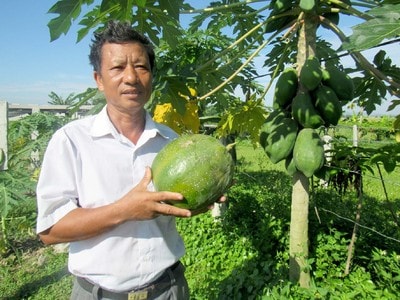 |
| The papaya farming model that generates high income for Mr. Nguyen Van Ba's household (Dien Lien commune, Dien Chau district). Photo: Quang An |
To achieve that goal, the district focuses on key solutions: Mobilizing and effectively utilizing resources; leveraging existing potential and advantages while exploiting external resources; continuing to promote investment attraction and strengthening investment in infrastructure development, especially key infrastructure, to serve as a foundation for economic development.
Economic development should be linked with the development of culture, health, education, training, environmental protection, achieving social progress and equity, improving the quality of life for the people, gradually reducing the poverty rate, ensuring social security; promoting the application of science and technology; focusing on training and attracting human resources, especially high-quality human resources, to meet development requirements.
Closely integrate socio-economic development with strengthening national defense and security. Continue to innovate thinking, strengthen the Party's leadership role, improve the efficiency of management and administration of government at all levels, and enhance comprehensive development cooperation with other localities. Proactively prevent, mitigate, and reduce natural disasters and mitigate the impacts of climate change.
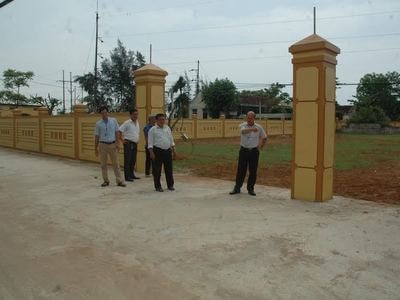 |
| Inspecting the quality of rural roads in Dien Phuc commune (Dien Chau district). Photo: Mai Giang |
Furthermore, the District Party Committee focuses strongly on planning and planning management, completing socio-economic development. Emphasis is placed on shifting the agricultural economic structure towards larger-scale commodity production. Focus is on developing the marine economy and strengthening fisheries infrastructure. Breakthrough solutions are being implemented to strongly develop industry, focusing on industries with comparative advantages. Proactive coordination with the Southeast Economic Zone is underway to accelerate infrastructure development and attract investment. Along with development, human resource development is crucial for the new era.
The Dien Chau District Party Committee also emphasized its determination to further innovate leadership methods, enhance the capacity and fighting strength of grassroots party organizations; promote the pioneering and exemplary role of cadres and party members, and build a truly strong Party Committee in terms of ideology, politics, and organization. It will implement the resolutions of the Party Congress for the current term into action programs, projects, and plans to ensure effective implementation and bring the resolutions into practice.
PV:Thank you, comrade!
Thanh Hien
(Perform)


