
Crossing rivers and lakes, plunging into flames to save lives.
(Baonghean) - Braving flames, rushing into collapsed buildings to rescue people and property, or wading through rivers and lakes to search for traces and bodies of victims... these are the jobs of rescue and relief soldiers belonging to the Fire Prevention, Firefighting and Rescue Police Department.
Facing danger
Having dedicated over five years to rescue and relief work, Lieutenant Ho Dinh Khanh, an officer of the No. 1 Fire and Rescue Police Team, cannot remember how many incidents he has directly participated in. However, for some specific incidents, he remembers in great detail, from the time they occurred to the circumstances during the mission.
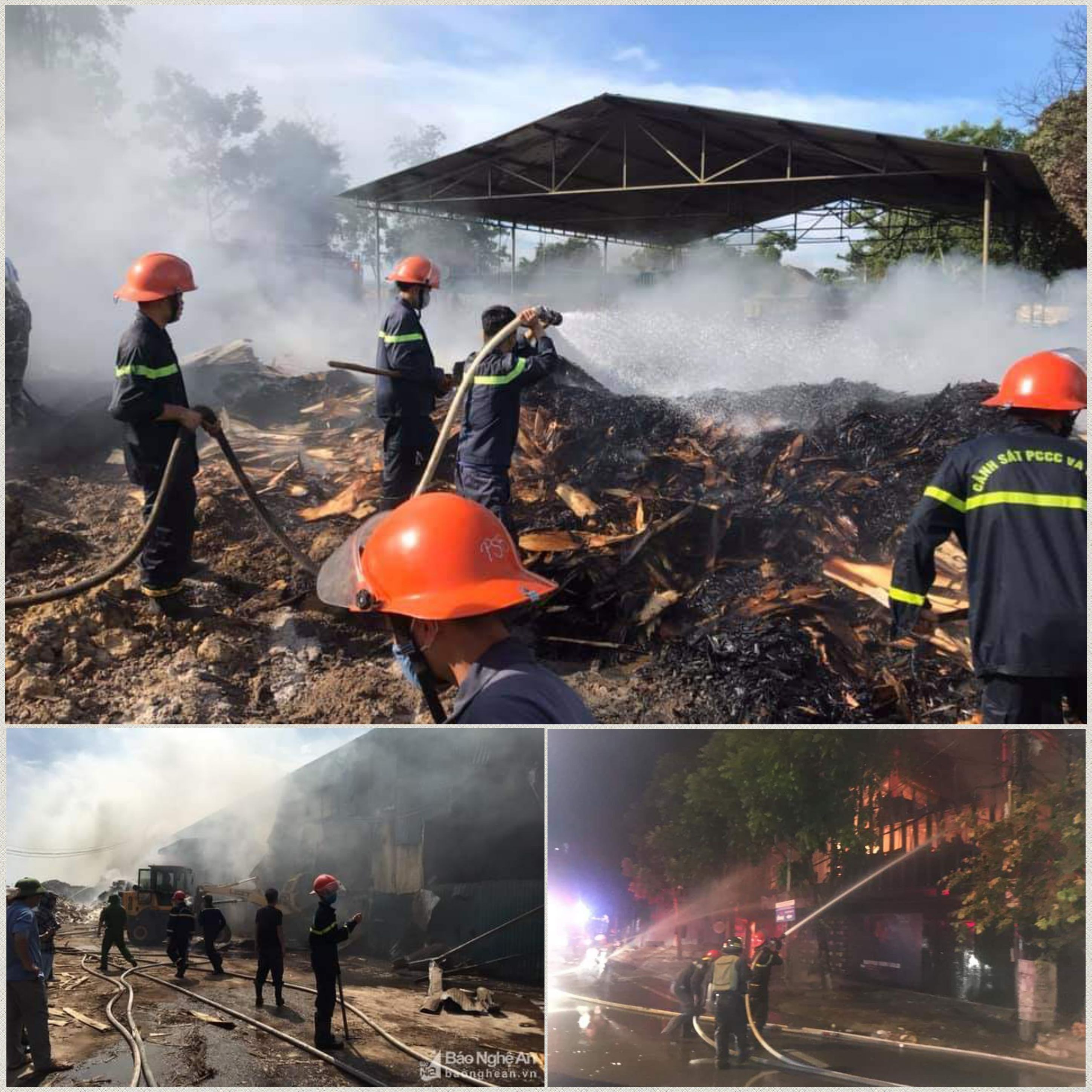 |
| Scenes from several fires in the province during early June 2020. (Archive photo) |
A typical example is the fire that occurred at 3:57 AM on November 6, 2019, at Tan Thinh apartment building, Le Mao extended road, Vinh Tan ward (Vinh City). Lieutenant Khanh recalled that upon receiving the report, the unit dispatched 1 command vehicle, 3 fire trucks, 1 water tanker, and more than 40 officers and soldiers to the scene.
Upon arrival, the electrical system in the technical room on floors 8, 9, and 10 of the apartment building was engulfed in flames, with a large amount of toxic smoke covering the entire hallway and open apartments. Hundreds of residents were trying to escape in a state of panic and congestion, with many trapped.
In response to the situation, the rescue team immediately deployed its forces, directly rescuing more than 20 people, including many elderly people and young children; guiding hundreds of people to safety; and simultaneously implementing firefighting plans. By approximately 4:20 AM the same day, the fire was brought under control and extinguished. At this time, the rescue team continued to organize smoke evacuation in the corridors and apartments affected by smoke.
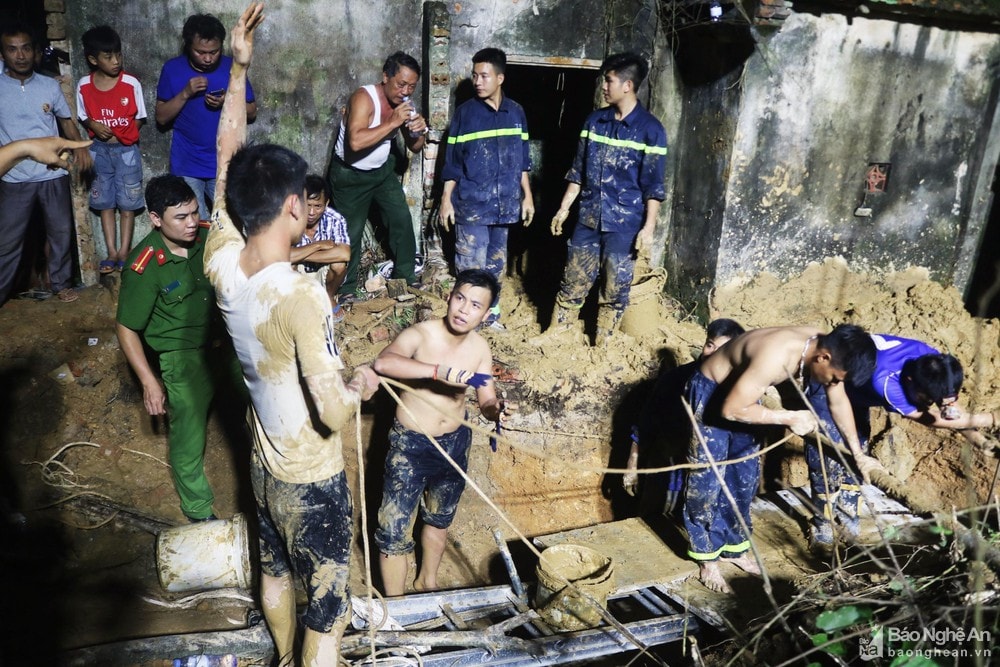 |
| The scene of the search for victims buried during well digging in Thanh Ha commune (Thanh Chuong district). Photo: Diep Phuong. |
Lieutenant Khanh said that not every incident can result in saving lives, because in reality, many cases are already too late. In those situations, what rescue workers can do is make every effort to find the bodies of the victims, contributing to sharing the pain and loss of the families, such as the well collapse in Thanh Ha (Thanh Chuong), and the drowning of three students in Thanh Tuong commune (Thanh Chuong)...
Sharing the same sentiment as Lieutenant Khánh, Lieutenant Colonel Lê Thanh Bình – currently the Deputy Head of the Fire Prevention and Rescue Police Department, considered by his colleagues as a "sharpshooter," skilled both on land and underwater – recalled: On the afternoon of May 24, 2019, in Thanh Hà commune, a well collapsed while digging, burying Phan Văn Sự and Phan Văn Dương. Only one was rescued in time, while Dương remained trapped underneath.
Upon receiving the information, the unit immediately deployed forces to the scene. The victim was buried under mud at a depth of approximately 4 meters, making rescue efforts difficult. Furthermore, the location where the victim was buried was unfavorable; the well-digging area was rough, and there were power poles nearby, which also hampered the deployment of equipment.
After coordinating with local authorities and using excavators to create a suitable space and level ground for the rescue operation, the team split into working groups. One group went down into the well to excavate and remove mud and soil, while another group remained on the surface using a winch to pull buckets of soil up. The groups took turns working throughout the night. After nearly 7 hours of strenuous searching, at 10 PM that same day, they finally managed to bring the victim's body to the surface.
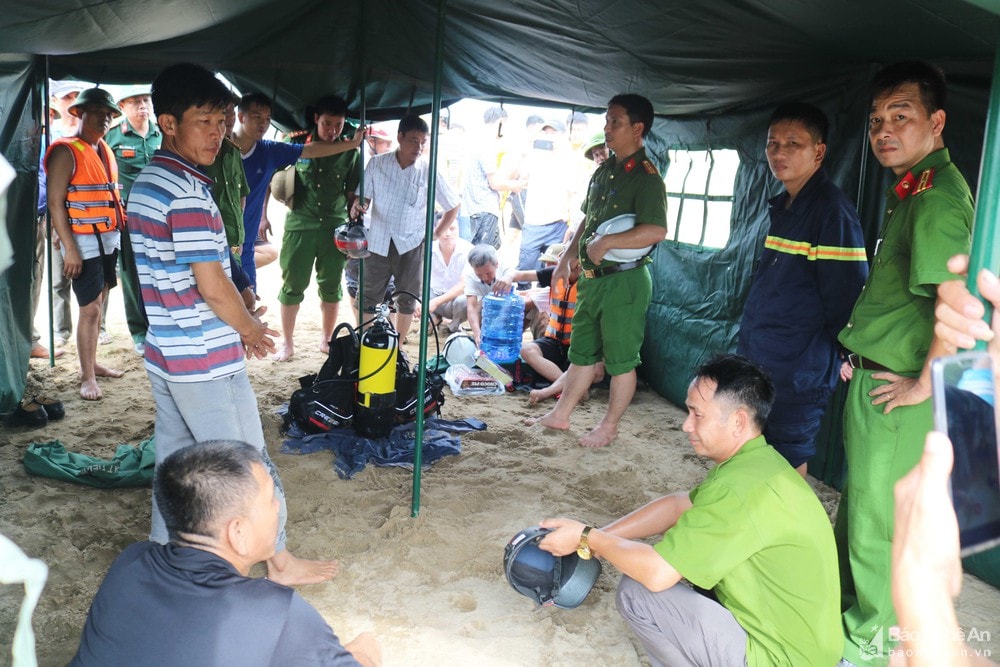 |
| Rescue forces are discussing plans to search for three students who drowned in Thanh Tuong (Thanh Chuong). (Photo: Archival image) |
According to Lieutenant Colonel Binh, while land-based rescue operations are arduous and dangerous, underwater rescue is many times more challenging. This is because in most underwater rescues, the victims have already died or been missing for many hours. The panic of the victims' families also affects the morale of those carrying out the rescue. Furthermore, there is no safe distance in the underwater environment, making it extremely dangerous. Moreover, the search area is vast, and the currents are constant. In addition, diving to search for victims always involves facing needles, shards of glass, obstacles, or whirlpools...
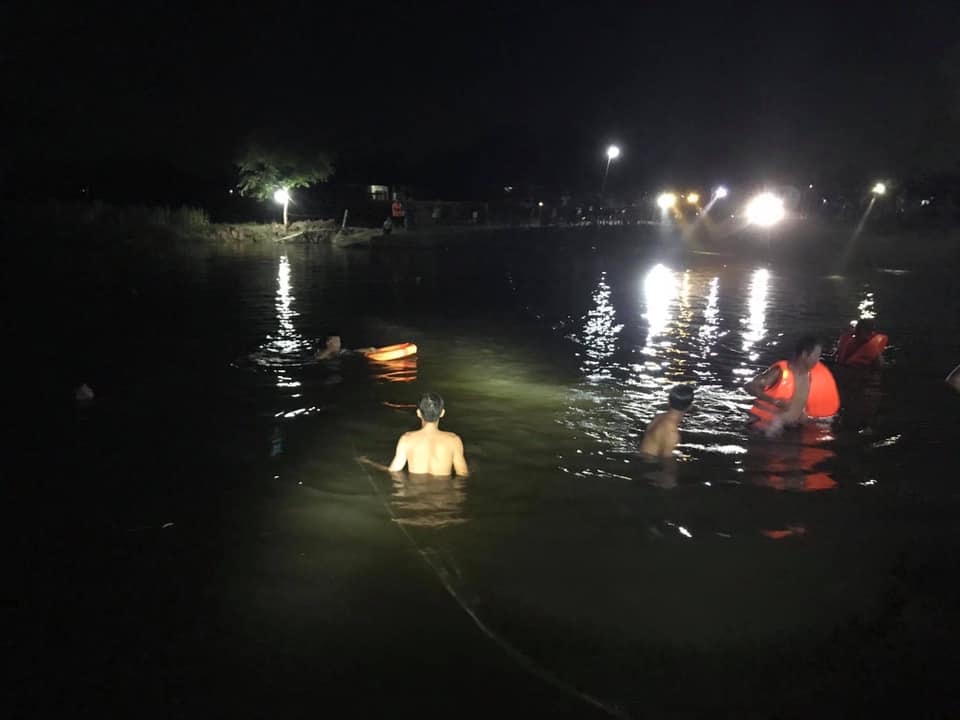 |
| Underwater searches always face countless difficulties. (Photo: Archival image) |
Always ready to perform the task.
Previously, the Fire and Rescue Police force only participated in rescuing people and property during fires. However, since 2012, they have also been assigned the task of rescue operations in incidents and accidents such as fires, explosions, landslides, building and structure collapses, traffic accidents, and drowning accidents. Therefore, with a force of just over 200 people and 9 regional teams, simultaneously undertaking firefighting and rescue work throughout the province, the entire force is constantly under immense pressure and hardship.
Accordingly, units must always ensure readiness in terms of personnel and equipment, and maintain a 24/7 on-call system to receive and process information. Whenever a report is received, officers and soldiers, even if they are eating or sleeping, must immediately set off, regardless of day or night, rain or shine. "Always ready, yet afraid. Afraid of the phone ringing, afraid of the air raid siren, because when those sounds are heard, it means somewhere the lives and property of the people are being threatened," that is the common sentiment of most officers and soldiers working in search and rescue.
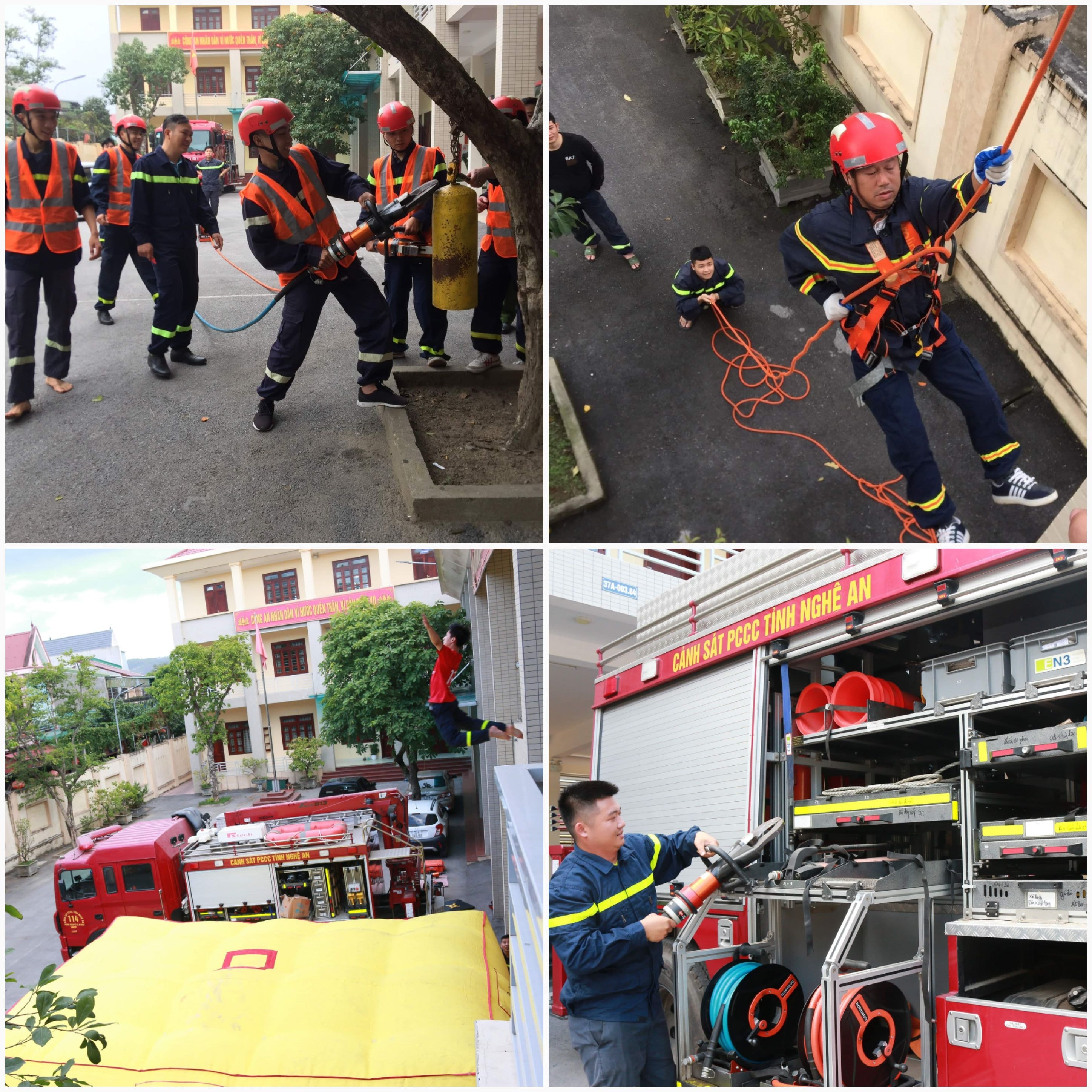 |
| Training is conducted regularly by officers and soldiers involved in search and rescue operations. Photo: D.C. |
Sharing with us, Lieutenant Phan Trong Son - of the River Fire and Rescue Police Team - said that each incident has different levels of complexity. Generally, with traffic accidents and workplace accidents occurring on land, rescue operations are somewhat easier because they can be observed visually. This allows for a comprehensive overview and prediction of developments at the scene, accurately identifying the location of trapped victims to devise appropriate and rapid rescue plans.
However, underwater rescue operations are more limited in visibility, making it difficult to identify potential dangers. Underwater, you can't see anything, you don't know where you are, and you can't see anyone underwater from the shore; communication is only possible through a snorkel. Going to the riverbed is like being lost in a "junkyard." The only search method is using your hands and feet to navigate through the cold, muddy water, which is fraught with countless unexpected dangers.
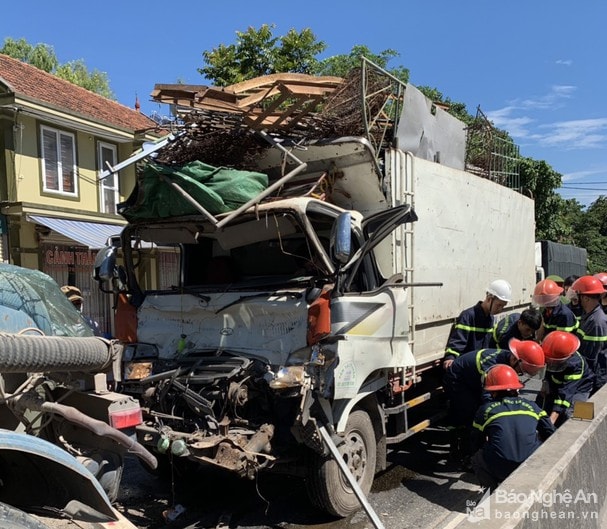 |
| Rescue forces rescued the truck driver in an accident that occurred on National Highway 1A, in Quynh Xuan ward, Hoang Mai town, at 2 PM on June 1, 2020. (Photo: Archival image) |
Furthermore, in accident situations, victims are psychologically affected due to pain and fear. In such situations, rescue workers also act as psychological experts, trying to encourage and reassure victims to remain calm and follow the instructions of the authorities. In addition, controlling individuals under the influence of methamphetamine is even more complicated. After using methamphetamine, many individuals fall into a state of paranoia and lose control of their behavior. They not only endanger those around them but also themselves.
For example, in November 2018, Le Ngoc Ha (born in 1985), residing in Hong Son ward (Vinh City), due to family conflict, carried his 2017-born son onto the roof of a row of rental houses on Nguyen Thuc Tu street, Tan Hoa block, Vinh Tan ward. Despite unsuccessful attempts at persuasion, the authorities had to continuously move inflatable rafts, dozens of meters wide, along alley number 2 on Nguyen Thuc Tu street and finally caught the child after he was thrown down onto the corrugated iron roof.
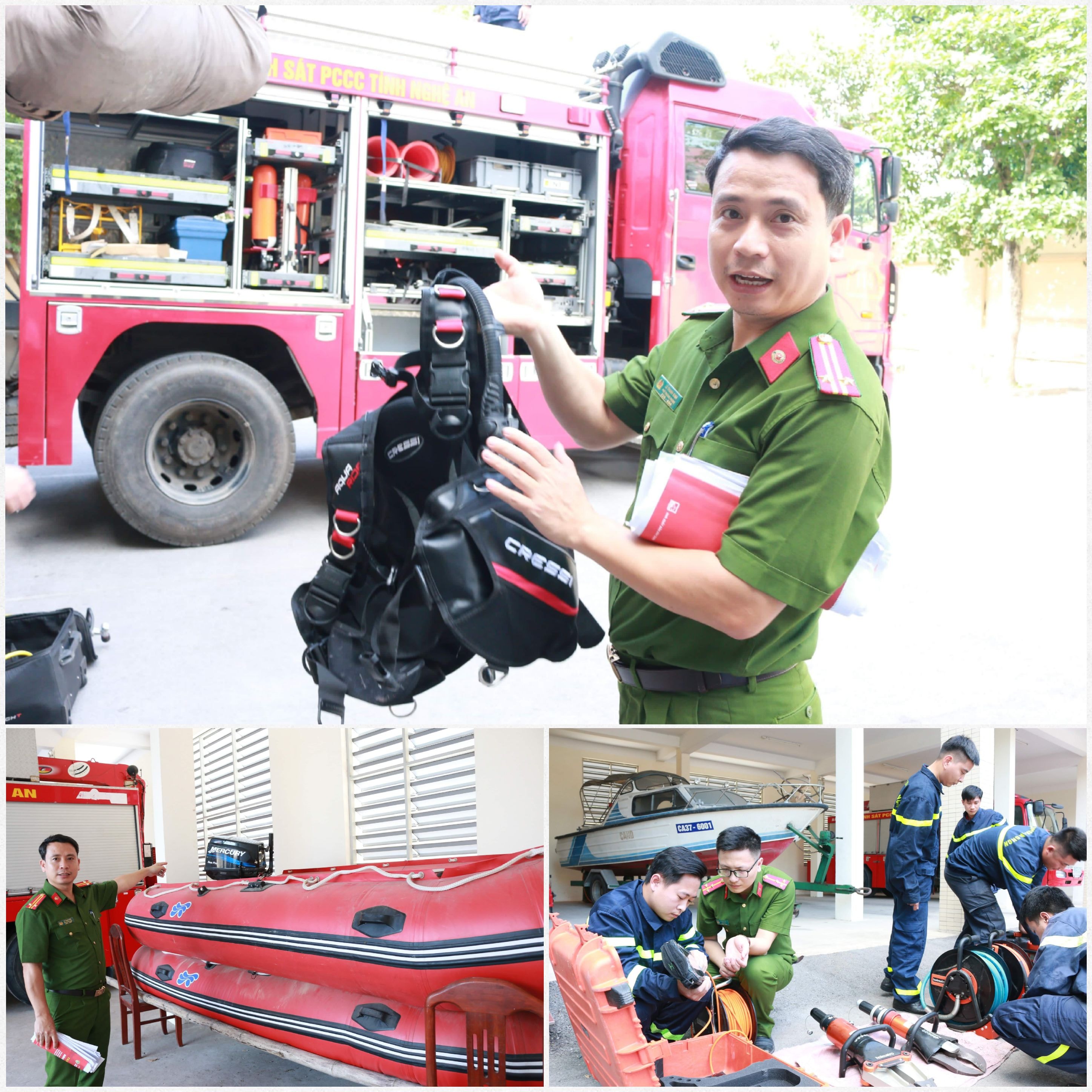 |
| With the understanding that only through daily use of tools and equipment can one become proficient in performing tasks quickly in practice, this is a task that the department head implements daily. Photo: D.C. |
In an interview with us, Lieutenant Colonel Le Thanh Binh, Deputy Head of the Fire Prevention and Rescue Police Department (Provincial Police), stated: "The work of a rescue soldier is arduous and high-pressure, as incidents can occur at any time. To perform their duties well, each officer and soldier must have a love for their profession and the courage to quickly handle situations. Therefore, along with training divided into two periods a year with high intensity and increasingly difficult training plans, political and ideological education is considered a crucial factor in training soldiers who are resourceful, courageous, unafraid of hardship, and ready to face any danger."
Despite the difficulties and hardships, having accepted their destiny, the rescue soldiers all believe that "when others run out, we run in; it's like instinct. Because we always consider rescue missions as doing good for the world, we always strive to complete our assigned tasks well."
However, the biggest concern for rescue workers today is equipment. In reality, the equipment, mainly from aid sources, lacks uniformity, and some of it is already outdated, significantly impacting rescue operations and making their tasks more difficult.
According to compiled data, in 2019 alone, the rescue force of the Fire Prevention and Rescue Police Department of Nghe An province conducted 48 rescue operations, searching for and rescuing 59 people and recovering 37 bodies. From the beginning of 2020 to May 15th, they conducted 9 rescue operations, searching for and rescuing 51 people and recovering 7 bodies.


