
Ky Son lac - a product that was once famous.
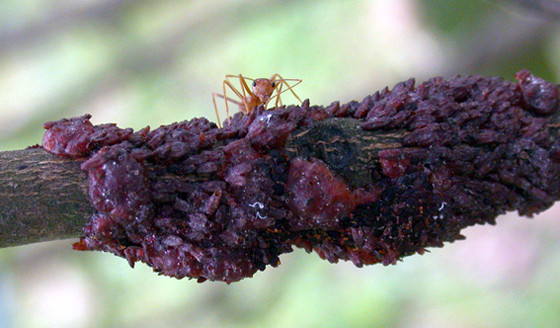
(Baonghean.vn) - Lac is actually the resinous product of red lac insects on the trunks of host trees. The border district of Ky Son was once known for having hundreds of hectares of lac forests with high economic value. However, after its heyday, lac gradually disappeared, and there is no way to revive it.
Raising lac insects is a traditional occupation for many people in Ky Son district. They cultivate these insects on host trees such as the pit nieng tree, the bean tree, the fig tree, and the alum tree, harvesting the resin that the ants secrete on the tree trunk.
This type of resin has many uses. In medicine, it has cooling and detoxifying properties. In industry, shellac resin is used as a pigment, paint, and coating for products that require resistance to heat, acid, and harsh weather conditions. Shellac products are also used in the aerospace industry to manufacture aircraft and high-end electronics.
Lac resin is also widely used in pharmaceuticals, food, cosmetics, etc. Therefore, lac resin is particularly popular and in high demand on the market.
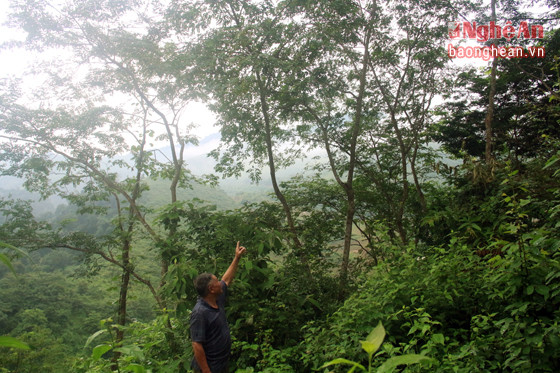 |
| Mr. Cụt Bún Ma (Nọong Dẻ village, Nậm Cắn commune, Kỳ Sơn district) stands beside the pịt niệng trees - the habitat of red ants. |
The years 1990-1991 were the golden age of Ky Son lac. During that time, many people earned a high income from this product.
Lac trees are most abundant in Ky Son district, particularly in the communes of Keng Du, Huoi Tu, Pha Danh, and Nam Can. Some families, like Mr. Luong Phia Chan in Keo Luc 1 village (Pha Danh commune) and Mr. Moong Pho My in Huoi Phuon 2 village (Keng Du commune), are considered "lac tree kings," harvesting tons of resin in some seasons. At that time, many people escaped poverty, and some even became well-off, thanks to this product.
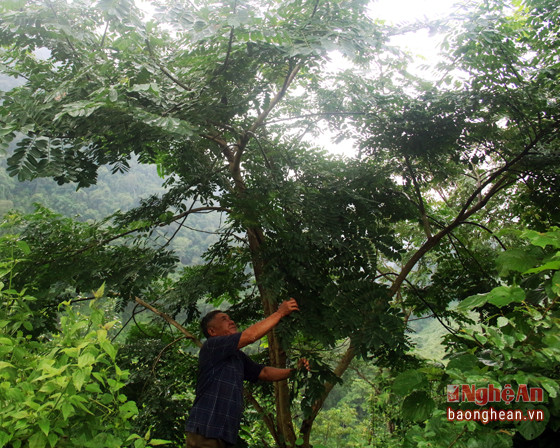 |
| Due to a shortage of seedlings, Mr. Ma has now cut down more than 300 trees, and the remaining ones are no longer being cared for. |
However, due to various unforeseen events and objective reasons, while the local people's knowledge of lac insect farming is very limited, rampant deforestation has led to a reduction in the lac insect breeding stock and the area of host plants.
On the other hand, fluctuations in the consumer market have led to the gradual decline of the lac insect farming profession among ethnic minority communities in Ky Son district. Many now deeply regret not being able to maintain this unique occupation. Currently, 1 kg of lac insect sells for around 1.5 million VND.
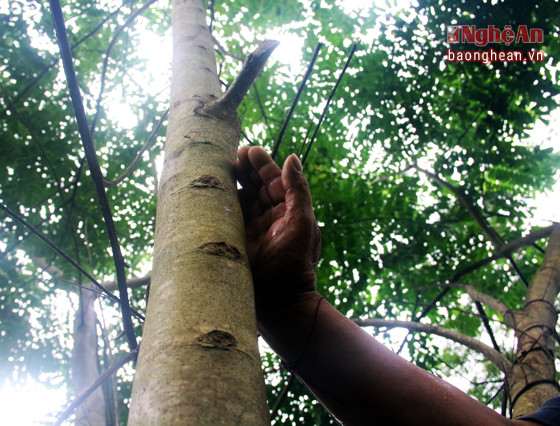 |
| The tree nodes serve as attachment points for lac insects to live and produce resin. |
We visited Mr. Cụt Bún Ma's house in Noọng Dẻ village, Nậm Cắn commune. Mr. Bún Ma was once known as the "king" of lac insects in the Nậm Cắn region, with over 500 pịt niệng trees, the main tree species used to raise lac insects.
Mr. Bun Ma lamented: “About ten years ago, my family planted over 500 lac trees on a 1-hectare hillside garden to harvest resin. During that time, we sometimes harvested tons of lac resin. But since 2002, we've cut down nearly 300 trees, mainly because of a shortage of seedlings. Before, whenever we needed lac seedlings, we could import them from Pha Danh and Keng Du, which was enough for the whole season. Now, those two communes don't even have seedlings to import anymore. And we don't know how to propagate them. Furthermore, in some seasons, we released lac insects, but they didn't perch on the trees. Releasing lac insects is also a matter of luck; sometimes we release many seedlings, but there's no guarantee they'll survive and produce resin on those trees. The success rate is only about 50% to 60%. So now, we only have over 100 lac trees scattered throughout the farm, but we just leave them unused because they're not serving any purpose.”
Upon investigation, it was found that many households in Nam Can are in the same situation as Mr. Cut Bun Ma's family.
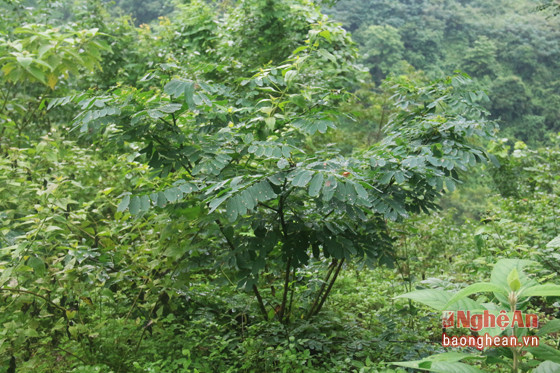 |
| A sapling of the pịt niệng tree has grown from the stump of the tree that was cut down. |
In Pha Danh commune, where a project to build a breeding garden for red lac insects in Ky Son district has been underway since mid-2013, Mr. Tran Quoc Dong, Secretary of the Party Committee of Pha Danh commune, stated that the goal was to build a breeding garden with a capacity of 2.5-3 tons of cuttings per year. However, in reality, the current production is much lower. In the first 11 months of this year, only 700 kg of cuttings have been harvested. The cuttings are only enough to supply the people in the commune and there is no surplus to distribute to neighboring areas. Furthermore, it is difficult for people outside the project area to develop a breeding area. Especially after the death of Mr. Luong Phia Chan, the "pioneer" of the lac insect breeding movement, no one in Pha Danh commune knows how to breed cuttings anymore.
 |
| Shellac resin product. Source: Internet |
It is known that currently in Ky Son district, there are over 150 hectares of scattered host trees suitable for breeding and raising lac insects. And each year, Ky Son district needs at least 10 tons of lac insect cuttings.
However, the supply of seeds for this area is insufficient. This is a major obstacle to the restoration of this product.
Now more than ever, it is time for all levels of government, relevant agencies, and departments to implement policies to support the revival of this unique product.
China
| RELATED NEWS |
|---|


