
Entrance fees to historical sites and scenic spots have not yet been implemented in Nghe An.
(Baonghean.vn) - Charging entrance fees to historical sites, scenic spots, museums, and cultural works has been implemented in many localities nationwide. However, in Nghe An, there are still many points worth discussing regarding this issue.
"Will there be entrance fees for historical sites, scenic spots, and museums in Nghe An province?"
On the afternoon of November 8th, the Provincial People's Committee held a meeting to hear and give opinions on the Project and draft Resolution of the Provincial People's Council regarding entrance fees for historical sites, scenic spots, museums, and cultural works in Nghe An province. Comrade Le Minh Thong - Member of the Standing Committee of the Provincial Party Committee, Vice Chairman of the Provincial People's Committee - chaired the meeting. Attendees included leaders from the Department of Culture and Sports, other relevant departments, agencies, and units, as well as representatives from the Vinh City People's Committee and Hung Nguyen District People's Committee. |
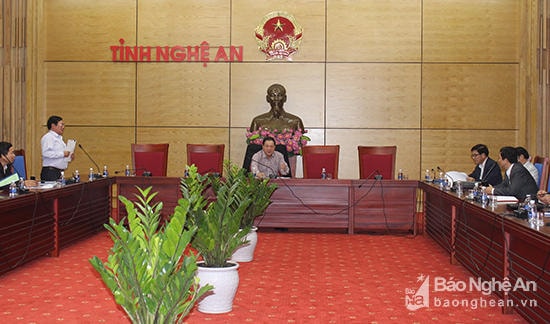 |
| The scene at the meeting. Photo: Phuoc Anh |
The premise for the roadmap to financial self-sufficiency.
“The draft Resolution stipulating entrance fees for historical sites, scenic spots, museums, and cultural works in Nghe An province is based on the Law on Organization of Local Government, the Law on Fees and Charges… I believe we must adhere to the law. If the law stipulates collection, then we must collect!” - Mr. Ho Mau Thanh, Director of the Department of Culture and Tourism, opened the meeting.
The head of the provincial Department of Culture and Sports meticulously analyzed the purpose of collecting fees. The aim is to more effectively manage and control fee-based activities within the framework of the law; to implement the policy of socialization, mobilizing contributions from the community to develop public service activities, and gradually reduce state budget subsidies for public services. In addition, the fees are intended to supplement funding for the preservation, restoration, and repair of historical sites, cultural works, and museums.
The draft resolution on fee collection, prepared by the Department of Culture and Tourism, clearly states that the fee payers are Vietnamese and foreign tourists; those exempt from fees are people with severe disabilities, Vietnamese Heroic Mothers, and children under 6 years old; those eligible for reduced fees are the elderly, people with severe disabilities, and those entitled to preferential policies for cultural enjoyment… The fee for adults aged 16 and above is 20,000 VND per visit, and for children aged 6 to under 16, it is 10,000 VND per person per visit. |
The Department of Culture and Tourism has planned a list of 13 historical sites, scenic spots, museums, and cultural works that are likely to charge entrance fees: Kim Lien Historical Site, Truong Bon Historical Site, Quang Trung Temple and Quyet Mountain Forest Park, Hoang Muoi Temple, Corn Temple, Qua Son Temple, Duc Hoang Temple, Cuong Temple, Khe Kem Waterfall, Tea Island and Cau Cau Dam, Nghe Tinh Soviet Museum, Nghe An Museum, and the Museum of Ethnic Cultures of Quy Chau District.
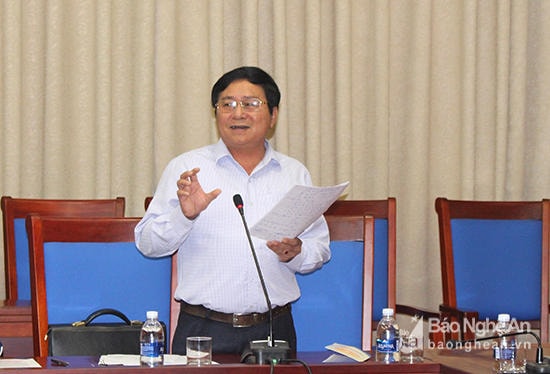 |
| Mr. Ho Mau Thanh - Director of the Department of Culture and Tourism, speaks at the meeting. Photo: Phuoc Anh |
According to estimates of visitor fees, if implemented, the Truong Bon historical site (Do Luong district) could generate over 1.1 billion VND; Hong Son Temple (Vinh City) and Corn Temple (Hoang Mai town) could generate over 1.3 billion VND; and Quang Trung Temple (Vinh City) could generate 950 million VND…
The Director of the Department of Culture and Tourism emphasized that this is a significant source of revenue, creating a foundation for the roadmap towards financial autonomy for public service activities.
Further consideration should be given to charging fees for visiting historical sites.
This was the opinion of representatives from several departments and agencies at the meeting. A representative from the Provincial People's Committee Office stated that collecting fees at scenic spots, museums, and cultural sites is reasonable, but collecting fees at historical sites needs further consideration. “Historical sites are closely linked to the spiritual life of the people; if we implement fee collection now, will it cause public outcry? We need to reassess the feasibility before deciding to collect fees at historical sites.”
Agreeing with this opinion, Mr. Tran Quoc Khanh, Deputy Head of the Provincial Party Committee's Propaganda Department, suggested that perhaps the fee structure should be changed. Instead of an entrance fee, a service fee would be more flexible. He argued that charging an entrance fee might not be appropriate for some sites, such as the Kim Lien Historical Site (Nam Dan).
"Some spiritual sites were built by the people themselves a long time ago. People come here monthly or annually to offer incense and gifts, not to sightsee. How can we determine whether they are locals or tourists in order to collect the correct fees?" - said Mr. Tran Quoc Khanh.
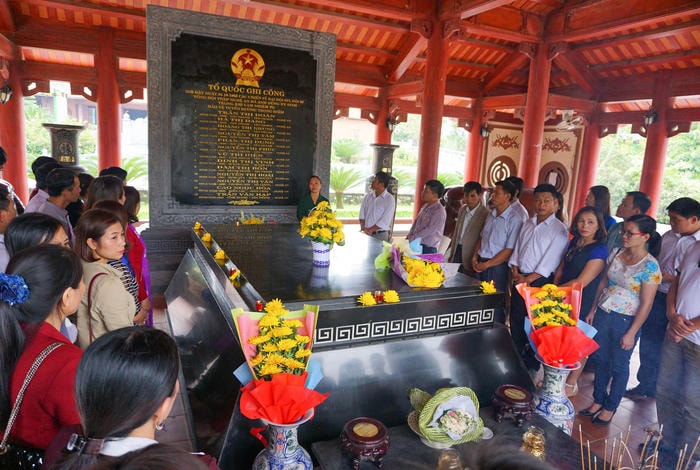 |
| Tourists visiting the Truông Bồn historical site. (Archival photo) |
Many concerns have been raised regarding the management of revenue collection. According to the draft Resolution, the system for collecting, remitting, managing, and using fees is divided into two groups: Units collecting fees for visiting historical sites are allowed to retain 80% of the total fees collected to cover operating costs of providing services, with the remaining 20% remitted to the state budget; Units collecting fees for visiting scenic spots, museums, and cultural works are allowed to retain 90% of the total fees collected to cover operating costs of providing services, with the remaining 10% remitted to the state budget.
Representatives from the Department of Finance and the Department of Justice raised the question: “When drafting this Resolution, the Department of Culture and Tourism must clarify where the 80% and 90% retained by the aforementioned units will be spent? The revenue level and the percentage retained should be based on the practical conditions of each historical site, scenic spot, museum, and cultural work.”
A representative from the Department of Tourism offered a different perspective: “Regarding the fee, some travel agencies believe that 20,000 VND per domestic visitor is too high. The Resolution needs to clearly state what benefits tourists receive when paying the entrance fee, such as guided tours and ceremonies… If it's not clearly stated, it might be misunderstood as just an entrance fee.”
Following diverse opinions from representatives of various departments and agencies, Vice Chairman of the Provincial People's Committee Le Minh Thong requested the Department of Culture and Tourism to fully incorporate and synthesize the feedback to finalize the draft Resolution in accordance with practical realities. For the time being, the collection of entrance fees to historical sites, scenic spots, museums, and cultural works in the province will not be implemented.
Phuoc Anh


