
Some poor communes and districts don't want to escape poverty.
(Baonghean.vn) - This is the situation reported by the Provincial People's Council.indicated through monitoring ofpoverty eradication efforts.
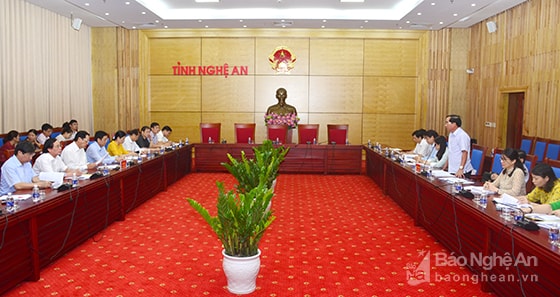 |
| Overview of the working session. Photo: Thanh Duy |
According to the report of the Provincial People's Committee, the province has 3 poor districts that benefit from investment policies under Government Resolution 30a, namely Ky Son, Tuong Duong, and Que Phong, and Quy Chau district, which has a high percentage of poor households, benefits from investment mechanisms under Prime Minister's Decision No. 293.
On the morning of May 15th, a delegation from the Provincial People's Council, led by Mr. Hoang Viet Duong - Vice Chairman of the Provincial People's Council, worked with the Provincial People's Committee to monitor the implementation of the National Target Program for Sustainable Poverty Reduction in Nghe An province from 2012 to 2016. Attending the supervision were members of the Provincial Party Standing Committee: Le Minh Thong - Vice Chairman of the Provincial People's Committee; Le Hong Vinh - Chairman of the Provincial Party Inspection Committee, Head of the Economic and Budget Committee of the Provincial People's Council. |
According to the multidimensional poverty standard for the period 2016-2020, by the end of 2016, the entire province still had 9.55% of households living in poverty, equivalent to 80,168 households; the rate of near-poor households was 10.04%, equivalent to 84,214 households.
The total investment in poverty reduction over the five years (2012-2016) amounted to more than 15,015 billion VND, not including resources contributed by the people themselves. However, the province's poverty rate remains higher than the national average.
One of the shortcomings and limitations in poverty reduction efforts, as pointed out by representatives from the Department of Labor, War Invalids and Social Affairs, is that some poor people still harbor the mindset of not wanting to escape poverty in order to continue receiving government assistance.
While acknowledging this situation, some members of the supervisory delegation argued that such an assessment was still inadequate. Ms. Thai Thi An Chung, Deputy Head of the Legal Affairs Committee of the Provincial People's Council, cited statistics showing that in the past period, only 3 communes and 25 villages in the entire province had escaped from the state of extreme hardship.
“What is the responsibility of state management? Do state management agencies at the commune level, including the district level and even at the village level, truly want to escape poverty?” – Ms. An Chung questioned, suggesting that officials also want their communes and districts to be poor in order to benefit from the poverty alleviation program. Therefore, “the Provincial People's Committee needs to further assess whether the leadership has been truly decisive.”
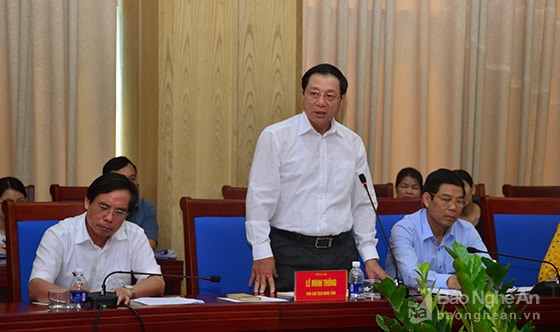 |
| Vice Chairman of the Provincial People's Committee Le Minh Thong speaks at the working session. Photo: Thanh Duy |
The sentiment that not only the people but also villages, communes, and even districts are reluctant to escape poverty has received much agreement. Based on practical monitoring, the Head of the Economic and Budget Committee of the Provincial People's Council, Le Hong Vinh, stated: "In reality, why blame the people when the communes and districts don't want to lose their poverty alleviation program?"
In his explanation, Director of the Department of Labor, War Invalids and Social Affairs Nguyen Bang Toan frankly admitted that in practice, not only individuals but also villages, communes, and districts do not want to escape poverty.
However, according to Mr. Toan, to solve this problem, "it's not just the Department of Labor, War Invalids and Social Affairs that needs to work together, resolutely making accurate assessments and taking responsibility."
To further illustrate, the head of the Department of Labor, War Invalids and Social Affairs of the province also stated that in Ky Son, there are cases where well-off families have their children move their parents to villages and hamlets so that they can qualify as poor households.
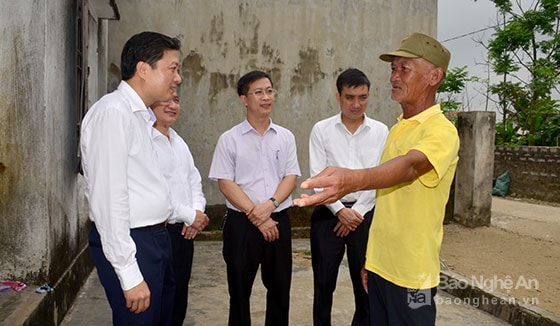 |
| The Provincial People's Council's supervisory delegation held discussions with officials of Yen Thinh hamlet, Dien Kim commune, regarding the implementation of policies for poor households. (Photo: archival material) |
During the monitoring session, issues such as the limited development and replication of economic models, access to policy bank loans for poor households, and the effectiveness of vocational training were raised by the monitoring team and received specific explanations from the relevant agencies of the Provincial People's Committee.
Affirming that poverty eradication is a very important and significant task, Vice Chairman of the Provincial People's Committee Le Minh Thong accepted the opinions of the monitoring delegation and assigned relevant departments to address the issues so that the province's poverty eradication efforts in the 2016-2020 period would be implemented more effectively.
The Vice Chairman of the Provincial People's Committee also requested that relevant departments further clarify the recommendations of the monitoring team in the report, such as: investment attraction, support from businesses for poverty reduction; labor export activities; inspection and supervision in the implementation of poverty alleviation...
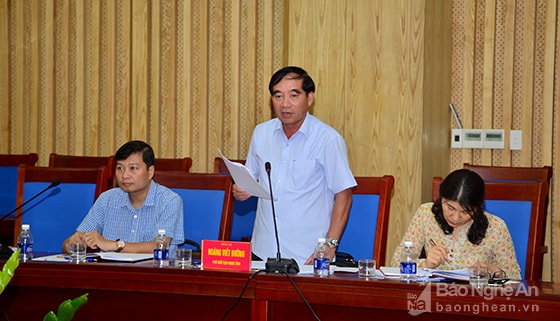 |
| Vice Chairman of the Provincial People's Council Hoang Viet Duong delivers the concluding remarks at the supervision meeting. Photo: Thanh Duy |
Concluding the meeting, Vice Chairman of the Provincial People's Council Hoang Viet Duong acknowledged the achievements of the province's poverty eradication efforts, which have been highly appreciated by the Central Government and various ministries and agencies.
The Vice Chairman of the Provincial People's Council also pointed out existing shortcomings and limitations such as: the high percentage of poor households; the mentality of dependence and reliance is still prevalent. In some areas, the investigation and identification of poor and near-poor households are not objective, and some poor households are overlooked.
In some areas, the number of households falling back into poverty or newly emerging poor households is much higher than the number of households escaping poverty. In many places, the number of poor households receiving health insurance cards is still low; the number of poor households receiving preferential loans in some areas is still low, but there has been no specific guidance or inspection to address the situation; and there is still a mindset of not wanting to escape poverty in order to continue receiving benefits.
"In some places, Party committees and authorities have not truly paid attention to sustainable poverty eradication. Many localities have not included poverty eradication criteria in their emulation campaigns and regular tasks," the Vice Chairman of the Provincial People's Council pointed out.
Based on that, the Vice Chairman of the Provincial People's Council requested the Provincial People's Committee to pay attention to directing the rectification of shortcomings and limitations pointed out by the Provincial People's Council's supervision, and to incorporate the feedback to supplement and finalize the report to be submitted to the Provincial People's Council so that this unit can present the supervision report at the upcoming session of the Provincial People's Council.
Thanh Duy


