
Nghe An police provide guidance on how to prevent online telecommunications scams.
(Baonghean.vn) - To date, there have been 7 cases of fraud and embezzlement of nearly 2 billion VND by a group of individuals impersonating police officers through telecommunications networks. So, how can we prevent falling into the trap of this group of fraudsters?
"After receiving a phone call, I was scammed out of 200 million VND."
Seven victims were scammed out of nearly 2 billion VND.
Following the Nghe An Newspaper's article about the case of Mr. Nguyen Van D. (born in 1947, residing in Hung Dung ward, Vinh City) being scammed by a group of individuals impersonating police officers via telecommunications, many readers reported having received similar calls.
Ms. Tran Thi Mai, an office worker at an agency in Vinh City, said: "Someone claiming to be a telecommunications employee called my office landline and informed me that I owed over 8 million VND in phone bills. They even instructed me to press a key to get more specific information, but I suspected it was a scam, so I hung up."
 |
| Mr. Nguyen Van D. (residing in Hung Dung ward, Vinh City) is still in shock as he recounts being scammed out of 200 million VND. Photo: PB |
Although this type of scam has only recently appeared in Nghe An, many victims have fallen into the trap. On August 20th, Mr. Nguyen Thanh H. (born in 1958, residing in Block 11, Ha Huy Tap Ward, Vinh City) was home alone when his landline phone rang.
Using similar methods to those used with Mr. D. in Hung Dung ward, the above individuals defrauded Mr. H. of 400 million VND. Similarly, Mr. Nguyen Thiet D. (born in 1960, residing in An Vinh block, Hung Phuc ward, Vinh City) was also scammed by the same group, losing 236 million VND.
According to Major Ha Huy Duc, Head of the High-Tech Crime Investigation Team, Criminal Police Department (Nghe An Provincial Police), from August 16th to August 25th, seven fraud cases occurred in Nghe An province, causing losses of nearly 2 billion VND. The common tactic of these perpetrators was to initially impersonate telecommunications employees, calling landline numbers to demand payment of large outstanding phone bills due to numerous international calls. Then, another perpetrator, posing as a police officer, informed the victims that their ID card number had been used to open a bank account for drug trafficking and money laundering. This "police officer" then requested the victims' cooperation in providing necessary information.
This person demanded that the victim transfer all the money in their bank accounts and savings to their account to verify whether the money was related to drug trafficking and money laundering. They demanded that the victim keep it a secret, otherwise "the criminals will eliminate them," or "they will be arrested immediately." Once the victim transferred the money to these accounts, they quickly withdrew it all to embezzle the funds.
According to Major Duc, these perpetrators target female or elderly victims who are often home alone. To gain the victims' trust, they use Voice over Internet Protocol (VoIP) to spoof phone numbers that resemble those of police agencies, such as +000113; +084000113. They create numerous accounts at various banks for the victims to send money to.
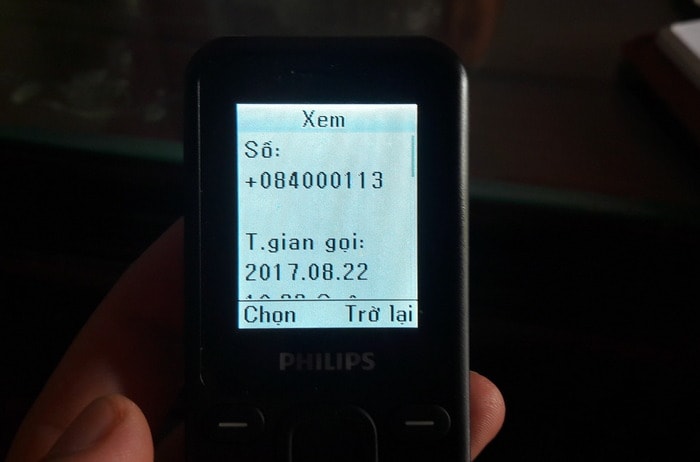 |
| The phone number that called Mr. D.'s mobile phone. Photo: PB |
How to prevent it?
As mentioned above, this is a new form of fraud that has emerged in Nghe An province but has caused significant losses to the people. In response to this situation, the Nghe An Provincial Police have issued a document to local police departments and agencies directing them to prevent and combat fraud and property appropriation crimes using this new method.
According to the head of the Criminal Police Department, it is predicted that in the coming time, if preventive and combat measures are not taken, this type of crime will continue to increase and become more complex, causing anxiety and concern among the public and affecting the security and order situation in the area.
Besides strengthening the dissemination of information about scams and fraudulent schemes through Party committees, government agencies, and mass organizations, people themselves need to know how to protect themselves. According to Major Duc, when people receive suspicious calls from unknown numbers, they should remain calm, not comply with requests or press any numbers on their phones. In particular, they should not transfer money to accounts as requested by strangers.
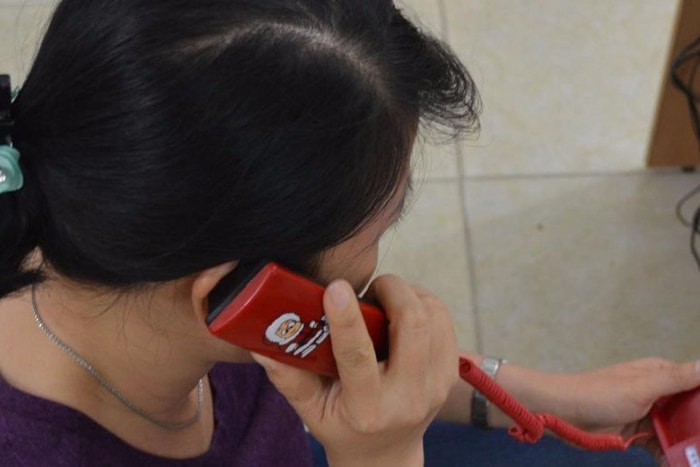 |
| People should not provide their bank account or credit card numbers to others. In particular, they should not transfer money to accounts at the request of strangers. (Photo: PB) |
People should also be wary of strange calls and should not provide their account or credit card information to others. If such a situation arises, they should immediately notify the police for coordinated action; they should not try to handle it themselves as this could easily lead them into a scam.
For bank tellers and staff, when they notice customers withdrawing or depositing money exhibiting unusual behavior (anxiety, panic, constantly holding their phones and listening to instructions), they must promptly notify the police, delay the transaction until the police arrive to handle the situation, and minimize potential losses.
The head of the Criminal Police Department of the Provincial Public Security said: This is a very sophisticated and professional form of fraud. After receiving reports from citizens, the unit is actively investigating and clarifying the cases to quickly apprehend the fraudsters. However, the most important issue is that people must be vigilant and protect their property against the increasingly sophisticated fraud schemes that are appearing today.
Pham Bang
| RELATED NEWS |
|---|


