
Exam questions and answers for the Literature subject in the 10th grade entrance exam in Binh Duong province in 2025.
The answer key for the 10th grade entrance exam in Literature for the 2025-2026 school year, organized by the Binh Duong Department of Education and Training, will help students easily compare their answers with the provided paper, thereby conveniently and accurately estimating their scores.
The entrance exam for 10th grade in public high schools in Binh Duong this year took place over two days, May 28th and 29th, 2025, with three main subjects: Literature, Mathematics, and English.
In addition, candidates applying to Hung Vuong Specialized High School will continue to take specialized subject exams on May 30th and 31st, 2025.
Please refer to the detailed answer key below to check your Literature exam results.
Binh Duong Province 2025 Grade 10 Entrance Exam - Literature
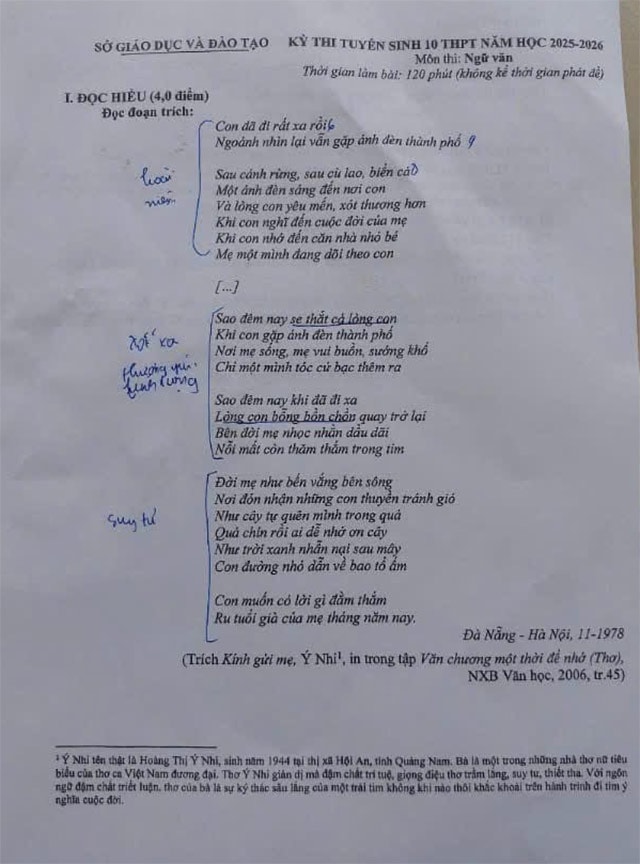
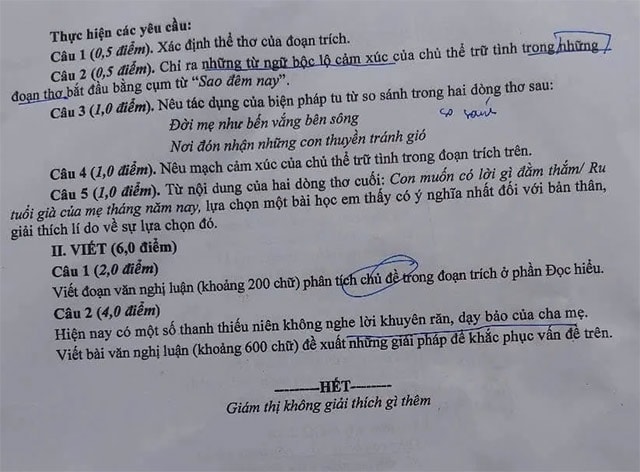
Answer key for the 10th grade entrance exam in Literature in Binh Duong province, 2025-2026.
I. READING COMPREHENSION (4.0 points)
Question 1 (0.5 points). Identify the poetic form of the excerpt.
- Free verse
Question 2 (0.5 points). Identify the words that reveal the emotions of the lyrical subject in the stanzas beginning with the phrase "What a star tonight."
The words that reveal the lyrical subject's emotions are: "My heart aches, my heart suddenly feels restless."
Question 3 (1.0 point). State the effect of the simile in the following two lines of poetry:
Figurative language: "Mother's life" is likened to "a deserted harbor".
Effects:
- It helps make the poem more vivid and engaging.
- It symbolizes a mother as a peaceful haven, a place where a child can return after the hardships and difficulties of life. Being with their mother brings peace and renewed strength.
- This expresses the gratitude and love the child has for their mother.
Question 4 (1.0 point): State the emotional flow of the lyrical subject in the above excerpt.
It all started with a longing for home and my mother while living in the city.
My thoughts become deeper and more poignant as night falls, reflecting on my childhood and my mother's sacrifices.
It concludes with gratitude, appreciation, and a desire to repay mother's kindness.
Question 5 (1.0 point): From the content of the last two lines of the poem, choose the lesson that you find most meaningful to yourself and explain why.
"I want to say something sweet."
"A lullaby for my mother's old age this May."
Lesson suggestion: Appreciate and repay your parents' kindness while you still can.
Explain:
My mother sacrificed her whole life for me, and even in her old age, she silently loves and watches over me.
Children should show gratitude and affection through practical actions and sincere words to bring joy to their parents in their old age.
This lesson awakens the love and responsibility of children towards their parents – the most meaningful thing in life.
PART II. WRITING (6.0 points)
Question 1. (2.0 points)
(1) Opening paragraph:
Introduction to the argumentative topic: a general introduction to the relationship between mother and child in life, the circumstances the author is experiencing, a brief overview of the emotions in the work...
(2) Body paragraph:
- The image of the mother emerges in the child's mind: Love, compassion, and longing well up when thinking about "mother's life," "the small house."
+ The mother silently waited, sacrificing.
A mother lives for her children without expecting anything in return.
+ A mother is forgiving, persistent, and silently protective.
=> Through the child's memories, the image of the mother emerges as one of sacrifice, hard work, and loneliness.
- Appreciating and understanding a mother's silent sacrifice: a mother is a haven of peace for her child to return to, a mother doesn't need anything in return, she only needs her child,...
- The aspiration to repay the immeasurable debt of gratitude to one's mother:
Awakening, genuine gratitude
+ Expressing a desire to make up for lost time, love, and care for her mother in her old age.
(3) Conclusion:
In summary, the essay should cover the following points: lessons learned, personal feelings about motherly love, etc.
Question 2. (4.0 points)
(1) Introduction
- State the argumentative issue: Solutions to address the problem of children increasingly disobeying advice, rebelling, or being indifferent to guidance and discipline.
(2) Body
- Nowadays, children don't always heed their parents' admonitions and teachings; instead, they become resentful, even rebellious, and act contrary to what their parents teach.
- The cause of the problem
+ From the children's perspective: Adolescent psychology, a desire to express their individuality and assert themselves. Influenced by the external environment, social media, and friends.
+ From the parents' side: Authoritarian parenting style, lack of listening and dialogue. Generation gap, differences in mindset, lack of understanding of children's psychology. Lack of time to care for and accompany their children.
- If students do not listen to their parents' teachings:
+ Prone to making mistakes in studies, lifestyle, and behavior.
+ Loss of direction, loss of moral values.
+ Family relationships become strained, creating distance and misunderstandings among family members.
- Propose solutions to overcome the problem.
+ From the parents' perspective:
Changing the approach to education: From imposition to companionship, sharing, and understanding.
Spend more time with your children, create an environment for conversation and exchange to understand them better.
Listen to and respect your child's opinions so they feel trusted.
From the children's perspective:
Understand and appreciate the sacrifices and love of your parents.
Listen to advice with an open mind, and selectively apply what is appropriate.
Gratitude and filial piety are fundamental to personal growth.
+ In addition, schools need to organize life skills education programs, teach communication skills within the family, and promote and guide the preservation of traditional values in the modern era...
Students should provide illustrative examples that are relevant to the topic, prioritizing examples of real people and real events.
(3) Conclusion: Summarizing the argumentative issue


