
Meet in our shared hometown.
(Baonghean) - The same path under the solemn shade of the mahogany trees led me home. The ponds of Chua Village and Sen Village began to glow with the vibrant pink of lotus flowers. Along the road, the gentle sound of singing could be heard: "In his childhood, Uncle Ho traveled the entire length of the ferry boat / In his childhood, Uncle Ho lived the entire breadth of folk songs..." (Listening to the Ferry Boat Song at Night, Remembering Uncle Ho - An Thuyen).
That's right, the simple people of Uncle Ho's hometown welcomed guests right from the beginning of the village with such a simple melody...
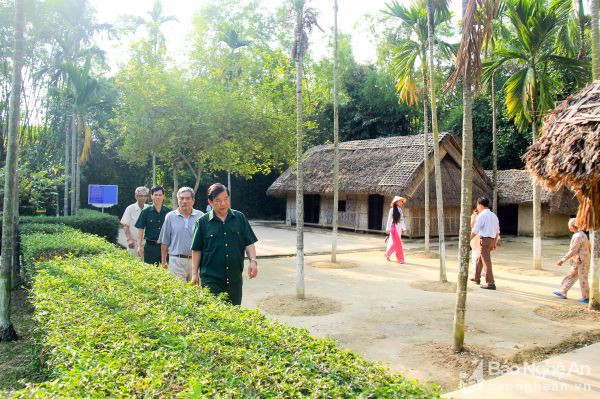 |
| Veterans visit President Ho Chi Minh's hometown. Photo: Nguyen Sach. |
How many times have I returned here, standing under the shade of these bamboo trees, admiring their straight, resilient branches, yet also possessing a soft, swaying quality; and their dense, tightly interwoven structure, firmly rooted in the fertile soil of the village. Thus, they form ramparts and embankments. How many times have I stood by the edge of this pond and well? The pond, like a silent, deep mirror, frames countless memories and emotions. And every May, the lotus blossoms, their fragrance permeating the fields and rice paddies. This scent leads the way to the neatly arranged, golden-threaded banks of the pond.
The wells, the village wells, awaken the sky, drawing in the cool, refreshing air of summer and evaporating the warmth of winter. How many times have my footsteps trod along these small paths, sometimes winding, sometimes straight, curving but not overly complicated? The roads, like the hearts of people, always open, revealing the vibrant freshness of countless houses and hamlets. The village gate, like an eye, holds the gentle slumber of a summer afternoon, and the warm breath of spring carried by the festive season of the Lunar New Year...
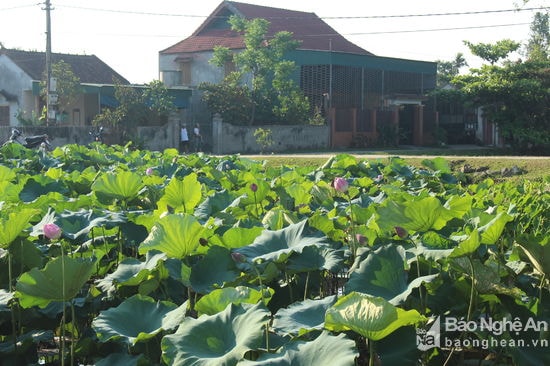 |
| A view of Hoang Tru village, President Ho Chi Minh's maternal hometown. Photo: Dao Tuan |
Yet, I am still overwhelmed by the sacred peace. Still overwhelmed by the countless stories I have heard and the many people I have met in this place.
As a resident of Chua village, after many years of raising fish in his pond, he decided to give up fish farming and cultivate lotus. He said that a few years ago, when people in President Ho Chi Minh's hometown heard about the lotus planting project, everyone supported it. Although raising fish brings in more income than growing lotus, he chose to plant lotus to beautify the landscape of President Ho Chi Minh's hometown, to help people everywhere understand why this land is called Kim Lien. He considered it a way to do something for his hometown.
She was a fruit vendor right by the small road. She waved me over to buy some guavas she'd just picked from her garden, but then insisted on not taking any money because she knew I was looking for a family of folk singers. She left her goods behind and led me to the house of Mr. Tư and Mrs. Út. Then, right there on the low table in Mrs. Út's house, she joined in singing, her voice trembling with the voices of the elderly couple, both in their 90s, saying: "The most joyful place is Kim Liên / The scenery is beautiful, and the people are like fairies..."
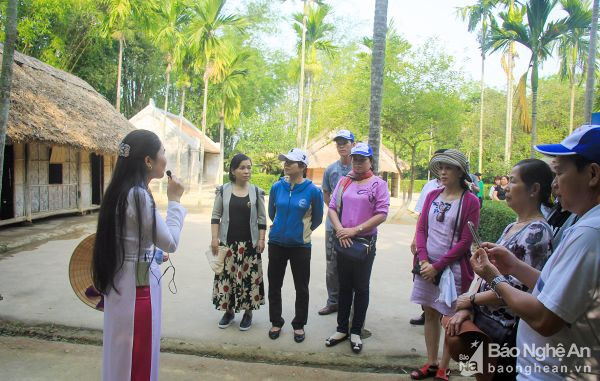 |
| Visitors from all over the world come to visit President Ho Chi Minh's hometown. Photo: Nguyen Sach. |
As a tour guide who has been telling stories about President Ho Chi Minh for 25 years, still wearing her simple ao dai (traditional Vietnamese dress), beads of sweat glisten on her face, reflecting deep emotion. Tour guide Bui Bich Dam recounts that she sheds tears every day, not only during her own stories but also when she witnesses the emotional reactions of visitors coming to President Ho Chi Minh's birthplace. She remembers most vividly a visitor from Hai Duong province, who arrived with a worn-out backpack and a provincial military officer from Quang Tri province on a May morning in 2005. The visitor arrived early and lingered for a long time. When asked about his visit, he said: "I came to visit President Ho Chi Minh's birthplace on behalf of my son. During the war, while marching south, my son had the opportunity to visit President Ho Chi Minh's birthplace."
On the battlefield, he wrote letters home telling his parents about the honor, and also expressing his wish that when peace was restored, upon returning from the South, he would visit Uncle Ho's hometown once more. But then he sacrificed his life. Today, I have come to bring my son's remains back, fulfilling his wish at the same time.” Ms. Dam also had the opportunity to meet the woman who made a solo journey on foot from Nha Rong Wharf to visit Uncle Ho's hometown. She witnessed severely wounded soldiers pushing their wheelchairs, wounded soldiers and disabled people who had lost their sight, but still wanted to personally offer fresh flowers in Uncle Ho's house, and to be beside the hammock where Uncle Ho slept in his childhood.
It is the visitors who come here every day who teach her more about Uncle Ho. More about the love and admiration for him. More about his greatness. More about and love for the sacred work she undertakes.
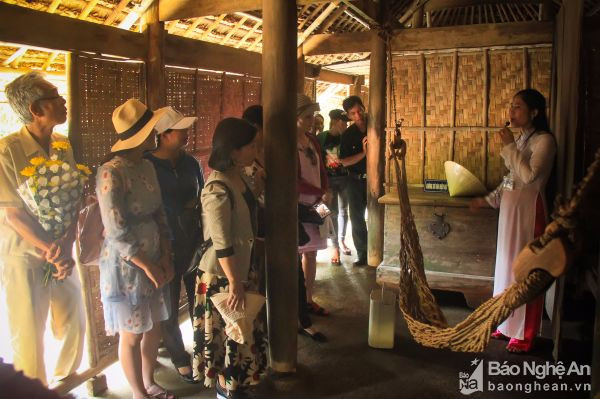 |
| Visitors listen to explanations about President Ho Chi Minh's relics. Photo: Nguyen Sach. |
We met four veterans, four wounded soldiers: Bui Huu Huynh, Dao Manh Hung, Pham Duy Ton, and Nguyen Duy Khoat, currently living in Ho Chi Minh City and Vung Tau. They are all from the North, one from Hai Phong, the other from Nam Dinh. All four were former comrades, serving in the same unit, soldiers of the Dong Thap 1 Regiment. Approaching 70 years old, this was the first time all four of these soldiers of Uncle Ho had visited President Ho's hometown, fulfilling a long-held dream. They rented a bus together, sitting side-by-side like they did during their time in the same trenches, to travel from Ho Chi Minh City to President Ho's birthplace.
They touched the fence, touched the bamboo screen, as if wanting to absorb all the beauty of his homeland into themselves, to return and continue living with happiness and serenity. They shared that: In their youth, following his words, they volunteered to fight and defeat the enemy, and then, following his words, stayed to rebuild their homeland in the South, accepting the South as their home. It was these moments of turning towards him that helped them overcome the most difficult periods in the war and in their lives afterward...
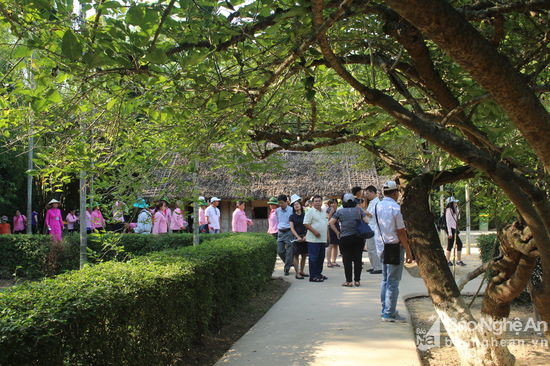 |
| Tourists visit President Ho Chi Minh's maternal hometown. Photo: Dao Tuan |
Like many others, I came to that countryside not only to visit the place where our President Ho Chi Minh was born and raised, but also to feel a connection to my roots. More than any other place, it binds people together, making them feel an invisible, soft yet strong thread connecting them and others, and they are ready to integrate, to love, and to move forward.
Thuy Vinh
| RELATED NEWS |
|---|


