
Ha Huy Tap - A staunch and unwavering communist
(Baonghean.vn) -General Secretary Ha Huy Tap belonged to the first generation of communists, a core member of the Party. Although his revolutionary activities were not long, Ha Huy Tap lived a vibrant and glorious revolutionary life; dedicating his entire life to the revolutionary cause of the Party and the nation; leaving the Party with valuable lessons in both theory and practice of revolutionary activities.
I. Brief Biography
 |
| General Secretary Ha Huy Tap (1906-2016) |
Comrade Ha Huy Tap was born on April 24, 1906, into a patriotic scholarly family in Kim Nac village, Tho Ngoa commune, now Cam Hung commune, Cam Xuyen district, Ha Tinh province. His father, Mr. Ha Huy Tuong, was a successful scholar but did not pursue an official career; instead, he stayed in his hometown teaching and practicing traditional medicine to help people.
His mother was Mrs. Nguyen Thi Loc, a simple, hardworking farmer who loved her husband and devoted her entire life to the countryside. Mr. Ha Huy Tuong and Mrs. Nguyen Thi Loc had five children, and Ha Huy Tap was the third child in the family.
Initially, Ha Huy Tap was taught Chinese at home by his father. Later, he went to school and passed the elementary school graduation exam in Tho Ngoa district with top marks, but due to difficult family circumstances, he could not continue his education. From September 1917, with the help of others, Ha Huy Tap was able to attend the French-Vietnamese Elementary School in Ha Tinh province. In 1919, Ha Huy Tap passed the top-scoring exam for outstanding students organized by the school, received a scholarship, and then entered Hue National School.
In 1923, he graduated with honors from Hue National School, but due to lack of resources for further education, he returned to work as a teacher at the French-Vietnamese Primary School in Nha Trang (Khanh Hoa). During this time, Comrade Ha Huy Tap came into contact with and read many documents, gaining a deeper understanding of the crimes of French colonialism and the impoverished lives of the working people in Vietnam and Indochina.
In August 1926, Comrade Ha Huy Tap transferred to teach at Cao Xuan Duc School in Vinh, Nghe An; he actively participated in the Phuc Viet Society (later renamed Hung Nam Society), actively propagating anti-authoritarian and anti-French colonial ideas among students and the working class. In March 1927, he began teaching at a primary school in Gia Dinh, then went to Ba Ria to work as a laborer, establishing a Party branch, a reading society, and organizing literacy classes for workers.
Initially, Ha Huy Tap was taught Chinese at home by his father. Later, he went to school and passed the elementary school graduation exam in Tho Ngoa district with top marks, but due to difficult family circumstances, he could not continue his education. From September 1917, with the help of others, Ha Huy Tap was able to attend the French-Vietnamese Elementary School in Ha Tinh province. In 1919, Ha Huy Tap passed the top-scoring exam for outstanding students organized by the school, received a scholarship, and then entered Hue National School.
In 1923, he graduated with honors from Hue National School, but due to lack of resources for further education, he returned to work as a teacher at the French-Vietnamese Primary School in Nha Trang (Khanh Hoa). During this time, Comrade Ha Huy Tap came into contact with and read many documents, gaining a deeper understanding of the crimes of French colonialism and the impoverished lives of the working people in Vietnam and Indochina. Comrade Ha Huy Tap was born on April 24, 1906, into a patriotic scholarly family in Kim Nac village, Tho Ngoa commune, now Cam Hung commune, Cam Xuyen district, Ha Tinh province.
His father was Mr. Ha Huy Tuong, who passed the imperial examinations but did not pursue an official career, instead staying in his hometown to teach and practice traditional medicine. His mother was Mrs. Nguyen Thi Loc, a simple, honest farmer who loved her husband and worked hard to raise her children, dedicating her entire life to the countryside. Mr. Ha Huy Tuong and Mrs. Nguyen Thi Loc had five children, and Ha Huy Tap was the third child in the family.
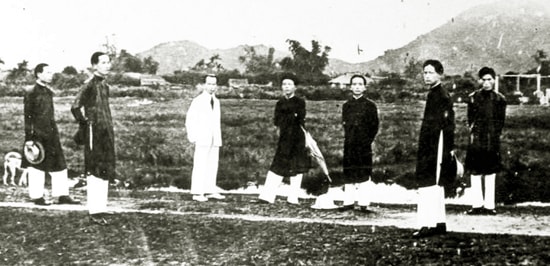 |
| Teacher Ha Huy Tap and his students in Khanh Hoa (Archive photo) |
From July 1936 to March 1938, Comrade Ha Huy Tap's revolutionary activities took place in his capacity as General Secretary of the Party. Following the 3rd Conference (1st term) of the Central Executive Committee of the Party in March 1938, he relinquished the position of General Secretary, but continued to participate in the Central Standing Committee. At the end of December 1928, Ha Huy Tap, along with several other comrades, was sent to Guangzhou (China) to discuss the merger of the Tan Viet Revolutionary Party with the Vietnam Revolutionary Youth Association.
From July 1929 to April 1932, he was sent to study at the University of the East in Moscow (formerly the Soviet Union). Around June 1933, Comrade Ha Huy Tap returned to China to engage in revolutionary activities, participating in the Overseas Command Committee of the Indochinese Communist Party; he also oversaw the preparation and organization of the Party's First Congress.
On May 1, 1938, while on a mission, General Secretary Ha Huy Tap was captured by the enemy and later imprisoned in Saigon and Nghe An. On August 28, 1941, the French colonialists executed Comrade Ha Huy Tap. He bravely sacrificed his life at the age of 35, leaving behind an example of unwavering loyalty and indomitable spirit, dedicating his entire life to the revolutionary cause of our Party and nation.
Peace
| RELATED NEWS |
|---|


