
Are primary school students in other countries safe when they go to school?
(Baonghean.vn) - In Japan, children go to school alone without parental assistance. However, the incident of a Vietnamese girl being murdered on her way to school in this country has caused widespread concern. So, what about elementary school students?in other countriesWhat means of transportation do you use to get to school, and is it safe?
"Mysterious messages circulated online after Vietnamese girl goes missing in Japan."
"Cause of death of 10-year-old Vietnamese girl in Japan"
1.Singapore
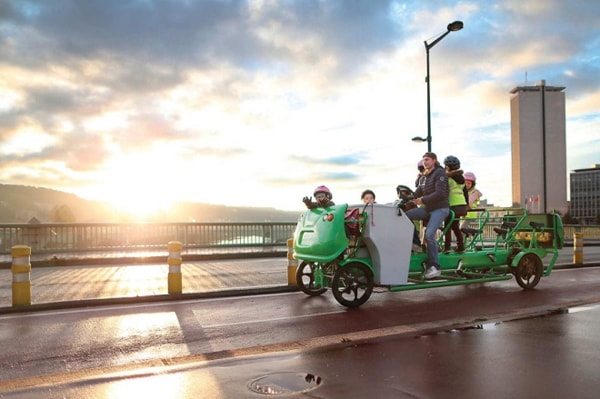 |
| The Singapore School Transport Association is implementing a smart bus system. Parents will be notified 10 minutes before the bus arrives home, when the children arrive home, and when they arrive at school. The system is automated, and drivers will follow routes based on the data. |
2.Caracas,Venezuela
 |
| In San Agustín, a slum on the eastern hills of Caracas, students get to school by cable car. The Caracas Metrocable system, built in 2010, shortens the distance to school for students. In addition, it helps them avoid violent gangs that may roam the streets. |
3. Netherlands
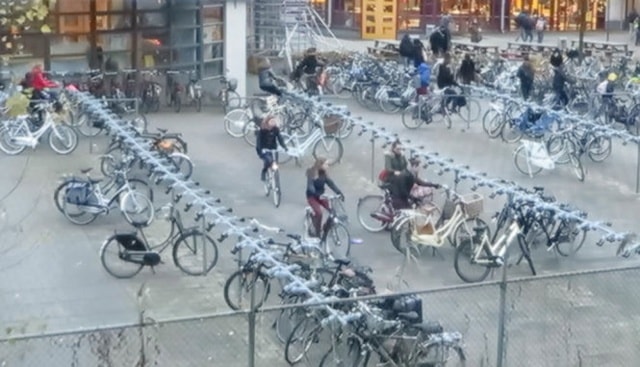 |
| In the Netherlands, the primary mode of transportation for students to school is bicycles. Two-thirds of Dutch primary school students walk or cycle to school. One of the main reasons Dutch students are comfortable cycling or walking to school is that the school is close to home. Approximately 50% of Dutch students have a school less than 5km from their home, and 38% have a school less than 15km from their home. In total, over 90% of Dutch students have a suitable distance from school to home for cycling. |
4.BangkokThailand
 |
| Motorcycles are very common in Bangkok (Thailand), but they are also very dangerous. Students in Thailand ride on the back of motorcycles driven to school by their parents. An estimated 1.3 million children regularly use this mode of transportation to get to school, but only 7% wear helmets. 2,600 children die and 72,000 are injured each year due to accidents. Despite this, motorcycles remain a popular and inexpensive way to get to school. |
5.America
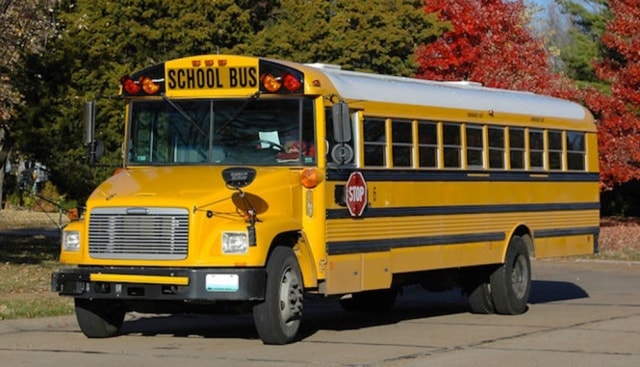 |
| In the United States, the primary mode of transportation for students to school is the bus. These yellow school buses have become iconic in America. Each year, a student spends approximately $500 on bus fares to school, and only Pennsylvania offers free bus travel for students. |
6.Ahmedabad,India
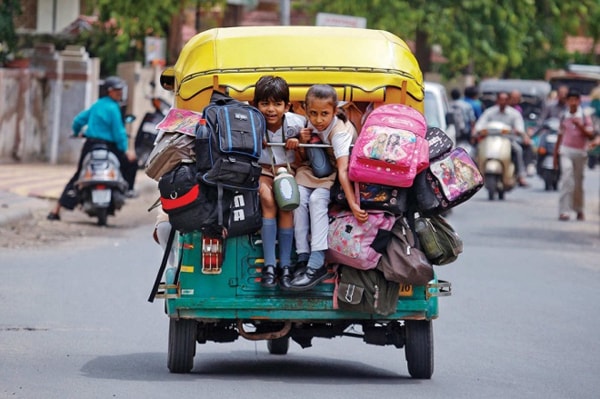 |
| The bus shortage is alarming in Ahmedabad, India. Children wanting to go to school are crammed onto overcrowded three-wheeled vehicles (called auto-richshaws), carrying 10-12 students at a time. Although this mode of transport violates local safety laws, police in some cities have argued that banning rickshaws would cause students to arrive at school late. |
7. Sichuan, China
 |
| All the aforementioned means of transportation pale in comparison to the students in the mountainous rural areas of Sichuan Province, China. They line up one another to climb a sheer cliff face using an old, rickety bamboo ladder with 2,625 steps. |
8. Pokhara, Nepal
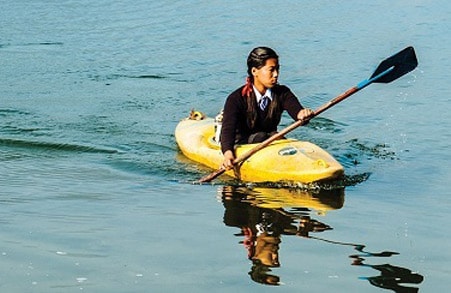 |
| A schoolgirl in Pokhara is kayaking to school, already neatly dressed in her uniform. |
9. Trinidad, Cuba
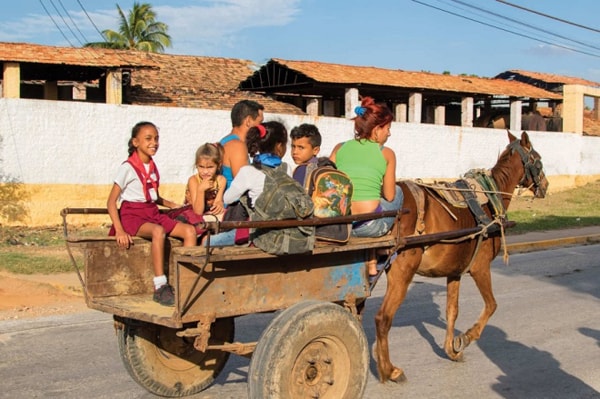 |
| In Trinidad, Cuba, students climb onto horse-drawn carts and are pulled to school every morning. |
10. Sweden
 |
| In Sweden, almost all primary school students walk to school because the nearest primary school is no more than 2km from their home. If the distance is greater, the government has regulations regarding transportation costs. |
Kim Ngoc
(Synthetic)
| RELATED NEWS |
|---|


