
Export turnover: Textiles and wood chips continue to surge.
(Baonghean) - In the first 10 months of 2015, 195 businesses in the province participated in import and export activities. Of these, exports in October are estimated to have increased by approximately 46.5 million USD, bringing the total export value for the first 10 months to 368 million USD, a 14.3% increase compared to the same period last year...
Textiles and wood chips continue to lead the market.
Among the many businesses involved in export activities, 51 businesses achieved export turnover of 1 million USD or more, and 21 businesses achieved turnover of 3 million USD or more. Several businesses achieved significant export turnover, such as Thanh Thanh Dat Co., Ltd., leading primarily in wood chips; Prex Vinh Co., Ltd., mainly producing processed clothing; BSE Vietnam Electronics Co., Ltd., primarily in mobile phone speakers; and the Economic Cooperation Corporation and Nghe An Import-Export Joint Stock Company, both specializing in cassava starch.
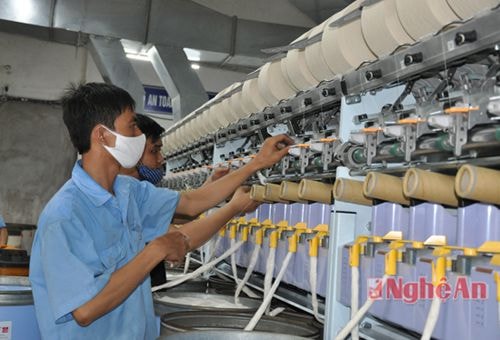 |
| Manufactured by Hoang Thi Loan Textile and Garment Joint Stock Company. |
Businesses in the province have exported over 30 product categories (product groups) to overseas markets. Textiles and garments continued to lead in export value over the first 10 months with $75.73 million, a 30% increase compared to the same period last year, accounting for 21.1% of the province's total export value. Eight businesses participated in this export sector, with Prex Vinh Co., Ltd. achieving the highest export value at over $30 million. Mr. Tran Duc Long, Chief Accountant of the company, stated that the goods were exported to many countries including South Korea, China, Japan, the United States, and Germany. Currently, the company is focusing on fulfilling orders for sportswear to be exported to South Korea at the end of November.
Nghe An's wood chip exports reached over 500,000 tons, generating $68.43 million in revenue, a 28% increase in volume and a 33% increase in value compared to the same period in 2014. Currently, Nghe An's wood chips are mainly exported to the Chinese market, with two participating enterprises: Thanh Thanh Dat Co., Ltd. (worth $60 million) and the Joint Venture Company for Planting and Processing Paper Raw Materials (worth over $9 million). For cassava and cassava starch – one of the traditional export items of enterprises in the province – exports from the beginning of the year to date reached 792,000 tons, with a value of $42.1 million, a 6.8% increase compared to the same period in 2014. The majority of exports went to the Chinese market, with eight participating enterprises, of which the Import-Export Joint Stock Company had the largest export value, exceeding $11 million.
Agricultural products are still facing difficulties.
The biggest challenge currently is the export of agricultural and aquatic products. Despite its potential, Nghe An's export turnover is fragmented, unsustainable, and to date, no strong solution has been implemented to boost this product sector; there is also a lack of close coordination between production, processing, and the market. According to data compiled by the Department of Industry and Trade, in 2013, the export turnover of aquatic products reached 22 million USD. In 2014, this item's turnover decreased sharply, reaching only 10 million USD. In the first 10 months of 2015, the export turnover of aquatic products in the province reached over 13 million USD, of which Xuri Viet Trung Seafood Processing Company Limited accounted for nearly 13 million USD, with the remainder handled by Phuong Mai Enterprise (Hoang Mai Town).
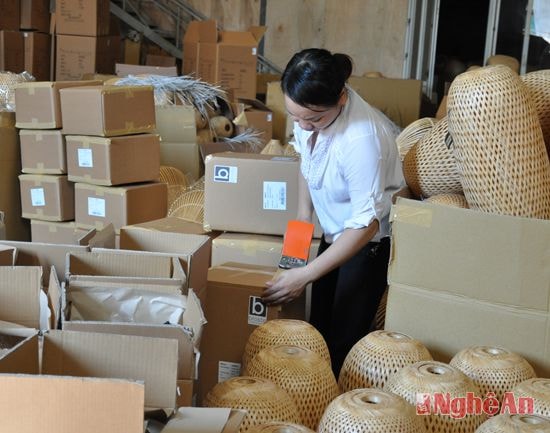 |
| Packaging goods for export at Duc Phong Co., Ltd. (Vinh City). |
Mr. Le Thai, Director of Xuri Viet Trung Seafood Processing Company Limited, said that since September, following fluctuations in the Chinese Yuan exchange rate, prices have improved to 1,800 USD/ton CIF, with higher prices expected in November. However, the current difficulty is the shortage of raw materials, requiring procurement from Ha Tinh, Quang Binh, Thanh Hoa, etc., but still not enough to meet orders. Furthermore, Mr. Thai frankly admitted that the province's seafood products are currently dependent on the Chinese market and have not yet been exported to EU, US, or Japanese markets. These markets have strict requirements regarding chemical residue control, food safety and hygiene, and preservation techniques, while seafood businesses are mostly small enterprises with weak production, processing, and preservation equipment.
For handicrafts – a product where Nghe An has potential in terms of raw materials and labor – it is currently facing difficulties, with low export turnover. Small business scale and weak competitiveness are challenges for many local handicraft enterprises. Meanwhile, the workforce in the rattan and bamboo weaving industry is shrinking, facing competition from other sectors. Many rural women who previously worked in rattan and bamboo weaving have now switched to working in garment factories. There are few young workers, mainly middle-aged people; raw materials are becoming depleted due to overexploitation without corresponding regeneration. Processing technology is outdated, mainly manual, and expensive, making it difficult to compete. Only a few businesses have imported some simple machinery from China, such as bamboo pressing and winding machines.
Ms. Vo Thi An, Deputy Director of the Department of Industry and Trade, said that this year, the export turnover target is 550 million USD. From now until the end of the year, export activities will face many challenges due to the decrease in prices of many agricultural and mineral products. Meanwhile, we still have to import many raw materials and fuels to serve production and export, making us very passive and dependent on external fluctuations... In the coming time, export growth will mainly be in product groups produced by FDI enterprises, goods that rely on cheap labor and rough processing rather than high value-added goods such as textiles and wood chips. To achieve the export turnover target this year, it is necessary to focus on rapidly increasing the proportion of export value of agricultural products, while minimizing the export of raw materials, increasing the content of processed products, and creating conditions for businesses to build raw material areas to meet production needs and serve exports...
Thu Huyen
| In the first nine months of 2015, businesses exported goods to 61 countries/regions worldwide, with China being the largest market at US$137.42 million, accounting for 42.7% of total merchandise exports. Other notable markets included: South Korea (US$36.48 million, 11.3%); Laos (US$33.7 million, 10.5%); India (US$26.87 million, 8.4%); and the United States (US$17.17 million, 5.3%). |
| RELATED NEWS |
|---|


