Troubled by informal lending schemes.
(Baonghean) - In just the last few years, numerous large and small informal lending schemes have collapsed in Do Luong district, with the total estimated amount reaching hundreds of billions of dong. Because of these schemes, abandoned villas have been left vacant as owners flee to avoid debt, and conflicts between people in the same neighborhood occur constantly, disrupting rural life.
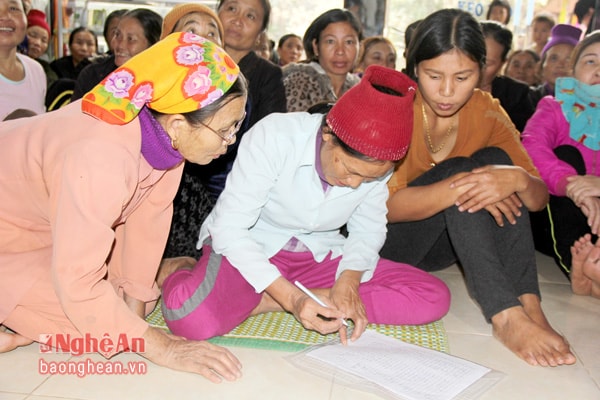 |
| Members of the informal lending group gathered at Mr. Viet's house to sign a lawsuit against Ms. Nhung. |
The village is in ruins.
In mid-November, the spacious house, which also serves as a clothing and household goods shop in the center of Tru Son commune (Do Luong district), belonging to Ms. Nguyen Thi Hong (49 years old), was crowded with people. Ms. Hong and her husband run a rotating savings and credit association (ROSCA) with nearly 120 members from four communes: Tru Son, Dai Son, My Son, and Hien Son. Today, the members came to the ROSCA's house to sign a petition suing Ms. Nguyen Thi Nhung (37 years old, from Dai Son commune) for causing the ROSCA collapse.
According to the ward head, more than a year ago, Ms. Nhung applied to join the ward and was accepted by the members. Initially, Ms. Nhung paid the ward fees in full. However, in August of this year, after drawing over 2 billion VND from the ward, Ms. Nhung withdrew. "When other households came to draw, Ms. Nhung refused to pay her debt."
"Excluding the amount previously paid to the ward on a regular basis, the amount that Ms. Nhung has embezzled from the members is over 1.2 billion VND," the ward leader said, adding that the members had held meetings many times and agreed to go to her house to demand the money, but Ms. Nhung deliberately refused to pay and even challenged them. Furthermore, her family members even assaulted and threatened them with sticks.
This is the third time in the past year that the informal lending group run by Ms. Hong has collapsed. The total amount of money lost in these three instances exceeds 7 billion VND. “There have been many other cases, but most of the debtors asked for extensions. Seeing their difficulties, their trusting attitude, and the fact that they were genuinely bankrupt, the members of the group didn't demand payment immediately. However, cases like Ms. Nhung's, where people took money from the group and then lent it out at exorbitant interest rates, built houses, or bought land, are unacceptable.”
"If there are no sanctions to deal with these cases, the consequences will be enormous. There will be bloodshed," said Mr. Nguyen Thuy Tam (65 years old, Hamlet 10, Tru Son Commune), and suggested that authorities should suspend Ms. Nhung's transactions to prevent her from disposing of assets. More than two years ago, Mr. Tam's family saved money each month to pay into the ward. He has paid over 200 million VND so far, but the ward collapsed before he could claim his share.
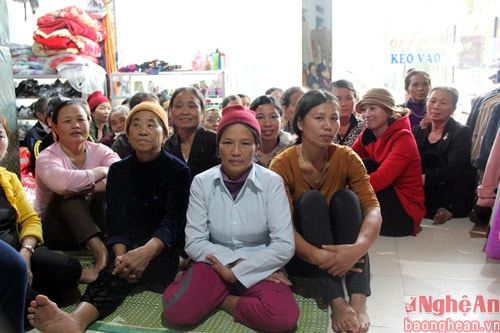 |
| The informal lending group run by Ms. Hong has nearly 120 members from 4 communes participating. |
While not losing as much money as Mr. Tam, over 40 million VND is a fortune for the family of Ms. Nguyen Thi Long (44 years old, Tru Son commune). The couple only owns a few small plots of land, and they work tirelessly year-round just to make ends meet. Meanwhile, their son suffers from epilepsy and requires a large sum of money for treatment. Unsure where to find the money, Ms. Long decided to borrow 7 million VND each month to participate in a rotating savings scheme, hoping to receive a large sum to take her son to the hospital.
However, the incident occurred just six months after she joined. “Now I don’t know what to do. Losing money has caused marital discord. It’s not just my family; now, every couple here is constantly arguing, all because of these informal lending schemes,” Ms. Long sobbed.
These "virtual tycoons"
A few years ago, if you had the chance to visit Dai Son commune, many people would have been surprised by its prosperity. Sturdy multi-story houses sped up in this remote village. Expensive cars filled the narrow alleyways. However, in a short time, that luxurious life gradually became a thing of the past, one that few people in this rural area want to talk about.
Dai Son and Tru Son are the communes with the highest number of people participating in informal lending schemes in Do Luong district, with thousands of households. After joining these schemes, with each draw reaching billions of dong, many families used the money to build multi-story houses, buy cars, and live very luxurious lives. However, after a short time of being wealthy, when they no longer had enough money to participate in the monthly lending cycle, they declared bankruptcy.
Facing opposition from other members, the cars were sold one by one, but it still wasn't enough. Many families had to abandon their homes and children, leaving their hometowns. To this day, dozens of such abandoned houses remain in Dai Son commune. Just last year, many families lived very comfortably. Every afternoon, they would drive their cars to take their wives to play volleyball and then have drinks, living a very luxurious life. But now, it's truly a case of "eating the banana with the peel on," not to mention having to live in hiding.
When asked about Nguyen Thi Nhung's case, no one seemed surprised. "There are countless cases like this around here," one resident said.
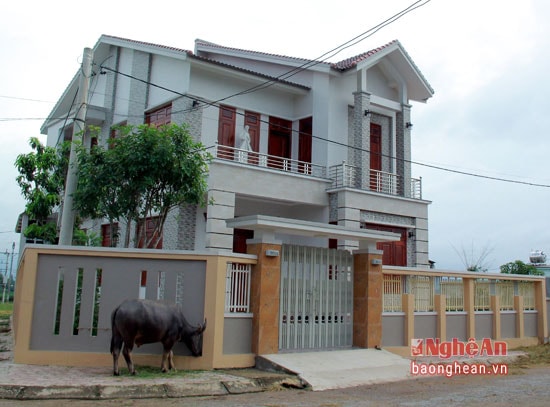 |
| One of the spacious houses in Dai Son (Do Luong) has been abandoned for months because its owner fell into debt and left his hometown. |
Furthermore, Mrs. Nhung and her husband used that large sum of money to build a house and buy a car. Mrs. Nhung also operated like a bank, accepting interest from anyone who deposited money. Then she would lend that money to others at exorbitant interest rates. She was both a debtor and a creditor. However, when Mrs. Nhung's debtors were unable to repay, she began to face bankruptcy.
Because the operation of informal lending groups is not regulated by any agency, local authorities do not have accurate statistics on cases of failed lending groups. However, it is estimated that in Dai Son commune alone, there are about 50 people similar to Ms. Nhung's case, with debts amounting to hundreds of billions of dong.
Sitting dejectedly in her largest bedding and mattress shop in Dai Son commune, Nguyen Thi Hang (33 years old) said that her business had never been as slow as it is now. The reason is the informal lending scheme. In previous years, Ms. Hang's shop was always bustling with customers. Especially when many participants in the scheme took turns drawing money, they spent large sums of money on expensive items, including the goods she sells.
“Now the pyramid scheme collapses in a chain reaction. Every family is in debt, and where will we get the money to buy things, even though Tet (Lunar New Year) is almost here? Even my family participated in the scheme, and now they’ve run away with the money, leaving us with over 100 million dong that we still haven’t been able to get back,” Ms. Hang said sadly, her gaze drifting towards the grand houses abandoned after their owners fled due to the collapse of the scheme.
Stating that the situation of failed informal lending schemes in some localities is very alarming, Colonel Thai Khac Thong - Head of the Do Luong District Police - said that he has repeatedly raised this issue in many meetings of the District Party Committee Standing Committee. The Do Luong District Police have also received many complaints about failed lending schemes; however, according to Colonel Thong, these are only civil disputes, so the police do not handle them and suggest that people should send their complaints to the court.
"There are still many cases that haven't been exposed yet, including many involving civil servants. The majority of these pyramid scheme collapses cannot be prosecuted because the investigating agency cannot prove the criminal act; there aren't enough elements to constitute a crime," Colonel Thong stated.
The head of the Do Luong District Police said that in meetings he had suggested that all levels of government should actively promote awareness campaigns to discourage people from participating in informal lending schemes. Regarding the fact that many people still participate in these schemes despite the high risks, Colonel Thong explained that many people tend to want to accumulate a large sum of money to use when needed.
"Previously, people would pool their money in a rotating savings and credit association (ROSCA) so they could draw it whenever their family needed it, avoiding the need to borrow. But now it has become distorted; many people participate only to use the money for high-interest loans or extravagant spending, leading to the collapse of these ROSCA schemes. Therefore, we need to raise awareness to eliminate them," Colonel Thong said.
Tien Hung