
Is Messi 'killing' the Argentina national team?
(Baonghean.vn) - Without Messi due to suspension, the Argentina national team suffered a 0-2 defeat against Bolivia. The prospect of Messi and his teammates having to watch the 2018 World Cup from home is gradually becoming a reality.
There's a familiar saying: "Success or failure depends on Messi," highlighting the importance of the 1987-born star to FC Barcelona over the past decade. But in his home country of Argentina, Messi's influence is even more tremendous.
With his talent and influence, Messi is becoming the "guardian" of the Argentine national team. Whenever the number 10 striker is on the field, his teammates can do nothing but wait for their captain to shine. When Messi plays well, Argentina wins. And vice versa.
Statistics don't lie: In 14 matches during the 2018 World Cup qualifiers in South America, Argentina won 6 games and Messi played in 5 of them; in the 8 winless matches (4 losses, 4 draws), Messi only participated in 1 game (a 0-3 loss to Brazil). In all 6 matches, Messi scored 4 goals and provided 2 assists, including two games that directly contributed 6 points (Argentina 1-0 Uruguay, Argentina 1-0 Chile). Even these brief statistics speak volumes about Messi's importance to the Argentine national team.
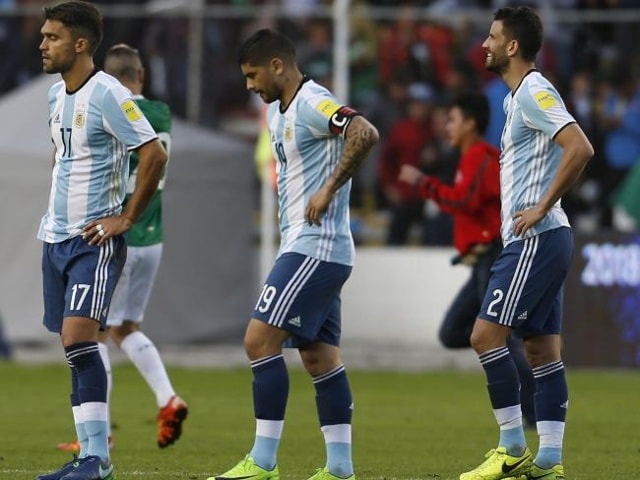 |
| The Argentinian players were defeated by Bolivia on the day star player Messi received his FIFA ban. Photo: Internet |
Once again, we must mention the double-edged nature of an issue. Messi's immense influence has turned the Argentine national team, with its array of superstars, into a one-man team. Higuain, Aguero... so outstanding in Europe, when they return to play for the national team, are merely pale shadows of their former selves.
However, with Messi on the field, even if his teammates underperform, the Barcelona star can still bring about favorable results for the team. The most frightening thing is that whenever Messi is absent, Argentina becomes a lackluster and harmless team. Losses against weaker opponents like Paraguay, Ecuador, and most recently Bolivia have proven this disheartening fact.
Another equally damaging aspect is that since the 2010 World Cup, Argentina's head coaches have consistently stuck to a simplistic tactic: building their game around Messi. To put it bluntly, the style of play under the reigns of Batista, Sabella, Tata Martino, and Bauza was simply for the players to feed the ball to Messi, allowing the star to lead the game, dribble, create chances, and score goals.
All 10 players on the field simply wait for the 1987-born striker to shine. It's no exaggeration to say that the current Argentina national team is one of the most monotonous teams among the "giants" of world football.
It seemed that fans in Argentina had accepted the reality of "Messi carrying the team alone" and entrusted the star with the task of leading Argentina to the 2018 World Cup, but disaster struck. A four-match suspension from FIFA meant Messi was unable to participate in the matches against Bolivia, Uruguay, Venezuela, and Peru.
With their 0-2 defeat in La Paz in matchday 14, Argentina dropped to 5th place (a position requiring a play-off against a representative from another region) and are only 2 points ahead of 6th-placed Ecuador. Given their recent form, even securing a place in the play-off is proving difficult.
Things could have been much better for the Argentina national team after their 1-0 victory against direct rival Chile, as the remaining journey in the 2018 World Cup qualifiers in South America wouldn't have been too difficult for the Tango dancers if Messi had been in the squad.
However, a moment of uncontrolled anger in the match against Chile put his team in a dangerous situation. Few would have expected a player as reserved and mild-mannered as Messi to hurl insults at the assistant referee during a seemingly insignificant incident, leading to such severe consequences.
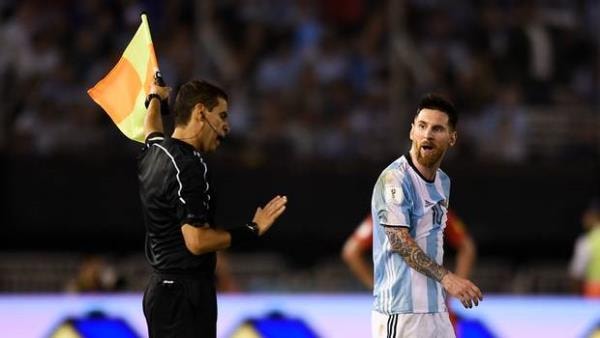 |
| The incident where Messi was accused of making insulting remarks to the assistant referee during the match against Chile. Photo: Internet |
"First blame yourself, then blame others." Messi and his fans may complain about FIFA's ruling, but Messi himself should examine his own regrettable behavior. During the most crucial stage of Argentina's 2018 World Cup qualifiers, this incident will significantly impact their chances of participating in the biggest football event on the planet next summer.
Messi's absence would leave the Tango dancers in a state of disarray, like a snake without a head. If the Argentine national team fails to qualify for the World Cup in Russia in June 2018, Messi would be one of the culprits behind that tragedy.
Of course, the blame cannot be placed solely on the Barcelona star, as the Argentine Football Association (AFA), head coach Bauza, and the rest of the team bear significant responsibility.
Thanh Hung


