
People are worried as the sugar industry integrates into the global market.
(Baonghean) - In a few weeks, sugarcane farmers in Nghe An will begin harvesting the 2017-2018 crop. The process will be extremely difficult as the ASEAN integration roadmap, scheduled for early 2018, is drawing very near.
According to the roadmap, after 2018, import and export taxes on sugarcane from ASEAN countries will be reduced to 0% instead of the current 30%. This poses many challenges for Vietnam's sugarcane industry, specifically for sugar factories and sugarcane farmers in various localities. Even more worrying is that even before that date, domestic sugar prices have been continuously fluctuating.
Falling sugar prices are causing concern for both consumers and factories.
There were times in 2017 when the price of sugar traded in Vietnam "hit rock bottom" at around 12,000 VND/kg, and although it edged up slightly in early November, the increase was insignificant. However, looking at world sugar prices, it is truly worrying when, when converted to Vietnamese Dong, the price at the beginning of November 2017 was only about 7,500,000 VND/ton, or approximately 7,500 VND/kg.
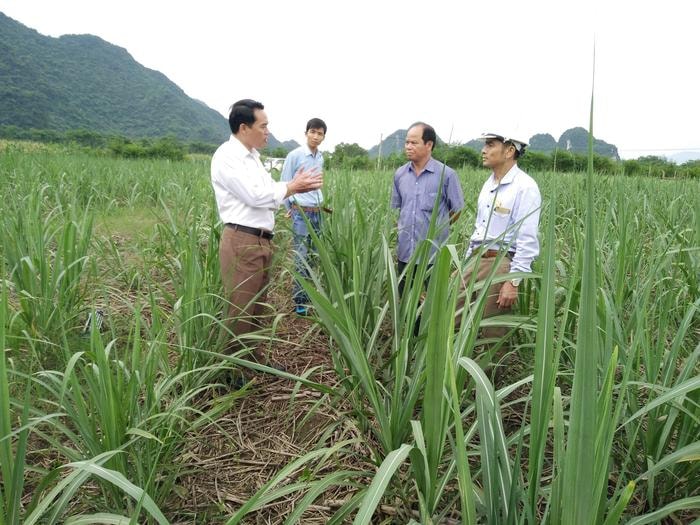 |
| Right from the start of the sugarcane season, sugar companies have sent technical staff to guide farmers on sugarcane planting and care techniques to achieve high yields. Photo: Thai Hien |
After analyzing the situation, the Vietnam Sugar Association has stated that if a 0% import tax on sugar is implemented, the domestic sugar industry will be seriously threatened, with a high probability that some manufacturing businesses will struggle to survive.
Therefore, the Vietnam Sugar Association has petitioned the Prime Minister to postpone the implementation of commitments within the ASEAN bloc until 2022, or at the earliest, 2020. Since no decision has been made by the Government, domestic sugar factories are genuinely concerned, leading to significant anxiety among sugarcane farmers.
The family of Ms. Dang Thi Nguyet in Hamlet 1, Dinh Son Commune (Anh Son District) is one of the first households to convert 5 sao (approximately 0.5 hectares) of riverside land to sugarcane cultivation. In the 2016-2017 sugarcane harvest, her family collected 30 tons of sugarcane, earning over 25 million VND after deducting expenses. However, upon hearing that sugar prices will decrease in the coming years, the family is very worried, as converting land to sugarcane cultivation is not easy and requires high investment costs.
Ms. Nguyet shared: "Currently, with the sugarcane purchase price of 850 VND/kg agreed upon at the beginning of the year by Song Lam Sugar Company, the profit margin for farmers is already low, let alone if it falls further. If sugar prices continue to drop, we sugarcane growers will inevitably suffer heavy losses."
Sugarcane farmers in the key sugarcane-growing area of Quy Hop district are also worried and anxious. Because if sugar prices fall, the factories in the province will buy sugarcane at lower prices, which will directly affect their income, especially for households that have depended solely on sugarcane farming for a long time.
Speaking about this issue, Mr. Truong Van Hong from Tay Loi hamlet, Van Loi commune (Quy Hop district) said: “Through the media, I have learned about the issue of sugar prices when integrating into the region. For my family, sugarcane has helped us escape poverty, but if the price drops, when will we ever become better off?!”
During the discussion, Mr. Ngo Van Tu, Director of Nghe An Sugar Company Limited, shared: “We are also awaiting policy decisions from the Government. Clearly, when sugar prices are low, it will lead to many problems such as the price of raw sugarcane, workers' income, and competitiveness in the domestic and international markets…”.
That is also the "mood" of all sugar factories in the province and across the country.
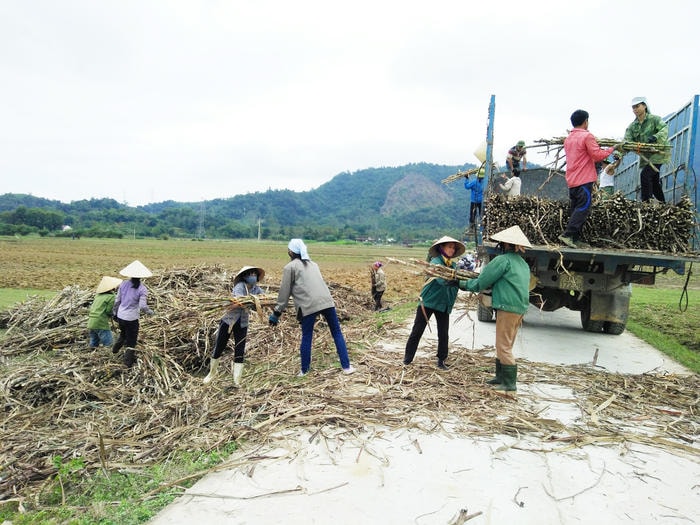 |
| In the 2016-2017 crop year, sugarcane yield in Anh Son reached 70 tons/ha. Photo: Thai Hien |
Transform to survive.
Nghe An province currently has 20,123 hectares of sugarcane. According to the plan, the province needs to reach 30,600 hectares of sugarcane raw material area to serve 3 sugar factories in the area.
Sugar mill leaders affirmed that, for the time being, during the 2017-2018 sugarcane harvest season, the purchase price of raw sugarcane in the province has not decreased, but in the coming years, no one can guarantee price stability. And if Vietnam implements a 0% import tax on sugar, the purchase price of sugarcane will certainly decrease.
Thus, sugarcane farmers will be most directly affected. Meanwhile, sugarcane is the main crop for people in many localities, and according to surveys by factories, the sugar content (sugar content - CCS) in sugarcane in Nghe An is higher than the national average (the national average is 9.74 CCS, while in Nghe An it reaches 10.5 to 11.40 CCS).
Therefore, to maintain and enhance the value of sugarcane, there is no other way than for sugarcane growers to transform their production methods towards improving productivity and crop quality. According to agricultural statistics, sugarcane yields in the province are still below the target, averaging around 54 tons/ha (the target is 64 tons/ha), and in reality, some areas have achieved yields exceeding 100 tons/ha.
Mr. Phan Van Hoa, Director of Agriculture at Song Lam Sugar Corporation, stated: Currently, the Ministry of Agriculture and Rural Development has required all sugar factories nationwide to purchase sugarcane based on sugar content. Therefore, improving sugarcane quality is essential for sugarcane growers to make a profit.
Regarding this issue, sugar companies have long been working alongside sugarcane farmers, sending technical staff to guide them in planting and caring for the crop to achieve high efficiency. They also actively seek out and work with farmers to apply new, high-yield sugarcane varieties, provide loans for fertilizers, and support improvements in planting, caring for, harvesting, and processing.
With this approach, the factory hopes to gain the trust and long-term commitment of farmers to sugarcane cultivation. This is also how sugar companies themselves survive the difficulties of the integration period.
"The sugar industry 'cries for help' ahead of the implementation of the ASEAN Trade Agreement."
N.Son - Th.Hien - Ph.Giang


