
Poet Le Quoc Han: 'Like a matchstick exchanging fire'
(Baonghean) - It's difficult to say more about him, given the dozens of articles by friends, colleagues, and students... demonstrating a thorough understanding of the person, talent, and thoughts of the educator, mathematician, and poet Le Quoc Han. Therefore, I will tell you about him from the simple perspective I have of my encounters and observations…
Le Quoc Han met me at the gate of his house. He said, "Please understand, I can't come to the cafe where we arranged to meet because I don't know how to ride a motorbike."
Seeing my surprise, he said, "But I don't need to go far. My whole working life has been practically tied to Vinh University. It's just a leisurely walk from home. When I need to go somewhere, I just ask someone to drive me, take a motorbike taxi or a regular taxi... People used to think I was just focused on my specialization all day long, completely unaware of society or life outside of it. But even later, when people realized I had many passions, none of them could pull me away from home or the university."
Then, with a wry smile, he poured tea for his guest and recited two lines from his poem "The Sand Crab": "Immersed in passions / Let the world laugh at my poverty."
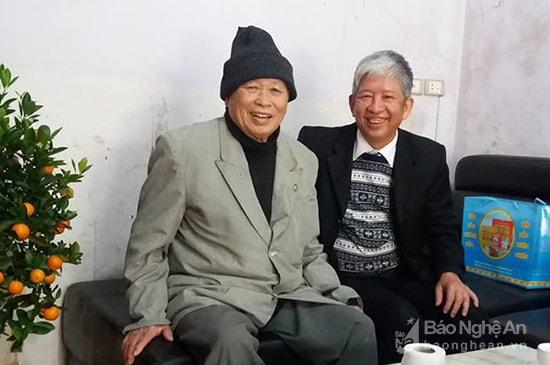 |
| Poet Le Quoc Han (right) wishes teacher Tran Duc Thinh a Happy New Year. Photo: Thuy Vinh |
His lighthearted jokes, however, contained a degree of truth. Once considered a mathematical prodigy, he had numerous opportunities to go far and achieve great things, but almost his entire working life was spent at Vinh University. The small house right behind the university where he taught was not only a home for him to live in, but also where he sat to prepare lectures, conduct mathematical research, write articles for newspapers and mathematics journals, and even where he wrote poetry.
It seems that all the works of this energetic man were born and grew within those simple four walls, amidst the gentle footsteps of his kind wife, the sound of boiling water in the morning, the clicking of the gate lock when she went to the market, and the fragrant aroma of rice wafting from the kitchen every noon and evening…
At Vinh University, generations of students have spoken fondly of a respected, caring, and talented professor, an outstanding educator. In the field of mathematics, he has made many contributions and was awarded the title of Associate Professor. And among the artists and writers of Nghe An, he is known as someone deeply passionate about literature, with many excellent works, and was formerly the Head of the Poetry Committee of the Nghe An Association of Literature and Arts.
A man with so many "roles" and talents like him, choosing a quiet life, surely there's a reason? I asked him that, and received a fleeting look of surprise in his eyes: "No, I find myself happy, fortunate. I chose the life I have now, remaining faithful to all my passions, never abandoning them, never becoming discouraged or regretting them." Le Quoc Han said this with all the sincerity of a man who has reached the end of his life with so many experiences.
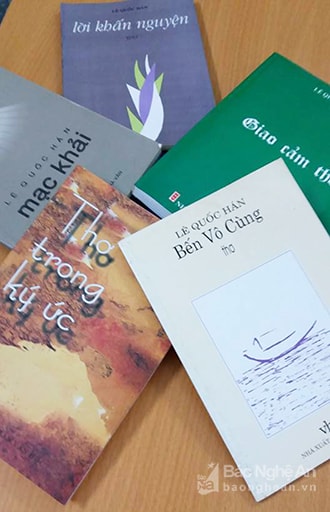 |
| Published poetry collections by poet Lê Quốc Hán. Photo: Thùy Vinh |
Born in 1949 in Ky Anh district, Ha Tinh province, Le Quoc Han passed the entrance exam to the specialized mathematics class at the University of Hanoi at the age of 15 with a score of 20.5/20 (the highest score ever), but for some sensitive reasons, he was not allowed to attend. Shocked and disappointed, the 15-year-old village schoolboy with dreams of numbers received advice from one of his literature teachers: "You should study literature to find solace." And he found new passions in literature, rebalancing himself and healing the wounds of his young soul.
Many people in his hometown still remember Le Quoc Han as a math prodigy, and also for his achievement of winning first prize in Literature three times in Ha Tinh province. However, after finishing high school, he "accepted the 10+1 teacher training program to become a village teacher." Teacher Han taught while also farming (from 1971 to 1976). He loved his profession, loved his students, and strived for them, consistently being recognized as an excellent teacher in the province. He said that he does everything with passion. And he simply explained that his students loved him because "he also loves them."
In 1976, Professor Le Van Thiem, then President of the Vietnam Mathematical Society and Director of the Institute of Mathematics, recommended that he be granted special admission to Vinh Pedagogical University without having to take an entrance exam. Professor Thiem had taken notice of him since he was a student who scored above the maximum mark in the specialized mathematics entrance exam at the University of Hanoi, won first prize in the mathematics competition organized by the magazine "Mathematics and Youth," and later achieved remarkable success in his research and teaching of elementary mathematics. During his undergraduate and postgraduate studies, he was an outstanding student and graduate with top honors. After graduation, he was retained by the university as a lecturer. It wasn't until 1991, when Vinh Pedagogical University opened its first doctoral program, that he was one of the few who passed the entrance exam, allowing him to return to his passion for mathematical research.
He chose a research topic in modern mathematics, a highly abstract field that not every mathematician would want to tackle. At the end of 1995, he successfully defended his doctoral dissertation. Many opportunities presented themselves, but he still chose his quiet corner to both teach and research.
He said: "What I consider a success, after successfully defending my thesis, is that for the first time I truly felt confident and thought that all the efforts in life, sooner or later, would be rewarded."
The "mathematical path" of a "mathematical prodigy" was fraught with obstacles and challenges, but when he embarked on the "path of poetry," he claimed to have encountered unexpected advantages. Although he had dabbled in poetry since high school (he said his love of poetry probably stemmed from his father, who often read romantic poems, especially French romantic poetry, to his children), he had neglected it for 20 years (from 1970 to 1990).
In 1991, while he was a graduate student, he returned to poetry as a way to find balance for his soul. Even in the early years of his return to poetry, Le Quoc Han attracted attention; his poems were featured in prestigious literary journals and appeared regularly in major poetry anthologies.
In 1996, he published his first poetry collection, "Prayers," and was admitted as a member of the Nghe An Association of Literature and Arts. In 2002, he became a member of the Vietnam Association of Literature and Arts. To date, he has published six poetry collections, all highly praised by critics. He has won numerous poetry awards from Song Lam Magazine, Tien Phong Newspaper, Tai Hoa Tre Magazine, and the Ho Xuan Huong Literature and Arts Award of the province…
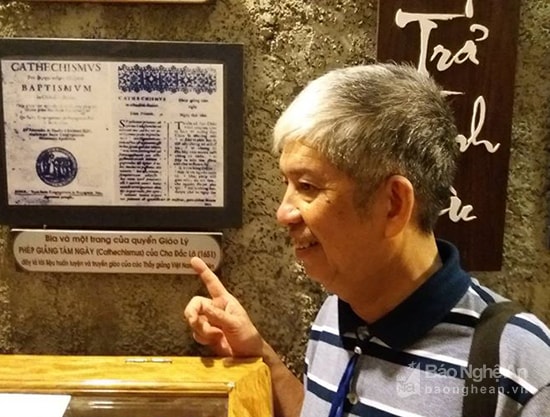 |
| Poet Lê Quốc Hán stands beside the first book written in the Vietnamese Quốc ngữ script at Mằng Lăng Church, Tuy An District, Phú Yên Province. (Photo provided by the subject) |
Many colleagues and friends were quite surprised to see "the calm teacher who seemed to only care about math problems all day, paying little attention to anything else" participating in a poetry club and writing poetry. They realized that, hidden behind his quiet, seemingly pure and resigned demeanor, lay breakthroughs, aspirations, and endless reflections and contemplations. He expressed all his experiences and feelings about life and people in his poetry. "Young - thinking themselves the heaviest / Old - knowing themselves to be light / Time, like a sharp axe / Carves gray even the youngest hair."
His poetry is imbued with the essence of his homeland, the love for his country, reflections on human nature and the ways of the world, and philosophical insights into life, all interwoven with a world of imagery. Without pretense, embellishment, or boisterousness, his philosophies and emotions in his poems always lead the reader to a pure, wholesome, and thought-provoking light.
He was also very meticulous in his research and self-renewal. Some called him "the mathematician who built the bridge to poetry." He once said that mathematics is the product of intellect, and poetry is the product of the soul: "No matter how wise a person is, if they do not have a heart capable of intense emotion, they cannot become a true mathematician, and no matter how sensitive and passionate a person is, if they are not guided by intellect, they can hardly become a great poet."
Besides writing poetry, textbooks, research papers, and articles for mathematics journals, he was also a self-taught literary critic. And in every field, he displayed his talent. He told me about his love and gratitude for the land and the school that had allowed him to fulfill his aspirations and had embraced him for almost his entire life, much like his gratitude to his birthplace.
And he felt he belonged here, in this house in the small alley bustling with the footsteps of students going to and from class. He felt suited to the space, though small, yet spacious and unhurried. "Here I feel like myself, it fits me perfectly," he said with a sense of happiness, "Like a loyal person who will reap the rewards."
Living life to the fullest, being true to oneself, not trying to conform to anyone or anything other than what one's intellect and heart tell one—that is the philosophy and practice of teacher and poet Le Quoc Han. Even though life is short, it is: "Like a summer raindrop / that dries before it touches the ground / Like a matchstick giving fire / that vanishes into nothingness in an instant" (Like - a poem by Le Quoc Han).
Thuy Vinh
| RELATED NEWS |
|---|


