
Many river and sea dyke systems in Nghe An are deteriorating.
(Baonghean.vn) - Most of the sea dikes and river estuary dikes in Nghe An province were built 40-50 years ago, mainly using manual earth embankment methods. Many sections of these dikes have now severely deteriorated and are no longer safe during the rainy and stormy season.
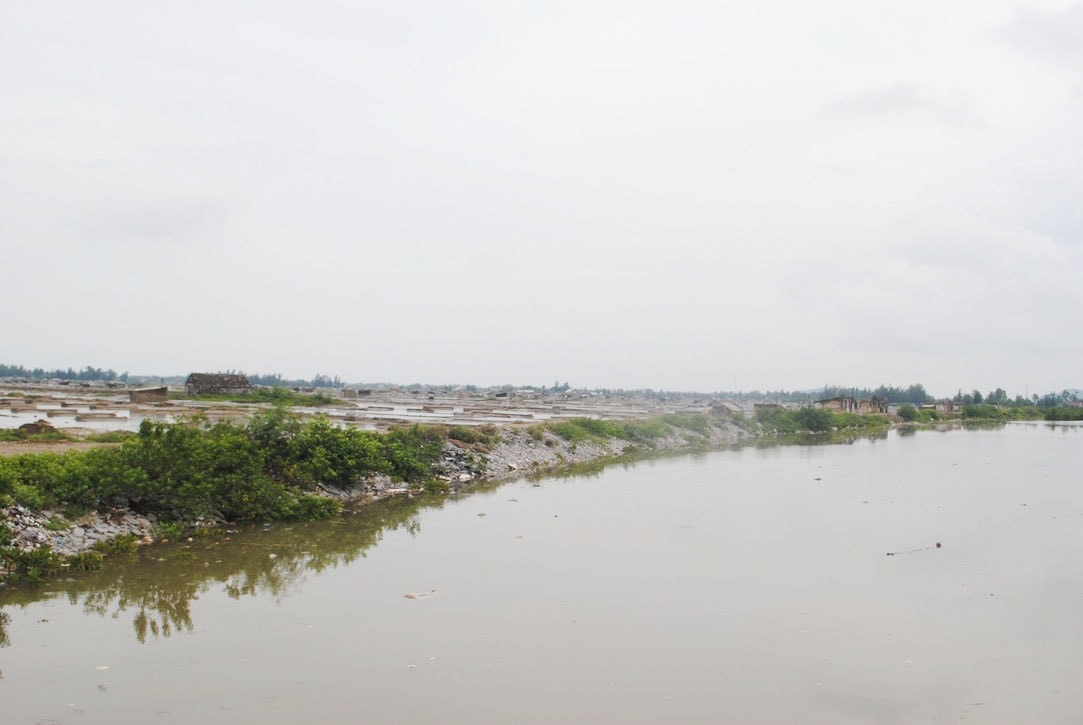 |
| The Mơ River dike system in An Hòa commune (Quỳnh Lưu district) has not been upgraded for a long time. Photo: Văn Trường |
In mid-September, while visiting the Mơ River in An Hòa commune, Quỳnh Lưu district, we observed that the narrow dike was causing extensive flooding of salt fields belonging to local residents. Mr. Trần Bình from An Hòa commune stated: "The Mơ River dike system has been severely damaged for a long time. Every year during the rainy season, the floodwaters inundate and damage salt fields, shrimp ponds, and even flood people's homes."
Mr. Ho Anh Dung, Chairman of the An Hoa Commune People's Committee, added: The Mo River dike system (to prevent saltwater intrusion and retain freshwater) running through An Hoa commune is over 7 km long, mostly constructed manually, with many sections prone to erosion. During the rainy season, water often overflows, affecting 160 hectares of salt fields and over 30 hectares of aquaculture farms in the commune, and damaging the salt storage system. In the long term, An Hoa commune is hoping for an upgrade of the Mo River system to prevent flooding.
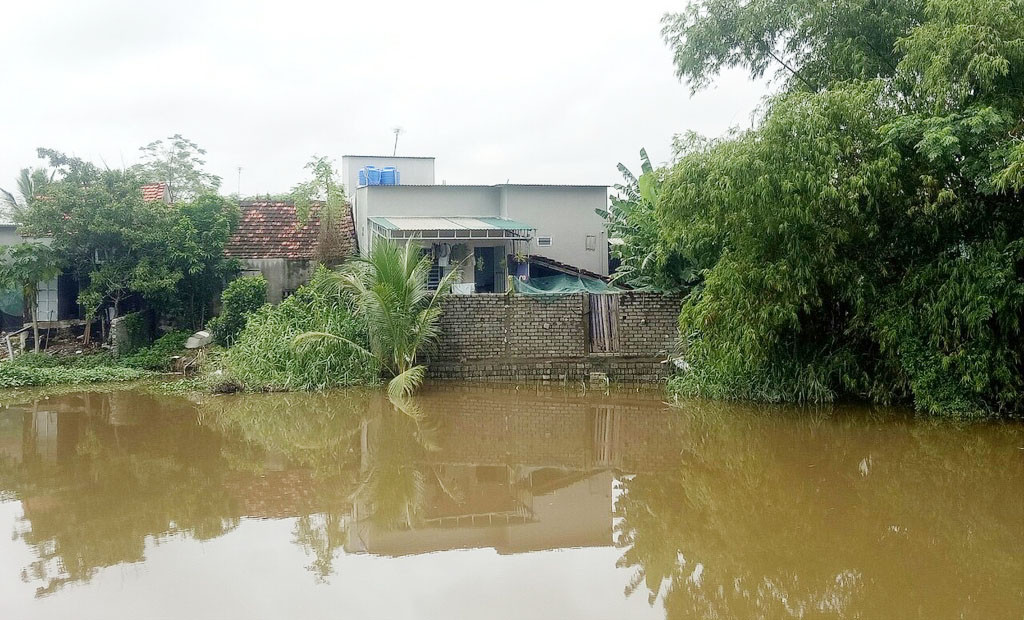 |
| The dike along the Thai River in Cau Giat town (Quynh Luu district) is too low, causing water to overflow and flood many households. (Photo taken on September 20) Photo: Van Truong |
In the same situation, the dike along the Thai River passing through the western part of Cau Giat town has not been upgraded, so during the rainy season, the rising water floods many houses along the Thai River. According to a report from the Department of Agriculture and Rural Development of Quynh Luu district, the river dike system in the district has over 46 km, including a 22 km long Thai River dike and a 4 km long Mo River dike. Currently, they are mainly made of earth without reinforcement, only able to withstand high tides and storms of level 6 and 7. In the past, the district has only upgraded 5 km of river dikes in two communes, Quynh Hung and Quynh Hong.
 |
| Just a few hours of heavy, prolonged rains are enough to cause flooding in the Thai River, affecting households in the Cau Giat town area of Quynh Luu district. Photo: Van Truong |
In Quynh Luu district, the sea dike system stretches for tens of kilometers, but many sections are severely degraded, such as in Quynh Luong and Quynh Tho communes. These sections, built with low-lying earth, are susceptible to flooding from even moderate storms, inundating residential areas and damaging crops and aquaculture farms. In 2020, Quynh Luu district upgraded nearly 2.5 km of the sea dike system, costing over 54 billion VND, in the sections passing through Quynh Tho and Quynh Long communes. Currently, over 15 km of degraded sea dikes still need upgrading.
The Dien Chau district is also in a similar situation, with its river dike system,sea dikeThe situation is also severely degraded, with many residents suffering from rising water levels and saltwater intrusion, threatening their lives. For example, in Dien Hoa commune, the Bung River dike system, which runs for more than 7 km, is mainly constructed of low, weak earth. Mr. Tran Van Minh, a resident of Dien Hoa commune, shared: "During the rainy season, the river water overflows the dike, flooding summer-autumn rice crops, fish ponds, and many houses of people living along the river."
The heavy rains from September 14-16 caused a 65-meter section of the Bung River dike to collapse, with some sections completely breaking at the base. Water from the Bung River overflowed, causing flooding in Dien Hoa commune. Currently, the commune is allocating over 20 million VND from its budget for temporary repairs. In the long term, government investment in upgrading the dike is urgently needed.
Mr. Le The Hieu, Head of the Agriculture and Rural Development Department of Dien Chau district, explained: Dien Chau district has 45 km of river dykes concentrated in the communes of Dien Hoa, Dien Quang, Dien Binh, Dien Thai, etc. Due to limited funding, the dyke system has not been upgraded for a long time. Most sections of the dykes were built manually with earth in the 1980s, so they have deteriorated, eroded, and are unable to withstand heavy rain and floods.
The coastal dike system in Dien Chau district has a length of over 15 km, concentrated in the communes of Dien Hai, Dien Hung, Dien Van, Dien Bich, Dien Ngoc, Dien Kim, Dien Trung, etc. In recent years, Dien Chau district has upgraded 7 km of coastal dikes, while the remaining dike system in the communes of Dien Van, Dien Trung, and Dien Kim is severely damaged and degraded.
According to a report by the Department of Irrigation, Nghe An province has a river mouth dike system nearly 200 km long. These dikes are responsible for flood control in the river mouths of the Mai Giang, Hoang Mai, Thai, Bung, and Cua Lo rivers.
 |
| The Bùng River dike system, spanning 7 km through Diễn Hoa commune, Diễn Châu district, is mainly constructed of earth, with many sections experiencing landslides and dike foundation breaches. Photo: Văn Trường |
Regarding the 82 km long coastal dike system extending from Quynh Lap commune (Quynh Luu district) to Cua Hoi (Nghi Hai ward, Cua Lo town), there are currently 41.783 km of coastal dikes and 11.65 km of seawalls, of which over 30 km have been upgraded. According to assessments, most of the river and coastal dikes are degraded and unable to withstand rain and storms, often leading to flooding.
During this rainy and stormy season, the Irrigation Sub-Department requests the Steering Committee for Disaster Prevention and Search and Rescue in districts and towns to deploy patrols and guard dikes according to the alert levels. They should review, inspect, and develop plans to ensure the safety of vulnerable dike sections and culverts under the dikes.
The Vinh River's water level is rising, threatening residents living outside the dike.
(Baonghean.vn) - As of around 11:00 AM today, October 31st, the water level on the east side of Cua Tien 2 Bridge is still rising, threatening residents living outside the Vinh River dike. It is known that the high-capacity pumps behind Vinh Market have been operating continuously since October 30th, but due to the extremely high water level in the Vinh River, the water is receding slowly inside the market.

Nghe An province invests 150 billion VND in building sea dikes and planting trees to act as wave barriers.
(Baonghean.vn) - In early May 2020, Nghe An province will begin construction of a sea dike worth over 150 billion VND in Hoang Mai town to protect coastal residential areas.


