
Remembering Uncle Ho's advice, we must unite, cooperate, and "bear with each other."
(Baonghean.vn) - Comrade Truong Cong Anh - Former Standing Committee Member and Head of the Provincial Party Committee's Propaganda Department, believes that remembering Uncle Ho's teachings means unity, and unity here means working together, "mutually enduring," using the strengths of one person to compensate for the weaknesses of another; conversely, using the strengths of others to compensate for one's own weaknesses.
| These days, the Party Committee and people of Nghe An have organized many activities to commemorate the 60th anniversary of President Ho Chi Minh's first visit to his hometown (June 14, 1957 - June 14, 2017). Nghe An Newspaper had a conversation with Comrade Truong Cong Anh - former Standing Committee member and Head of the Provincial Party Committee's Propaganda Department - about the process of building and selecting truly virtuous and talented cadres to fulfill President Ho Chi Minh's sacred wish to make Nghe An a prosperous province among the northern provinces. |
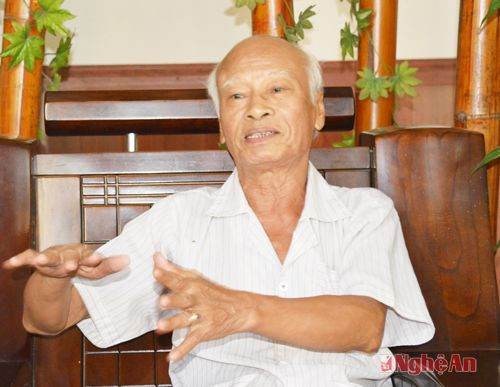 |
| Comrade Truong Cong Anh during a discussion about Party building work with Nghe An Newspaper. (Archival photo) |
Reporter:Comrade, during his two visits to his hometown and in his last letter to the Party Committee and people of Nghe An, one of the issues that President Ho Chi Minh emphasized was the need to focus on building, training, and selecting a team of cadres, especially leading cadres. As someone with many years of experience and having held various positions within the Party organization of Nghe An province, how do you assess the cadre work of our province in recent times?
Comrade Truong Cong Anh:Throughout my career and even after retirement, I have observed that personnel management has always received special attention from Party committees, government agencies, the Fatherland Front, and mass organizations from the provincial to the grassroots level. This is a matter that needs to be affirmed! This is reflected in the efforts to build, train, and cultivate a successor team, starting with young cadres, and attracting talented individuals to work in their hometowns. Recently, Party committees at all levels have also systematically implemented personnel planning; strengthened cadre rotation, which is considered a measure to further develop cadre capabilities, and simultaneously reviewed the accuracy and objectivity of the organization's personnel planning. Based on this, cadres are promoted and assigned according to their abilities and strengths. All these actions aim to select a team of cadres who, according to President Ho Chi Minh, possess sufficient virtue and talent, contributing to the development of the province throughout the years.
However, regarding personnel work in our province, in my opinion, there are several issues that need continued attention and care. In each visit to his hometown and in his last letter to the Party Committee and people of Nghe An, President Ho Chi Minh always emphasized the importance of unity, and this issue still needs attention today. Unity here means the concerted effort and cooperation among the cadre, especially among key cadres. The strength of unity is crucial.
I've said before that if we compare the province's key positions with those of other localities, we are not inferior; but when it comes to concerted effort, we are not as good. Or, as we often say, the people of Nghe An are intelligent, but many intelligent people sitting together doesn't necessarily create greater intelligence; on the contrary, they might even cancel each other out. That's the issue of unity. Unity here doesn't mean fighting or causing disunity, but rather it's about collaboration, mutual understanding, using one person's strengths to compensate for another's weaknesses; and conversely, using another's strengths to compensate for one's own weaknesses.
The second problem is that the province has not yet developed a personnel strategy to serve its socio-economic development and national security and defense strategy. Most notably, while we have formulated an economic development strategy, clearly identifying key industries, occupations, crops, and livestock, and priority development areas, we have not focused on building a suitable and capable workforce to implement those key industries, occupations, crops, and livestock. In reality, for a long time, we have only focused on personnel work in general within the political system, without specifically addressing the personnel needs of each key economic sector and industry.
That's precisely the problem we've been talking about for a long time: the lack of specialized, highly qualified personnel. In other words, personnel management is currently "running outside" the province's development objectives, failing to prioritize the development of its workforce; failing to use the workforce to drive development. This is clearly reflected in the province's competitiveness index compared to other localities nationwide, which is currently mediocre; a situation where "the top is paved with smooth roads, but the bottom is riddled with obstacles"...
Reporter:One of the current requirements is to reform the administrative apparatus at all levels to be streamlined and efficient, with the most crucial aspect being personnel management. So, in your opinion, what changes does the province need to make in its personnel management?
Comrade Truong Cong Anh:Currently, we are aiming to streamline the administrative apparatus to make it less cumbersome and more efficient. In principle, streamlining requires designing necessary, high-quality positions and jobs. To design these positions and jobs effectively, we must first design the overall structure correctly and accurately; based on that, we can clearly determine the appropriate number and quality of personnel to ensure the smooth operation of the system. Furthermore, the current requirements for building a state apparatus, from the Government to all levels, emphasize integrity, innovation, and action; therefore, the province needs to build a team of officials to meet these requirements.
To achieve this, in personnel work, from planning, training, arrangement, promotion, and rotation, we must always ask ourselves: what will our actions and implementation solve? This means building a team of cadres who are truly dedicated to the Party, the country, and the people; cadres who always prioritize the common good of the province, locality, sector, agency, or unit, and only then their personal interests. In reality, there are cadres who, when representing the government at various levels, organizations, agencies, or units to resolve a problem or manage a relationship, still prioritize their personal gain over the collective interest. Or, they readily accept and befriend those who are generous with them, while avoiding relationships that are open, fair, and without any "generosity." This is an issue related to the qualities of a public official, as President Ho Chi Minh said: "Whatever is beneficial to the people, do it with all your might; whatever is harmful to the people, avoid it with all your might." Every official and public servant must always keep this saying of Uncle Ho at their bedside to reflect upon and act upon.
Personnel planning must be carried out on an objective and honest basis, establishing specific and scientific criteria, with necessary flexibility, avoiding a situation where planning is considered "predetermined," where those included in the plan can remain stable without major wrongdoings, while those outside the plan lack motivation to strive. Planning should also strengthen inter-sectoral and inter-local coordination, avoiding parochialism.
Regarding personnel rotation, this is one of the measures to review whether the organization's planning is appropriate, while also fostering the capacity of cadres, thereby making accurate considerations for placement and promotion. Therefore, this work requires strengthening and proposing specific solutions. Regarding the selection and utilization of cadres, we need to learn from and follow President Ho Chi Minh's ideology of recognizing, evaluating, and utilizing talented and virtuous individuals, without being constrained by their background, academic rank, or degree. Even if a cadre may not meet expectations when employed, if they are willing to work for the benefit of the people and the country, they can still be used.
And recently, there has been public opinion somewhere about nepotism and cronyism, because that place has not followed Ho Chi Minh's ideology in considering and appointing cadres. Therefore, in considering and appointing cadres, we must follow his ideology: "Promoting cadres must be based on work, talent, and to encourage other comrades to be more enthusiastic. In this way, the work will certainly progress. If it is based on love or hate, kinship, or favoritism, no one will respect it, and it will cause trouble within the Party..."
Reporter:These days, our province is holding many activities to commemorate the 60th anniversary of President Ho Chi Minh's first visit to his hometown, while also demonstrating our determination to fulfill President Ho Chi Minh's wish for Nghe An to become a model province and the most prosperous province in the North. To achieve this goal, what suggestions do you have for the province?
Comrade Truong Cong Anh:To realize the aspiration of building Nghe An into a model province, the most prosperous in the Northern region, the core issue is to nurture a workforce that truly meets development requirements. Specifically, there must be a personnel strategy aligned with the development strategy of the province and each sector and locality. Each socio-economic development strategy and plan must be accompanied by a corresponding personnel strategy and plan. To have a personnel strategy and plan that corresponds to the development strategy and plan, it is necessary to reassess the current state of the workforce, what is already available and what is lacking, and from there determine the training needs, how to attract, assign, and utilize personnel. In short, personnel work must begin with socio-economic tasks and return to serve those socio-economic development tasks.
Simultaneously, attention should be paid to building a state apparatus that is truly honest, innovative, and proactive, based on a scientific organizational structure; thereby building an appropriate administrative system and a suitable team of officials.
Another important point is to review the long-standing issues we have been addressing regarding personnel work, from planning, training, placement, utilization, promotion, inspection, supervision, and discipline. We should continue to build upon what is right and good, resolutely correct and remedy what is wrong and bad, and address what requires supplementation and innovation. We must also focus on ideological work to foster unity and consensus among cadres, overcoming the problem of "three talented people sitting together not creating a greater talent."
Ultimately, it is necessary to open up, integrate, pay attention to foreign affairs, and harmoniously manage relationships between localities, between subordinates and superiors, and between the province and central ministries and agencies, in a spirit of openness, exchange, and learning from friends, in order to create external resources for development.
ReporterThank you, comrade!
Mai Hoa
(Perform)


