
Farmers who refuse to be poor.
(Baonghean) - In recent years, the movement of farmers' associations participating in developing household economies to overcome poverty has been widely replicated in Nghe An province.Nghe An Newspaper introduces some exemplary individuals who have developed economically and risen to wealth in rural areas.
Dynamic business transformation
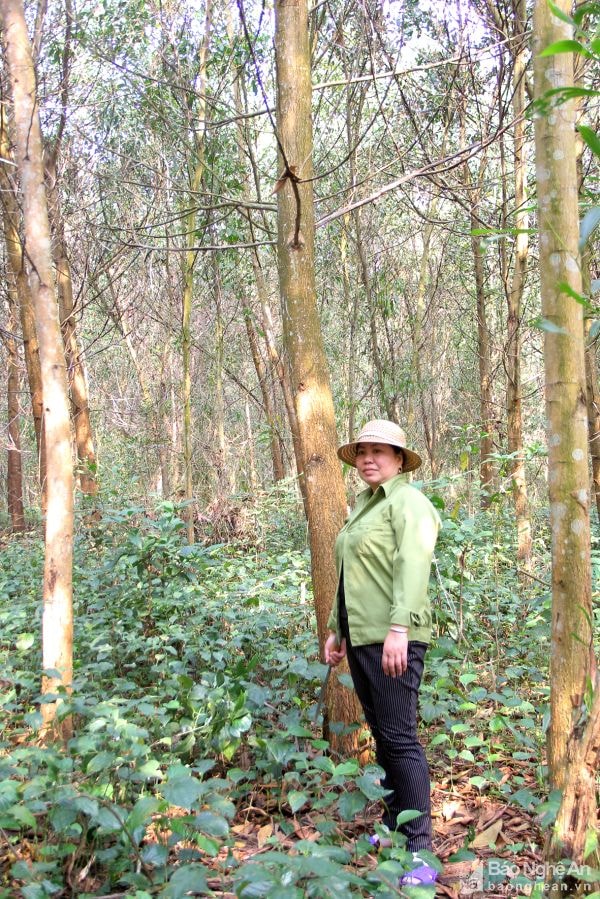 |
| The acacia forest belonging to Ms. Hong's family. Photo by Kim Nghia. |
Previously, Ms. Luong Thi Hong (Na Phay village, Muong Ngoc commune) also went to the forest to find cassava, yam, and wild vegetables to survive.
At the end of 2005, Ms. Hong borrowed 200 million VND from the Agricultural and Rural Development Bank to buy pigs, chickens, and ducks for breeding; invested in planting 5 hectares of acacia trees and opened a general store. When she started to save up, she opened a stall selling blankets, sheets, pillows, and mattresses. In just 5 years, her family had accumulated considerable wealth. In 2010, her family invested in building livestock and poultry farms, upgrading their shop, and establishing a gas station.
Notably, every year Ms. Hong has donated 5-6 million VND to the Fund for the Poor, the Charity Fund, and the Gratitude Fund; in response to the movement of farmers participating in building new rural areas, her family donated 30 square meters of land, contributed over 10 million VND and labor to concrete the village road.
To date, Ms. Hong's family maintains a farm raising two local black breeding sows, generating an income of 35 million VND per year; a flock of chickens bringing in 100-120 million VND per year; pigeons bringing in 50-60 million VND per year; and a grocery store selling blankets, sheets, pillows, and mattresses, bringing in 170-180 million VND per year. Particularly noteworthy is the gas station, which generates nearly 300 million VND per year; plus additional income from rice and acacia cultivation. On average, after deducting expenses, Ms. Hong's family earns a net profit of 750-850 million VND per year. They have now been able to buy a car, build a spacious house, invest in their children's education, and provide employment for four permanent workers with salaries ranging from 3.5-4 million VND per person per month, and 20-25 seasonal workers with wages of 150,000-200,000 VND per day.
Kim Nghia
A diligent person is not afraid of difficulties.
Within the impressive estate of Mr. Nguyen Van Huu's family (Hamlet 1, Hung Yen Bac Commune, Hung Nguyen District), there is a lush garden filled with fruit trees and a variety of agricultural and livestock production activities.
After completing his military service, in 1989, Mr. Huu returned to his hometown to start a family and tried several professions, but all failed. A twist of fate led him to the business of growing flowers and ornamental plants. Initially, he just grew them for fun, but gradually he learned grafting, cuttings, and shaping, expanding his business. In 1992, when the local government introduced a policy allowing households to cultivate barren land, Mr. Huu and 15 others pioneered the cultivation of plants in the Da Da area. Overcoming numerous initial difficulties, especially the lack of water, Mr. Huu mobilized his brothers to dig ponds for daily use, irrigation, and fish farming.
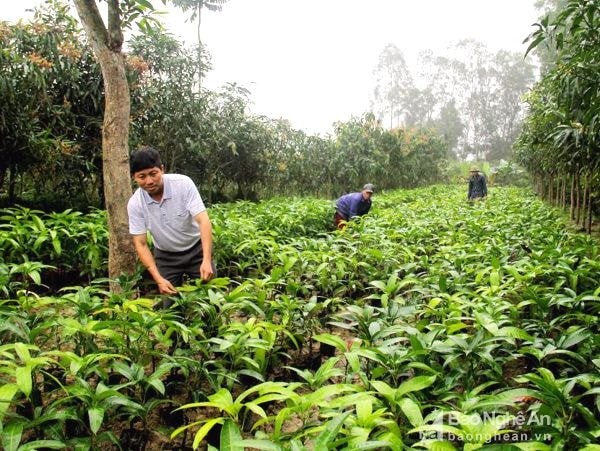 |
| Nguyen Van Huu's tree nursery in Hung Yen Bac commune (Hung Nguyen district). Photo: Hoang Minh |
Thus, Mr. Huu reclaimed, bid for, and converted farmland for his relatives and neighbors, creating a 2.2-hectare area where he gradually expanded the cultivation of ornamental trees, fruit trees, flowers, and plants. To date, his garden boasts hundreds of ancient ornamental trees and numerous fruit trees, ornamental trees, and office trees; as one crop is sold, another is propagated, grafted, or purchased. Mr. Huu also combines this with raising buffaloes, cows, pigs, chickens, ducks, pigeons, and fish ponds, using these to supplement the other. On average, after deducting expenses and labor costs, his family earns a net profit of 3-4 billion VND per year, with an income of 33 million VND per person per month. In addition, he provides regular employment for 6 workers with wages of 6-7 million VND per person per month; during peak seasons, he hires additional seasonal workers from the region.
Having grown up in difficult circumstances and received help from many relatives and acquaintances, he always felt compelled to give back to society when he had the opportunity. Each year, he dedicates 7-10 million VND to supporting and assisting families receiving government assistance, those facing illness, hardship, or difficulties. He is especially willing to lend seedlings to families in the Da Da area and surrounding regions to help them develop their economy.
Hoang Minh
Where you fall, that's where you get back up.
Mr. Truong Dinh Thong (a member of the Tho ethnic group, residing in Nghia Long commune, Nghia Dan district) has persistently built a large-scale industrial pig farming operation.
In 1992, after being discharged from the army and returning to his hometown, Mr. Thong started building a farm model. He received 11 hectares of barren land, planting 10 hectares of eucalyptus and acacia trees and 1 hectare of fruit trees. He also leased 3 hectares of reservoirs from the Agricultural Cooperative to raise fish. The initial investment was 20 million dong, of which 10 million dong was borrowed from the bank and 8 million dong from relatives and friends. In the early years, the family's main income came from the 3 hectares of reservoirs, but this was only enough to cover bank interest and labor costs. To increase income, he raised hundreds of goats, chickens, and laying ducks, gradually paying off his debts.
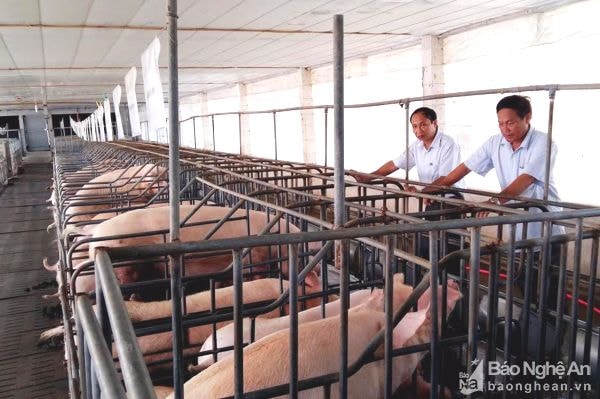 |
| The lean pork farming model of Mr. Truong Dinh Thong in Nghia Long commune (Nghia Dan district). Photo: Minh Dan |
During a visit to Dong Nai province, seeing people raising lean pigs on an industrial scale, he wanted to try his hand at it. In 2006, he converted 1 hectare of fruit tree land into a 1,200m2 pig farm raising 100 breeding sows, fattening pigs, and 3 breeding boars, with a total investment of 1.2 billion VND. He invested in building a closed-loop biogas system, using pig waste as fuel to power generators and provide heating for the pigs in the winter...
In addition, he also planted 2.4 hectares of oranges and tangerines with an initial investment of over 200 million VND. On average, he sells 1,200-1,400 pigs for meat each year, earning about 12 billion VND. Income from fish farming and fruit tree cultivation is about 300 million VND; after deducting expenses, his family earns a profit of over 1 billion VND per year.
From his farm, Mr. Thong's family provides employment for 20 permanent workers each year with a stable salary of 3.5 million VND per person per month, and 50 seasonal workers. He directly guides many households in the commune on farming techniques and provides them with livestock to develop their economy. Particularly in the past three years, his family has supported the local community with excavators, rollers, and trucks for transporting soil to build new rural roads, worth over 150 million VND.
Minh Dan
"Parishioners in Nghe An expose the moral decay of Father Nguyen Dinh Thuc."
| RELATED NEWS |
|---|


