
Que Phong: Many poor households suffer from a mindset of dependence and reliance.
(Baonghean.vn) - The mentality of waiting and relying on others; households with members suffering from drug addiction and those lacking the ability to work due to old age are the main reasons for the high poverty rate in Tien Phong and Que Son communes (Que Phong district).
According to Mr. Sam Viet Hung, Vice Chairman of the People's Committee of Tien Phong commune (Que Phong district): Some households still have a mentality of waiting and relying on others; drug addiction and lack of labor capacity due to old age are the reasons for the high poverty rate. This was also a problem raised with the working group of the Provincial People's Council during their monitoring program on the implementation of the national sustainable poverty reduction program in Que Phong district on the morning of April 13th.
 |
| Comrade Hoang Viet Duong - Vice Chairman of the Provincial People's Council, Head of the monitoring team, discusses with the leaders of Tien Phong commune People's Committee (Que Phong district) about the implementation of the sustainable poverty reduction program in the locality. Photo: Mai Hoa |
In Tien Phong commune, home to four ethnic groups (Thai, Kinh, Khmu, and Tho), over the years, through policies for poor districts and ethnic minority areas, and the new rural development program, infrastructure has been invested in quite comprehensively, including roads, electricity, schools, and commune offices. Currently, all five schools meet national standards; 23 out of 25 villages have electricity and basic transportation systems.
However, due to the complex terrain and inadequate irrigation system, rice production is affected during the hot, dry season. Two villages, Xop Sanh and Na Sanh, still lack electricity; the roads leading to Xop Sanh and Cun villages are still muddy; and 15 hamlets do not have community cultural centers.
Regarding the implementation of national target programs for sustainable poverty reduction, the locality has actively deployed initiatives such as supporting poor households in building houses; providing vocational training and labor export; allocating land and forests; and developing economic models for sugarcane cultivation and pig farming. On average, the number of poor households decreases by 3-4% each year. However, the poverty rate remains high, at 40.5%, and near-poverty is 25%; households still fall back into poverty annually. The entire commune still has 100 households living in temporary housing.
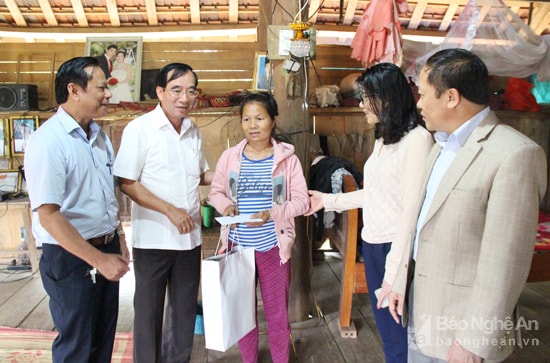 |
| The delegation from the Provincial People's Council presents gifts to poor households in Pieng Cu I village, Tien Phong commune (Que Phong district). Photo: Mai Hoa |
According to Mr. Sam Viet Hung, Vice Chairman of the Commune People's Committee, the reasons for this situation are that, generally, poor people have the awareness to strive to escape poverty, but there are still poor households due to a lack of labor because of old age and weakness; some households still have a mentality of waiting and relying on others; and some households have members involved in drug abuse.
In Que Son commune, poverty reduction is identified as a crucial political task for the locality. Therefore, in addition to the general policies of higher levels, the commune also issues its own policies. Simultaneously, it assigns organizations and associations within the political system and units stationed in the commune to assist households in escaping poverty; creating conditions for households to develop economic models and expand their livelihoods.
Currently, the commune has many developing economic models focused on supplying food for the entire district, such as green beans, cucumbers, zucchini; fish, ducks, chickens, and pigs. Although the poverty rate is lower, at 22.27% and near-poverty at 25%, according to Mr. Nguyen Hong Chau - Chairman of the Commune People's Committee, many poor households will find it very difficult to escape poverty. For example, there is a family where both parents have passed away, and now only an elderly grandmother is raising four young grandchildren. There are still 60 poor households living in temporary shelters.
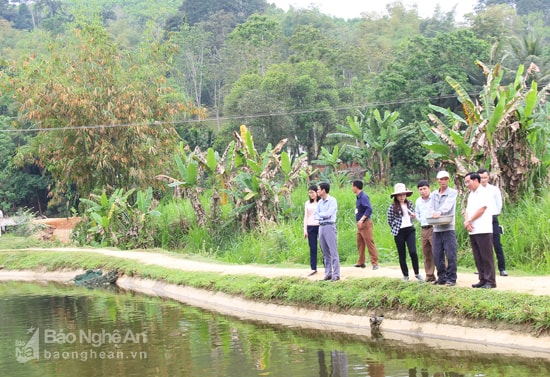 |
| The delegation from the Provincial People's Council surveyed the economic model of Mr. Ho Dinh Chau's family in Hai Lam hamlet, Que Son commune, which includes 1,000 laying ducks, 30 pigs for meat production, and 1 hectare of fish farming area. Photo: Mai Hoa |
Based on field surveys and discussions with the leaders of Tien Phong and Que Son communes, on behalf of the working group, Mr. Hoang Viet Duong - Vice Chairman of the Provincial People's Council - suggested that, in addition to implementing poverty reduction policies from higher levels, localities should issue their own policies and guidelines that are relevant to their local situation.
Strengthening propaganda and education to raise awareness and the will to escape poverty among the people; focusing on building and developing production models to ensure sustainable livelihoods for the people; enhancing vocational training and supporting labor export. In conjunction with this, coordinating with all levels, sectors, and organizations to resolve issues related to production land for the people; supporting the elimination of temporary housing...
Mai Hoa


