
The National Assembly is embroiled in heated debates over budget allocation and public debt.
(Baonghean.vn) - Assigning responsibility for losses and waste amidst limited state budget resources, difficulties, and rapidly increasing public debt; and the increasingly shrinking allocation of the budget... these are the 'hot' issues that National Assembly deputies discussed enthusiastically in today's session (November 1st).
According to the National Assembly's work agenda, this morning (November 1st), the National Assembly discussed in the plenary session the five-year financial plan; the objectives and directions for mobilizing and using borrowed capital and managing public debt for the period 2016-2020; and the medium-term public investment plan for the period 2016-2020.
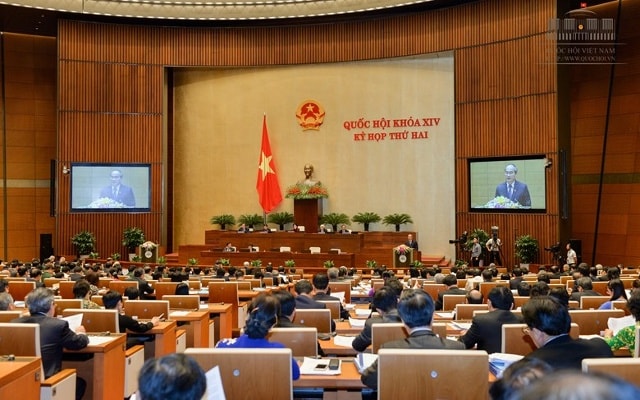 |
| Overview of the session |
Many National Assembly deputies expressed concern about the current difficulties in the state budget, yet public spending, especially the use of borrowed funds, remains inadequate. In particular, five major projects with a total investment of over 30,000 billion VND have been left unfinished or operating inefficiently, even being abandoned and facing bankruptcy.
Agreeing with the assessment of National Assembly deputies that "public debt is increasing rapidly, and the pressure to repay debt is great," Minister of Finance Dinh Tien Dung said that in 2001, public debt only accounted for 36.5% of GDP; in 2005, this ratio had risen to 40.8% of GDP; in 2010 it was 50% of GDP and in 2015 it was 62.2% of GDP.
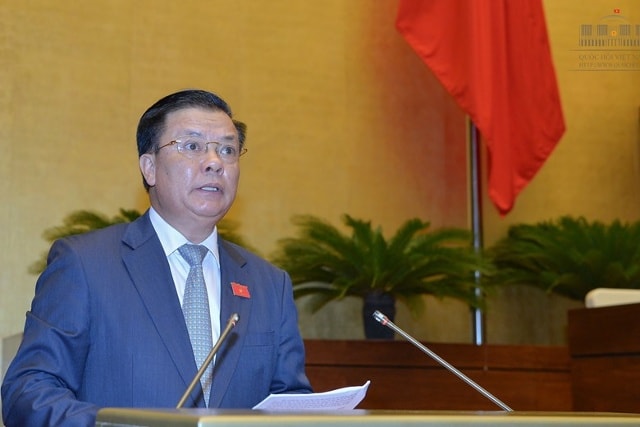 |
| Minister of Finance Dinh Tien Dung speaks about the issue of public debt. |
In terms of scale, in 2015, total public debt was approximately 2.68 trillion VND, 2.3 times higher than in 2010, 7.6 times higher than in 2005, and 14.8 times higher than in 2001. The rate of increase in public debt during the 2011-2015 period was 18.5% per year, three times higher than the economic growth rate.
In its annual implementation, Vietnam has had to apply debt refinancing measures: In 2013, it had to refinance 47,000 billion VND, just one year later, the amount refinanced increased to 106,000 billion VND, and this figure reached 125,000 billion VND in 2015. In 2016, it is projected that another 95,000 billion VND will have to be refinanced.
Nevertheless, the head of the Ministry of Finance also affirmed that, in the past two years, the restructuring of public debt (including repayment terms and interest rates) has significantly improved, with "repayment terms being doubled and interest rates being halved."
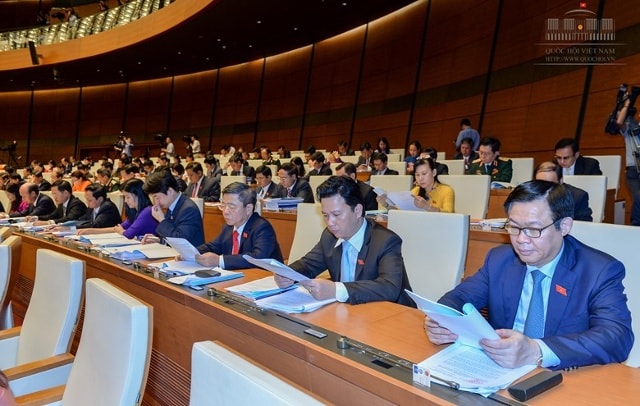 |
| Delegates engaged in lively discussions in the National Assembly. |
Explaining the medium-term public investment plan, Minister of Planning and Investment Nguyen Chi Dung stated that the current challenge for the Government is that, in the context of limited budget resources, there are currently two opposing viewpoints: On the one hand, it is argued that investment should be concentrated on a few "leading" sectors, fields, and localities to create a ripple effect and contribute increasingly to revenue; on the other hand, attention should be paid to disadvantaged localities to narrow the development gap.
In the afternoon session, the National Assembly continued its plenary discussion on the results of the implementation of the state budget in 2016; the state budget estimates and the plan for allocating the central budget in 2017.
 |
 |
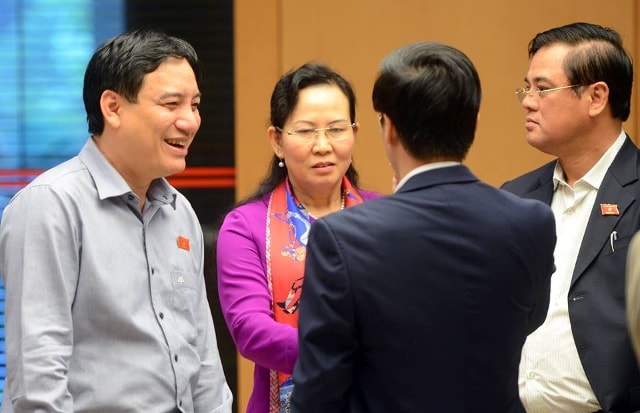
| Delegates exchanged views on the sidelines of the session. |
The atmosphere in the parliament became tense between two opposing viewpoints: one, from representatives of disadvantaged localities, argued that the State should allocate resources to help these localities stabilize their livelihoods and invest in essential infrastructure projects.
Meanwhile, another viewpoint suggests that local budgets will face significant difficulties and struggles if revenue retention is drastically reduced (for example, Da Nang reduced its retained budget by 17% from 85% to 68% and Ho Chi Minh City reduced it by 5% from 23% to 18%).
In his presentation to the National Assembly, Minister of Finance Dinh Tien Dung stated that he hoped the 16 localities that contribute to the central government would share the burden with the remaining 47 localities that are receiving subsidies from the state budget. The Ministry of Finance assessed these 16 localities as "golden geese" for the state budget and emphasized the need for sharing resources with the central government for the common good of the country.
Gim Duong - Anh Tuan


