
Regulations will be established regarding students' use of Facebook.
Using technological devices is a necessary need for students, but certain rules are needed to limit the negative impacts of these devices.
At the press conference introducing the 4th Information Technology Festival of the Hanoi Department of Education and Training, Mr. Pham Xuan Tien, Deputy Director of the Hanoi Department of Education and Training, assessed the importance of information technology in the process of reforming teaching methods.
Thanks to the application of information technology in teaching, students are more interested in learning and absorb lessons faster. For example, when learning about a chemical reaction, students learn about the chemical substances and the reaction process without needing to use actual chemicals.
Or, in Literature class, when teaching about a word related to a place name, the teacher doesn't need to describe it in detail using specific words; instead, they can show the students a picture or take them on a virtual tour of that place.
The development of information technology has greatly benefited teaching and learning. However, it also has negative aspects. Many students become overly dependent on technology, gradually losing their social communication skills. Many access the internet to inappropriate websites and harmful information.
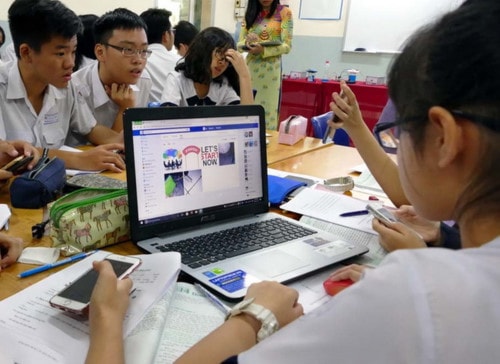
Nowadays, tablets, smartphones, and other electronic devices are very common among students. However, there are many cases of misuse, affecting the quality of lessons, or leading to the posting of content that negatively impacts friends and teachers.
Mr. Tien stated that students could be allowed to use phones at the beginning, end of class, or during recess, but during class time, their use should be absolutely prohibited to avoid distractions while the teacher is lecturing.
It's also possible that each classroom will have a small locker for storing phones. Students can put their phones in the locker when they arrive at class and retrieve them at the end of the day. The regulations will also outline disciplinary measures for students who violate the rules.
It will be impossible to ban students from using Facebook. However, there will be some regulations such as prohibiting them from insulting friends, speaking ill of others on their personal pages, and sharing posts that are inappropriate or violate moral standards.
Students can use their personal profiles to share useful lessons and good experiences to support their studies. Recently, there have been many incidents of students speaking ill of each other on Facebook, leading to conflicts and negatively impacting their studies.
Mr. Tien stated that these regulations are expected to be included in the school's code of conduct: Previously, many schools in the area had separate regulations regarding teachers and students' use of phones and Facebook. Therefore, the Department will issue unified regulations across the province.


