
The Government Inspectorate has pointed out a series of violations in BOT and BT projects.
The Government Inspectorate has just issued an official announcement concluding its inspection of compliance with legal regulations in the implementation of several investment projects under the build-transfer (BT) and build-operate-transfer (BOT) contract forms in the fields of transportation and environment at the Ministry of Transport.
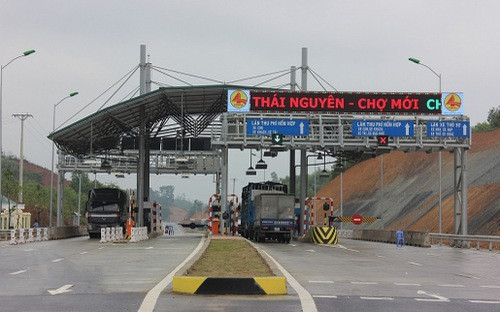 |
Combining the renovation and upgrading of 7 km of National Highway 3 with the new construction of the Thai Nguyen-Cho Moi road into a single project, and then placing two toll stations in two different locations for each project, is illogical. |
100% of BOT and BT projects are awarded through direct negotiation.
Specifically, according to the Government Inspectorate, during the implementation process, the Ministry of Transport did not fully comply with the procedures for compiling and publishing the list of projects calling for investment in the form of BT and BOT projects in January of each year as stipulated by the Government. This resulted in essential information about investment policies and projects not being comprehensively and promptly disclosed to investors, limiting the number of potential investors participating.
In fact, since the implementation of BT and BOT investment contracts in the transportation sector, more than 70 projects have been completed without selecting investors through competitive bidding. 100% of these projects were awarded through direct negotiation, with some selected investors lacking the necessary capabilities, leading to numerous shortcomings and errors that limit project effectiveness.
For example, 3/4 of the companies in the consortium of investors implementing the Phuoc Tuong and Phu Gia road tunnel projects failed to contribute capital as committed, had to withdraw from the consortium, and requested a maximum reduction in their capital contribution ratio. The consortium had to invite replacement contractors, leading to project delays.
Corporation 36, a company in the consortium of investors implementing the Hoa Lac - Hoa Binh road project and the renovation and upgrading of National Highway 6 section from Xuan Mai to Hoa Binh, committed to contributing over 67.3 billion VND, while its equity capital is 285 billion VND, but it has already invested 279 billion VND in the BOT National Highway 19 project…
Regarding the approval of investment content, the total investment amount, according to the Government Inspectorate, is not in accordance with regulations and contains some discrepancies.
The Ministry of Transport still places too much emphasis on the project's return on investment, lacking proper research into the ability of road users to pay tolls, as well as the impact on transport operating costs and social costs, before deciding to invest in projects; placing some toll stations at unreasonably close distances, with high and rapid increases in tolls, causing difficulties for road users and leaving them with no other options. Typical examples include Hanoi, Thai Binh, Nam Dinh, Hoa Binh, etc., leading to a situation where drivers try to avoid toll stations.
On the other hand, the financial planning of some projects lacks accuracy in determining revenue, and the actual revenue of some projects differs significantly from the financial plan, which will be a burden for people and businesses using the roads due to the extended toll collection period.
It mostly involves renovating and upgrading existing roads.
The conclusion of the Government Inspectorate also clearly indicates that most BOT investment projects involve upgrading existing roads, thus exacerbating traffic congestion in already crowded areas, and failing to aim at expanding the network and rationally allocating traffic lanes.
Some projects, such as the Hoa Lac-Hoa Binh road and the upgrading of National Highway 6 section from Xuan Mai to Hoa Binh, the Thai Nguyen-Cho Moi road project, and the upgrading of the Phap Van-Cau Gie road, have had their investment scale and classification decisions inconsistent with the approved plan.
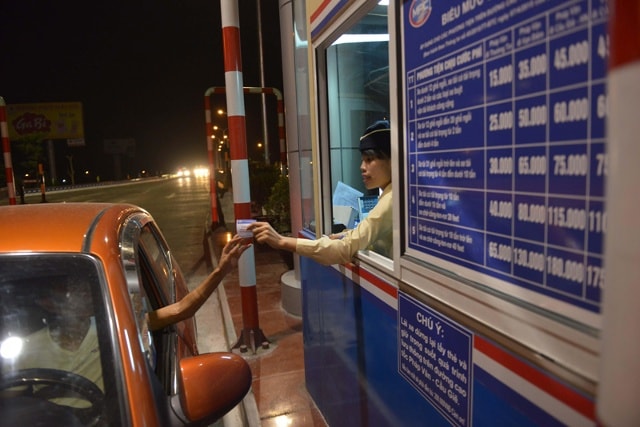 |
| Toll collection on the Phap Van - Cau Gie Expressway. Photo: Vnn |
When approving investment projects, the renovation and upgrading of National Highway 6 were combined with the construction of the new Hoa Lac-Hoa Binh road, and the renovation and upgrading of 7 km of National Highway 3 were combined with the construction of the new Thai Nguyen-Cho Moi road into a single project, with each project having two toll stations in two illogical locations.
The approval of the investment project to upgrade the Phap Van - Cau Gie road in two phases has not ensured good connectivity and synchronization with existing transportation and technical infrastructure items.
The project to restore and upgrade National Highway 20 from Km123+105 to Km268 approved the purchase of toll station operating rights for another project not included in the total investment; approved land clearance costs that were inaccurate and significantly different from reality; and approved the separation of the National Highway 20 upgrade project from Km0+000 to Km123+105 from the overall project from Km0+000 to Km268 into an independent project, but failed to fully comply with regulations on project appraisal to determine costs appropriate to the time of approval.
Upon reviewing several aspects of the total investment for 6 projects, it was found that the approved value was incorrectly inflated by over 451.6 billion VND.
Specifically, the Phuoc Tuong and Phu Gia road tunnel projects cost over 44 billion VND; the Phap Van-Cau Gie road upgrade project cost 18.8 billion VND; the Hoa Lac-Hoa Binh road project and the renovation and upgrading of National Highway 6 section from Xuan Mai to Hoa Binh cost over 51.2 billion VND; the Thai Nguyen-Cho Moi road project cost over 101 billion VND; the restoration and renovation project of National Highway 20 section from Km0+000 to Km123+105 cost over 225.195 billion VND; and the restoration and renovation project of National Highway 20 from Km123+105 to Km268 cost 11.14 billion VND.
According to the Government Inspectorate, the results of capital mobilization for BT and BOT projects did not achieve the goal of diversifying capital sources and economic sectors participating in investment; the financial plans were inaccurately determined, especially the traffic toll collection plan.
Accordingly, in addition to the corresponding capital contribution of 12% - 15% from investors, the remaining 100% is borrowed from banks at high interest rates, with no other sources of capital involved; the majority of the loans are from state-owned commercial banks with controlling stakes in the charter capital and government-guaranteed loans.
The outdated toll collection methods cause traffic congestion, especially the unreasonable placement of toll stations such as: placing toll stations outside the project area (Phuoc Tuong road tunnel project, Phu Gia tunnel project); using toll stations on one road to support toll collection for investment in another road project (Thai Nguyen-Cho Moi road project, Hoa Lac-Hoa Binh road project and the renovation and upgrading of National Highway 6 section Xuan Mai-Hoa Binh...).
The fee collection mechanism for capital recovery is inadequate; fee rates are high and adjustments are unreasonable; projects are not yet completed but are already collecting fees equivalent to those of new investment projects…
"These shortcomings, from various perspectives, have a certain impact on the interests of investors, the State, and especially create pressure on traffic costs for people and transportation operating expenses. In reality, there have been several incidents where people have expressed their grievances and gathered in large numbers to protest, and to date, there has been no definitive solution," the Government Inspectorate pointed out.
According to Kieu Linh/Vneconomy


