
The Prime Minister directs urgent response to Typhoon No. 3.
Prime Minister Pham Minh Chinh has just signed and issued Official Dispatch No. 86/CD-TTg dated September 3, 2024, directing ministries, agencies, and localities to urgently implement measures to respond to Typhoon No. 3 of 2024.
Official dispatch sent to the Secretaries and Chairmen of the People's Committees of the provinces and cities of: Quang Ninh, Hai Phong, Thai Binh, Nam Dinh, Ninh Binh, Thanh Hoa, Nghe An, Ha Tinh, Quang Binh, Quang Tri, Thua Thien Hue, Da Nang, Quang Nam, Quang Ngai, Lang Son, Cao Bang, Bac Kan, Thai Nguyen, Ha Giang, Lao Cai, Yen Bai, Tuyen Quang, Phu Tho, Hoa Binh; and the Ministers of the Ministries of: National Defense, Public Security, Natural Resources and Environment, Agriculture and Rural Development, Industry and Trade, Transport, Construction, Foreign Affairs, Culture, Sports and Tourism.
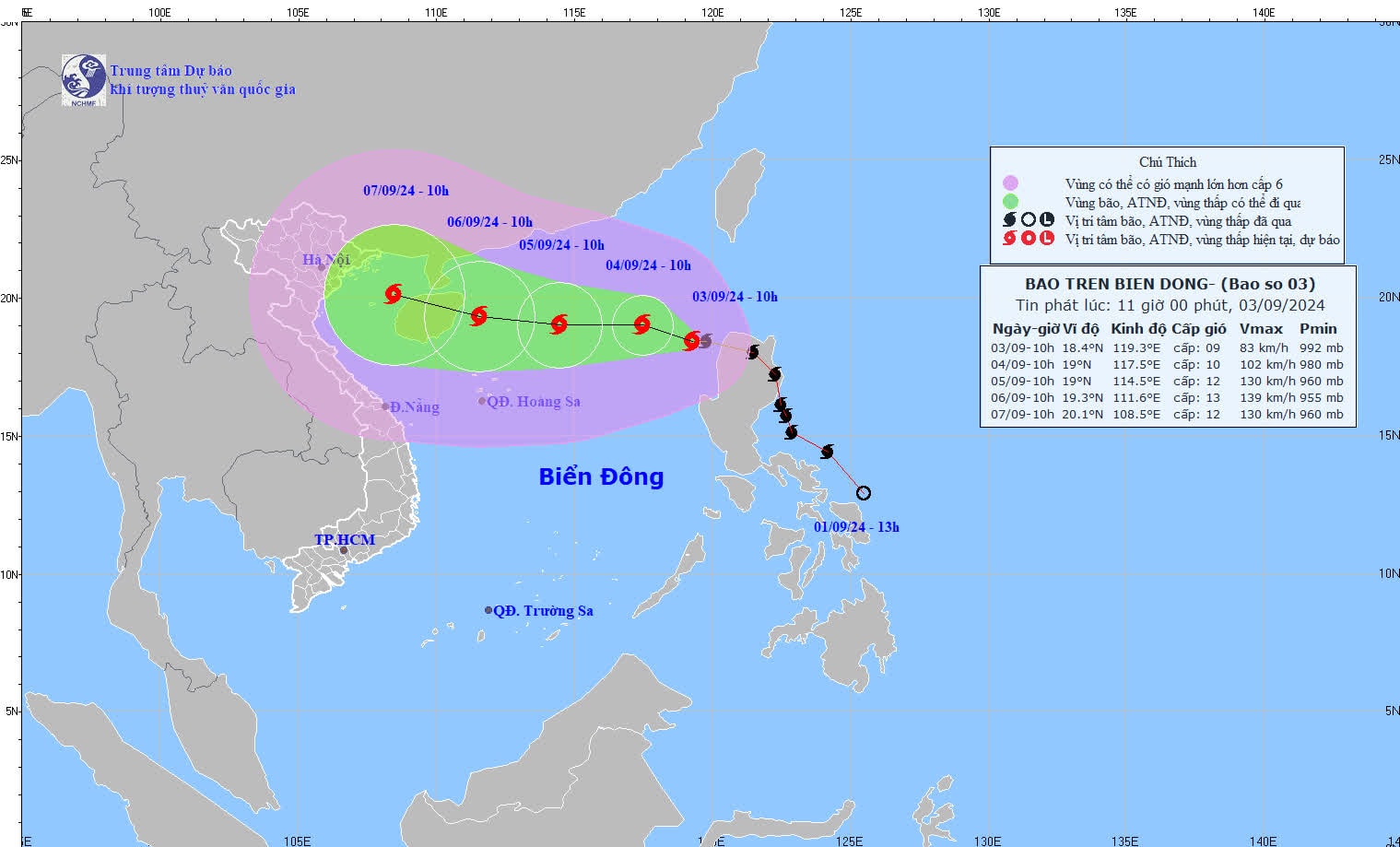
This morning (September 3, 2024), the storm, internationally named YAGI, crossed Luzon Island (Philippines) into the northeastern South China Sea, becoming the third storm to operate in the South China Sea in 2024. The strongest winds near the storm's center reached level 8, with gusts up to level 12.
Forecasts indicate that Typhoon No. 3 will continue to strengthen, with maximum wind speeds at sea potentially reaching level 13, gusting to level 16 in the coming days. It is moving rapidly towards Hainan Island (China) and the Gulf of Tonkin, with a very high probability of directly affecting the sea and land areas of Northern and North Central Vietnam.
This is a predicted storm of very strong intensity. To proactively respond to the storm and the resulting floods, the Prime Minister requests:
1. Ministers of ministries and Chairpersons of People's Committees of the aforementioned localities shall proactively organize the close monitoring of forecast information and developments of storms, rain, and floods, and promptly direct and implement response work according to the "four on-the-spot" principle within their assigned tasks and authority, avoiding passivity and surprises to ensure the safety of lives and minimize property damage for the people.
2. The Chairpersons of the People's Committees of the aforementioned provinces and centrally-administered cities shall, based on the actual situation and the potential impact of storms and floods in their localities, proactively provide timely information, guidance, and direction to the people in responding to storms and floods, including:
a) Focus on ensuring safety for activities at sea and on islands:
1) Organize the review and counting of vessels, proactively inform and guide vessels (including fishing boats, transport ships, and tourist boats) still operating at sea to be aware of and avoid entering or leaving dangerous areas, or to return to safe shelters; take measures to ensure the safety of vessels at anchorage areas.
2) Review and implement measures to ensure safety for tourism, aquaculture, and fishing activities in the sea, estuaries, and coastal areas; resolutely evacuate people from aquaculture rafts and watchtowers to safe places before the storm directly impacts them.
3) Based on the specific situation, proactively decide on prohibiting fishing vessels, transport ships, and tourist ships from sailing.
b) Ensuring safety in coastal and inland areas:
1) Proactively organize the evacuation of people from weak, unsafe houses and areas at risk of deep flooding and landslides, especially at river mouths and along the coast.
2) Implement measures to ensure safety and minimize damage to houses, warehouses, offices, public works, industrial zones, factories, and dikes; protect agricultural production and prevent flooding in urban and industrial areas.
3) Control travel, organize traffic flow, guide traffic, and restrict people from going out during storms and heavy rains to ensure safety.
c) Ensuring safety in mountainous areas:
1) Proactively relocate and evacuate people in areas at risk of deep flooding, flash floods, and landslides; prepare forces, vehicles, equipment, and essential supplies according to the "four on-the-spot" principle to be ready to respond to all situations.
2) Inspect and proactively implement measures to ensure the safety of reservoirs and downstream areas; deploy standing forces ready to operate, regulate, and handle emergency situations.
3) Control and guide traffic safely, especially through underpasses, overflows, areas with deep flooding, and areas with strong currents; proactively deploy forces, materials, and equipment to address incidents and ensure smooth traffic flow on major transportation routes.
4) Be prepared with personnel and resources to promptly carry out rescue and relief operations and quickly mitigate the consequences of storms and floods should they occur in your agency, unit, or locality.
3. The Minister of Agriculture and Rural Development shall closely monitor the situation of storms and floods, proactively direct and coordinate closely with the Ministry of Natural Resources and Environment, relevant ministries, sectors, and localities to promptly and effectively implement measures to ensure the safety of dikes and dams, protect agricultural production and aquaculture, and promptly report and propose to the Prime Minister any issues beyond his/her authority.
4. The Minister of Natural Resources and Environment shall closely monitor and strengthen the dissemination of forecasts, warnings, and timely information on the developments of storms, floods, and the risk of flash floods and landslides so that relevant agencies and the public can proactively implement response measures.
5. The Ministers of the Ministries of National Defense and Public Security shall direct the forces stationed in their respective areas to review response plans and proactively organize the deployment of forces and resources to be ready to support localities in responding to storms and floods, evacuating people, and conducting rescue operations.
6. Ministers of the Ministries of Transport, Industry and Trade, and other relevant ministries and agencies, according to their state management functions and assigned tasks, shall proactively direct and coordinate with localities to implement measures to ensure the safety of offshore oil and gas activities, mineral exploitation, and the power grid system; ensure the safe operation of hydropower reservoirs; and ensure traffic safety in accordance with regulations.
7. Vietnam Television, Vietnam Radio, Vietnam News Agency, and other media agencies should increase airtime and provide timely coverage of the developments of the storm and floods, as well as the response efforts, so that people are aware and can proactively take preventive measures.
8. The Minister of Health directs subordinate agencies to handle issues related to environmental sanitation, food safety, etc., caused by storms, rain, and floods.
9. Deputy Prime Minister Tran Hong Ha is assigned to directly monitor and direct the implementation of this directive by ministries, agencies, and localities.
10. The Government Office, in accordance with its assigned functions and duties, shall monitor and urge the implementation of this Official Dispatch, and promptly report to the Prime Minister and the Deputy Prime Minister in charge of any unforeseen or emerging issues./.


