
Finding the 'Leader' in Orange Farming
(Baonghean) - In recent days, I've been quite surprised to receive numerous calls from orange growers in Nghia Dan and Quy Hop districts. They all expressed feelings of hurt and wounded pride when comparing Vinh oranges with Cao Phong oranges (Hoa Binh province) after learning about a lavish orange festival held in the North. Some even suggested that the Cao Phong Orange Festival was a "slap in the face" to the self-respect of those who have cultivated the Vinh orange brand for decades.
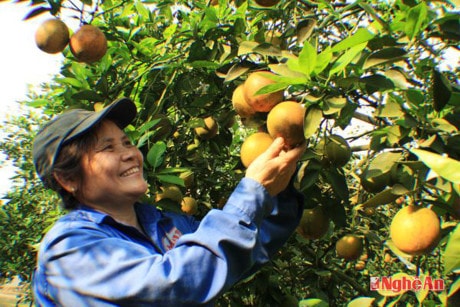 |
| Cam Vinh, a product from Nghe An province, has been granted a geographical indication by the province (Photo courtesy). |
"Bringing the Vinh orange brand to the global market."
What direction should the Vinh orange brand take?
When discussing this issue with a leader in the province's Science and Technology sector, he stated that no one denies the value of Vinh oranges, from their nearly century-old tradition to their quality and brand... but what Nghe An is lacking is a "leader." As explained by the Science and Technology leader, in any troop of monkeys, there must always be a leader to guide the group, from foraging for food to protecting their safety and maintaining order to adapt to the natural environment.
Similarly, in manufacturing and business, there will need to be strong enough enterprises to lead and guide the entire group. These "leading" enterprises must have specific preferential mechanisms and policies from the State and must be bound by regulations when implemented.
However, the reality of production and business is the opposite. Take Vinh oranges, for example. Everyone knows that Vinh oranges have been known for centuries, even being exported to Russia and Eastern European countries since the 1960s. Vinh oranges are so famous that they've even been featured in poetry, music, and art as a testament to the distinctive product of a barren, impoverished region. Vinh oranges have established a brand, geographical indication, and, more importantly, orange growers have become high-income earners and noticeably wealthier. So what more is there to discuss?
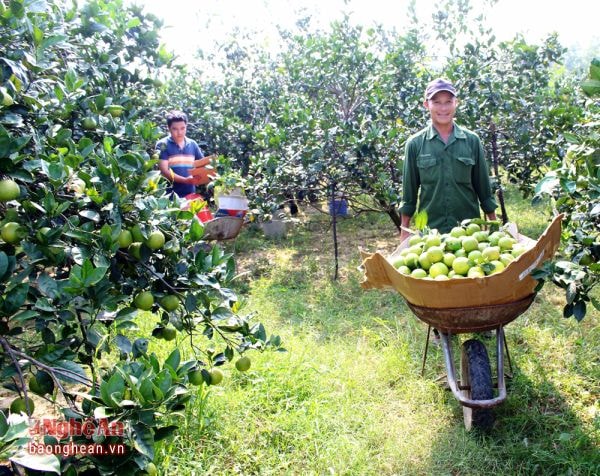 |
| Farmers in Nghia Hong commune (Nghia Dan district) harvest oranges. Photo: Thai Truong |
The problem with Vinh oranges lies in the mindset of small-scale farmers and farmers.
With approximately 2,000 hectares, Vinh oranges are currently mainly distributed in the districts of Nghia Dan, Quy Hop, Con Cuong, Anh Son, Thanh Chuong, and Yen Thanh. In reality, most orange growers today are those who started their family businesses, with many originating from former state-owned agricultural and forestry farms. In the new context, these state-owned farms have been forced to transform their operations from state-owned units into joint-stock companies or limited liability companies.
The households transitioned from being laborers to receiving land under contract and paying annual rent. On the contracted land, some households had a few hectares, while others had as little as 0.5-1 hectare. The people continued to cultivate Vinh oranges, a traditional crop. Although the area was not large, the value obtained from the oranges was consistently high and stable, leading the households to become complacent.
Isn't an average profit of 300-500 million VND per hectare of oranges per year already quite satisfying? Everyone does things their own way, from choosing orange varieties and cultivation methods to planning the orchards and determining wholesale and retail prices. The market's demand for uniformity in a product with a shared brand and geographical indication is nowhere to be seen.
And consumers have no way of distinguishing between genuine Vinh oranges and those with unique characteristics. Communication, promotion, and marketing of Vinh oranges have long been conducted through word-of-mouth.
Even the process of bringing oranges to market is fragmented, with each household acting independently and primarily selling to small traders and retailers at markets and on sidewalks. They don't participate in any associations and operate without any standardized regulations… All of these factors put Vinh oranges at a disadvantage and make them vulnerable to competition from similar agricultural products from other localities.
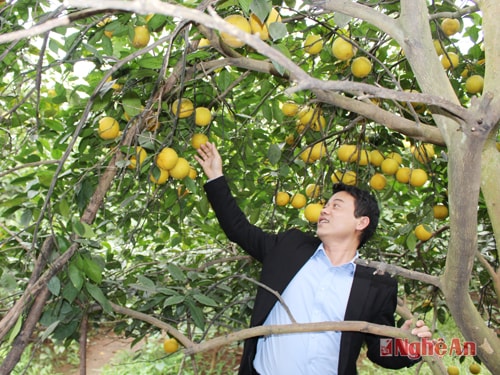 |
| Near Ve Vung Lake (Yen Thanh), tourists can visit the 25-hectare orange farm of Mr. Nguyen Huu Binh's family in Dong Trung hamlet, Dong Thanh commune. The orange cultivation model has been recognized by the North Central Vietnam Institute of Science and Technology as meeting VietGAP standards. |
At this point, the role of the "leading enterprise"—a business strong enough to manage the entire value chain from cultivation to market—becomes the guiding force. This leading enterprise must address all the aforementioned realities, supported by government policies and mechanisms. From there, issues of agricultural product quality, branding, promotion, and product protection will be ensured.
Leading businesses will gather around themselves orange growers as a satellite system to ensure related interests are protected. This is how Vinh oranges can move from a branded ticket to the market. Realizing this requires the involvement of the State, from mobilizing and creating a path for businesses to unifying the legal and technical framework from production to market.
It's not just Vinh oranges; the lack of a "leader" is happening with almost all of Nghe An's characteristic agricultural products. It's also argued that the mindset of small-scale farmers, with their subtle competition for market influence, is stifling the value of Nghe An's distinctive agricultural products. According to the head of the Department of Science and Technology, he recently submitted two agricultural products to the Intellectual Property Office (Hanoi) for geographical indication and trademark protection: Tri Le passion fruit and Nghe An peanuts.
However, the Intellectual Property Office only granted protection to one of the two aforementioned agricultural products: Tri Le passion fruit. Why wasn't Nghe An peanut, with the largest area, highest production, and highest quality in the country, protected? Simply because there wasn't a strong enough enterprise to take the leading role.
Dao Tuan


