
Automatic cars can go 'crazy' if driven by inexperienced drivers.
Many people label automatic cars as "crazy," and perhaps there's still much to discuss on this topic. Here are some situations where automatic cars, according to drivers, act "crazy."
Perhaps no one is ever taught how to start an automatic car, so I'll venture to use my own experience as an example. The first car I drove before getting my license was guided by my older brother: "Press the brake -> Start the engine -> Shift to D (or S if there's a sport mode) -> Release the brake and gradually press the accelerator." The car would slowly move; it was all so simple.
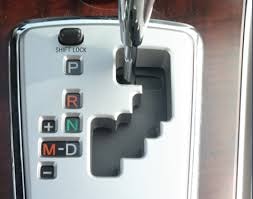 |
| Automatic transmission car. (Illustrative image) |
The second way to start a new Accord, as instructed by a friend, is: "Press the brake pedal -> Start the engine -> Shift to D -> Release the brake pedal, the car will slowly move forward -> Move your foot from the brake pedal to the accelerator pedal to continue driving."
The third method I was instructed on by the dealer when test driving the Fiat 500 was even simpler: "Start the engine normally -> Shift to D or switch to (+), (-) mode -> Press the gas pedal slowly to get the car moving. If in (+), (-) mode (manual mode) -> Release the gas pedal, press + once to shift, press + a second time to shift into the next gear. It's all very simple."
I don't know if there are any other automatic cars that have different starting methods, but the second method once caused a stir when taxi drivers even appeared on television claiming that Ford's accelerator pedal was faulty. However, we must understand that with automatic cars, we have to start them the way the manufacturer programmed them.
Situations that cause automatic cars to go "crazy" according to the driver.
Returning to the main point, regardless of how you start it, the acceleration of an automatic car depends on the accelerator pedal. If the driver presses the accelerator gently, everything proceeds normally. However, the car can easily cause chain-reaction collisions if, for some reason, the driver misjudges the accelerator, presses it too hard, or mistakenly presses the wrong pedal during an emergency. In this case, it's not the car that's "crazy," but the driver who's "crazy," only the car can't help; it will "crazy" along with the driver.
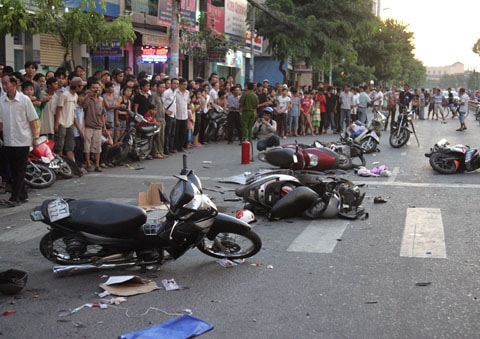 |
| Scene of the multi-vehicle accident that killed 2 people and injured 12 in Ho Chi Minh City on October 12, 2011. |
While the vehicle is in motion
If you're driving in city traffic in 3rd or 4th gear (you won't see this unless the car has a gear selector display like the Fiat 500) and you hit someone, the consequences will be minor if you brake in time. However, if you accidentally press the accelerator, it's a disaster; a series of collisions will occur because when encountering an obstacle, the high resistance combined with the reduced speed will cause the car to automatically shift to a lower gear to increase traction.
Even a passenger car can easily run over several motorbikes, unlike a manual transmission vehicle. If it's a heavy-duty truck, the consequences are far more serious. Fortunately, there aren't any automatic transmission trucks in Vietnam yet. And when driving at high speed on the highway and crashing into someone, it doesn't help at all.
When climbing obstacles or reversing.
According to proper procedure, you should only use one foot to control both the accelerator and brake pedals. In situations involving obstacles or climbing hills, pressing the accelerator too hard can cause the car to lurch forward, leading you to panic and mistakenly press the brake instead of the accelerator (when you need to use the brake). This can be even more serious. Mistakes like crashing into houses while climbing curbs or falling into rivers due to reckless reversing are very common.
The solution is to move your left foot over the brake pedal when climbing an obstacle in the city or when reversing. It's a unique method, and I don't know if anyone else teaches it, but if it were recognized and included in textbooks, the risk of this type of accident would certainly be significantly reduced. In the event of an accident like this, the only conclusion would be that the driver was reckless, not that the car was "crazy."
When you're driving a car with a manufacturing defect.
This is a hopeless situation; it's all down to luck. Even American traffic inspectors have died in accidents with this type of vehicle, despite lengthy attempts to call for help. The manufacturer is the one at fault, not the car.
Things change if you're in a manual transmission car.
In summary, comparing manual and automatic cars, we can conclude that neither car is "crazy"; the fault lies with the driver or the manufacturer. However, in some cases, a manual car can inadvertently help you reduce or prevent consequences, while an automatic car can't do anything. Therefore, it's a "stupid" car, not a "crazy" car as some people claim.
The global trend in vehicle development is towards convenience and safety, but perhaps many issues still remain in the development process. Not all vehicles produced are perfect; for drivers to ensure their own safety and the safety of others, they must first improve their driving skills and thoroughly understand the vehicle they are operating. Only then can they truly master it.
This will prevent unfortunate accidents caused by a lack of knowledge or laziness. Manual transmission cars are complex but simple if you master them; automatic transmission cars are simple but can be problematic if you are lazy to learn and overconfident.
According to VNE


