
Alarming increase in rural traffic safety.
(Baonghean) - Rural transportation is an essential infrastructure system connecting rural areas with national highways, provincial roads, urban areas, and economic zones; promoting socio-economic development in the rural areas of our province. A worrying issue currently is the lack of traffic safety in rural areas...
Infrastructure shortcomings
Nghe An's rural road network currently accounts for over 70% of the province's total road network length. This includes 378.4 km of district roads, 11,882.5 km of commune roads, 633.1 km of urban roads, 372 km of specialized roads, 25 ferry crossings, and 1,325 bridges of various sizes along district and commune roads. The development of Nghe An's rural road network is ongoing. From 2010 to the present, the length of rural roads has increased by 3,172 km; 242 bridges of various sizes have been newly constructed on district and commune roads. However, according to the Provincial Traffic Safety Committee's assessment, rural roads have the lowest technical classification; they are narrow, two-way roads without a median; the permitted speed is low; the signaling system is inadequate, visibility is limited in many sections; and the road surface quality is poor.
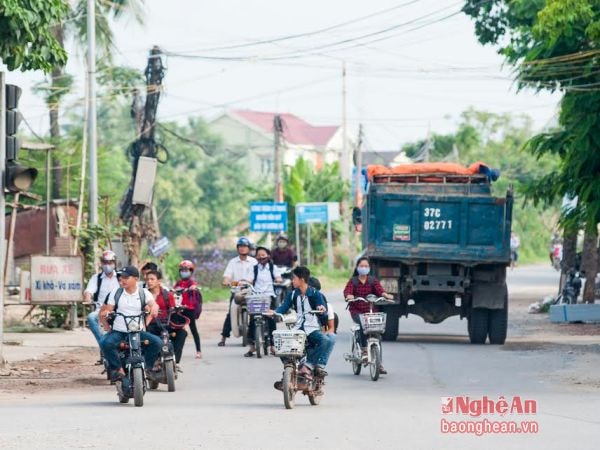 |
| Traffic is chaotic in Hamlet 5, Xuan Hoa Commune (Nam Dan District). |
Mr. Vo Minh Duc, Chief of the Provincial Traffic Safety Committee Office, stated: While more and more rural roads are being concreted, auxiliary equipment is almost nonexistent. This is because most of the funding for road improvements comes from fundraising and donations, primarily focusing on the roadbed. As a result, intersections, market areas, and blind spots lack warning signs, and sections passing through dangerous areas also lack guardrails. Meanwhile, in recent years, due to improved living conditions, the number of vehicles in rural areas has increased rapidly, especially motorcycles and small trucks.
In the first six months of 2016 alone, Nghe An province registered 6,290 new cars, 67,801 new motorcycles and scooters, and 16,745 new electric motorbikes. The rapid increase in the number of vehicles, coupled with inadequate transportation infrastructure, has led to increasingly complex and escalating traffic accident situations in rural areas.
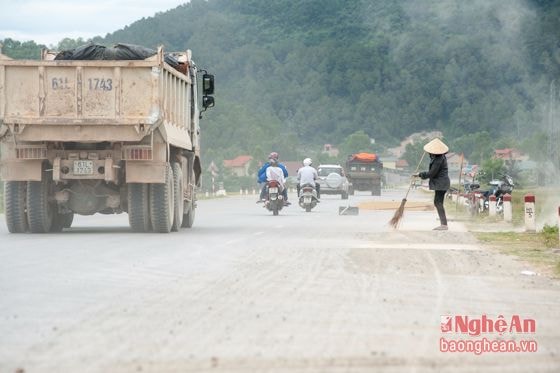 |
| People are drying rice on National Highway 46B, the section passing through Hung Tay commune (Hung Nguyen district). Photo: Thanh Cuong |
As someone who has been involved in handling traffic accidents in rural areas, Mr. Vu Dinh Can - Head of the Public Security Department of Tang Thanh Commune (Yen Thanh District) said: During the process of building new rural areas, the roads in the commune have been basically "hardened". On inter-commune roads, along with cars and motorbikes, many rudimentary vehicles participate in traffic. Meanwhile, trees planted by people encroaching on traffic safety corridors have not been completely dealt with, rural roads lack sidewalks; there are no speed limit signs, and no traffic lights at intersections... These are the main causes of accidents. In Tang Thanh commune, since the expansion of Road 534 running through the area, accidents frequently occur at intersections between motorbikes coming from village roads and cars traveling on this main road.
| To prevent and minimize traffic accidents in rural areas, the National Traffic Safety Committee has proposed solutions, focusing on raising awareness and encouraging rural residents to voluntarily comply with traffic safety laws and regulations, and to implement accident prevention measures such as wearing helmets when riding motorcycles, adhering to speed limits, reducing speed and observing safely when entering main roads from side roads; and not driving after consuming alcohol. |
Cognitive limitations
It can be seen that the main reasons for the increase in rural traffic accidents in recent times are that although road surfaces in rural areas have improved due to upgrades, allowing vehicles to travel faster, the roads remain narrow, visibility is limited, and there is a lack of traffic signs, making collisions more likely. In addition, the knowledge of traffic laws among road users in these areas is still limited. Meanwhile, the traffic patrol and control force on rural roads is insufficient and thinly spread. Local traffic police patrols are usually only deployed on national highways, provincial roads, and at most, district roads. Inter-commune and inter-village roads are almost completely neglected, lacking traffic control.
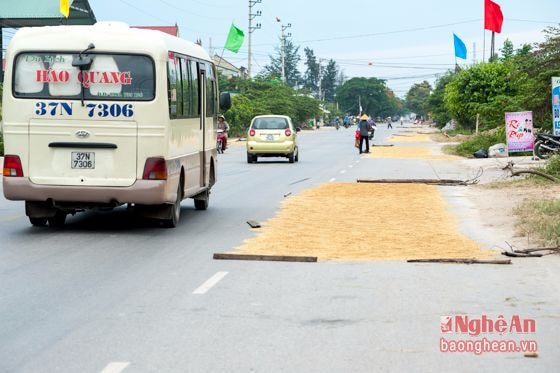 |
| Dang Thai Mai Street (North Vinh Industrial Zone) has also been turned into a rice drying area. |
According to statistics from the Provincial Traffic Police Department, people in rural areas often commit several typical traffic violations such as: driving on the wrong side of the road; carrying more passengers than allowed; not wearing helmets when riding motorcycles; reckless driving, speeding, driving under the influence of alcohol; driving without a license or with an invalid license (in the first six months of 2016, accidents due to lack of attention resulted in 21 deaths, and accidents due to speeding resulted in 22 deaths). In addition, most people live along traffic routes but have poor awareness of traffic laws, and the encroachment on traffic safety corridors for setting up stalls, drying straw, rice, etc., still occurs frequently in localities throughout the province.
Lieutenant Colonel Duong Thanh Canh, Deputy Head of Tan Ky District Police, stated: Rural traffic accidents mainly occur due to the awareness of drivers, with many cases resulting from driving under the influence of alcohol. In Tan Ky, accidents often occur on the Ho Chi Minh Highway passing through the district, because vehicles travel at high speeds on this road, while people follow the custom of "every man for himself" when participating in traffic on rural roads.
| According to data from the Traffic Police Department, in 2015, traffic accidents on rural roads (from district roads downwards) accounted for 10.93% of the total number of accidents, 12.67% of fatalities, and 11.63% of injuries, with motorcycle accidents accounting for up to 80%. If provincial roads are included, the number of accidents on rural roads accounts for over 28% of the total number of road traffic accidents, and approximately 70% of all road traffic accidents occur on rural roads. In the first three months of 2016, rural traffic accidents accounted for 12.1%, and if provincial roads are included, the figure rose to 28.1% of the total number of road traffic accidents. |
Things to do
To reduce rural traffic accidents, Mr. Vo Minh Duc added: First, localities need to quickly install traffic signs and safety equipment in rural areas, build speed bumps from secondary roads to main roads; and at the same time, encourage people to clear trees and trim fences to avoid obstructing visibility at intersections on inter-commune and inter-village roads. In addition, it is necessary to mobilize forces to ensure traffic order and safety in rural areas, with the core being the district and commune police forces, to increase patrols, inspections, and handling of violations on roads where accidents frequently occur. It's not just about raising awareness and reminding people, but also about handling violations to improve people's traffic awareness. Furthermore, it must be recognized that ensuring traffic order and safety in rural areas is the responsibility of the entire society, the entire political system, first and foremost the relevant state agencies, and especially the local government and its leaders, who need to take decisive action.
Duc Dung
| RELATED NEWS |
|---|


