
Typhoon No. 4, with gusts reaching level 10, will directly affect Nghe An province.
(Baonghean.vn) - According to the North Central Meteorological and Hydrological Station, Typhoon No. 4 (Sonca) will directly affect Nghe An, causing heavy rain and strong winds.From July 25th to 26th.
On the afternoon of July 24th, Mr. Nguyen Xuan Tien, Deputy Director of the North Central Meteorological and Hydrological Station, stated that Typhoon No. 4 would directly affect Nghe An province.
At 13:00 on July 24th, the center of Typhoon No. 4 (also known as Sonca) was located at approximately 17.3 degrees North latitude and 110.8 degrees East longitude, about 140km southeast of Hainan Island (China). The strongest winds near the center of the typhoon were at level 8 (60-75 km/h), with gusts of level 9-10.
The forecast for the next 24 hours indicates the storm will move in a west-northwest direction at a speed of 10-15 km/h. By 10:00 AM on July 25th, the storm's center will be located at approximately 18.3 degrees North latitude and 108.1 degrees East longitude, in the southern part of the Gulf of Tonkin, about 200 km east of the coast of Thanh Hoa and Quang Binh provinces. The strongest winds near the storm's center will be at level 8 (60-75 km/h), with gusts of level 9-10.
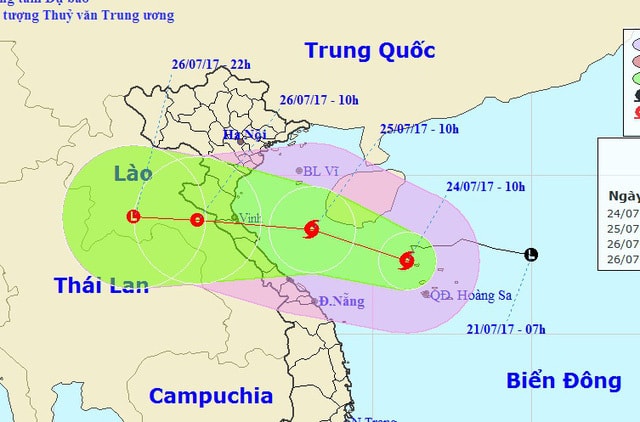 |
| Location and trajectory of Typhoon No. 4. |
Over the next 24 to 48 hours, the storm will move west-northwest at approximately 15 km/h, making landfall in the provinces from Thanh Hoa to Quang Binh and weakening into a tropical depression. By 10:00 AM on July 26th, the center of the tropical depression will be located at approximately 18.6 degrees North latitude; 104.5 degrees East longitude, over central Laos. The strongest winds near the center of the tropical depression will be at level 6 (40-50 km/h), with gusts at levels 7-8.
From tomorrow morning (July 25th), in the Gulf of Tonkin (including Bach Long Vi island district), winds will gradually strengthen to level 6, in the southern part of the Gulf of Tonkin, winds will reach level 7, and in areas near the storm's center, winds will reach level 8, with gusts of level 9-10; sea waves will be 3-5m high; in the coastal waters of provinces from Thanh Hoa to Quang Binh, waves will be 2-3m high. The sea will be rough.
Over the next 48 to 60 hours, the tropical depression moved mainly westward at a speed of about 20 km per hour, continuing to move inland and gradually weakening into a low-pressure area over central Laos.
With its predicted path, Typhoon No. 4 will directly affect Nghe An province. From July 25-26, 2017, the typhoon will cause heavy rain and strong winds.
Moderate to heavy rain and thunderstorms are expected at sea. Winds will gradually strengthen to force 6-7, reaching force 8 near the storm's center, with gusts of force 9-10. Wave heights will be 1.0-2.0m, gradually increasing to 2.0-3.0m; near the storm's center, waves will reach 3.0-5.0m. The sea will be very rough. The level of natural disaster risk from the storm is level 3.
On land, from the afternoon of July 25th to the end of July 26th, there will be moderate to heavy rain, with very heavy rain and thunderstorms in some areas. Wind speeds inland will be level 5-6, reaching level 7 in some coastal areas, with gusts exceeding level 7. The total rainfall for the entire period is likely to reach 100-200 mm.
 |
| Mr. Nguyen Xuan Tien, Deputy Director of the North Central Meteorological and Hydrological Station, said that Typhoon No. 4, with its current trajectory, will directly affect Nghe An province. Photo: Tran Chau |
Given this situation, the people need to...Regularly monitor and update yourself on storm forecasts broadcast on mass media to take appropriate preventive measures.
At sea, over the next 24 hours, ships and boats must move away from the dangerous area (strong winds of force 6 or higher, rough seas) from latitude 16.50N to 20.00N; west of longitude 113.00E. Near the center of the storm, winds will be strong at force 8, gusting to force 9-10; sea waves will be 3-5 meters high; and the sea will be very rough. It is necessary to constantly monitor the storm's path forecast to escape the dangerous area.
Inland, measures to protect against strong winds are necessary, such as trimming trees and reinforcing houses and structures. Coastal and mountainous areas, in particular, need to be prepared for flash floods and landslides; low-lying areas and urban centers need to be prepared for flooding.
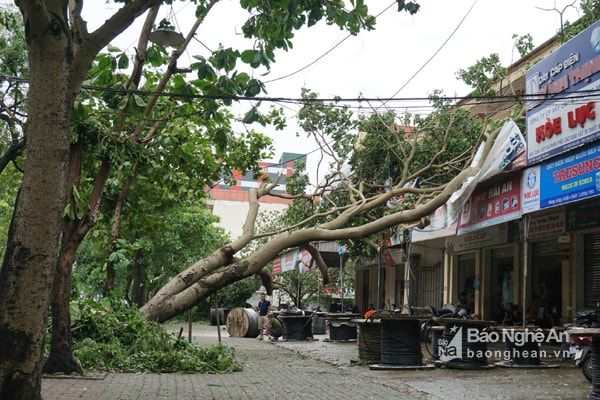 |
| Nghe An province suffered the most severe damage after typhoon No. 2. Photo: Tien Hung |
Nghe An province suffered the most severe damage after typhoon No. 2, with 136 houses completely destroyed, nearly 9,000 houses having their roofs blown off or damaged. Nearly 1,500 kiosks and shops were damaged, and hundreds of other houses had their roofs damaged by fallen trees or landslides… Many educational and medical facilities, cultural centers, transportation infrastructure, and irrigation systems were also severely damaged after Typhoon No. 2. Heavy rains caused by the typhoon flooded tens of thousands of hectares of crops. More than 300 livestock and 25,000 poultry died or were swept away. One fishing boat and three small boats were sunk, and dozens of hectares of shrimp ponds were damaged… As of July 21, 2017, the total damage caused by Typhoon No. 2 in Nghe An province was estimated at over 993 billion VND; of which, agricultural production accounted for nearly 574 billion VND, and infrastructure over 420 billion VND. |
Tran Chau - Ngoc Anh


