
Peace in the Catholic village
(Baonghean) - For the past five years, I have regularly returned to this peaceful Catholic village and found that life continues to flow as calmly and peacefully as ever. The veterans I have met and been close to for so long, more than anyone else, know how to cherish the tranquil life here…
“This season was a great harvest, brother,” – Mr. Tran Van Suu, residing in Team 3, Thanh An commune (Thanh Chuong district), called out from the other end of the line. “Come visit and you’ll see for yourself.” For many years now, despite being hundreds of kilometers apart, my family and Mr. Suu's have become close friends, even though we come from different regions and have different beliefs. Just now, he informed me about the recent spring rice harvest. The yield reached nearly seventy quintals per hectare.
Mr. Sửu didn't forget to remind me to "call me when we reach the fork in the trail so I can come and meet you." But I decided to walk to his house. These days, everyone in the house must be busy harvesting. Many places are harvesting the spring rice crop at this time, including Mr. Sửu's village.
Every time Mr. Suu returned to his Catholic village, Team 3, Thanh An commune (Thanh Chuong district), he would often ride his motorbike nearly 3km from his house to the Ho Chi Minh Highway to pick me up. His hospitality prevented him from letting me waste forty minutes walking. But this time, I "escaped" his presence and walked, wanting to leisurely admire the rural scenery of this semi-mountainous region. The rice fields were crisscrossed by undulating hills. This season, the rhododendron bushes began to burst into bloom, their tiny purple flowers peeking out from behind the bushes like children playing hide-and-seek or shyly peeking out from windows.
The countryside during harvest season is bustling with activity. Groups of people head to the fields to reap the crops. The men drive ox carts, a means of transport that has been used by the people of this semi-mountainous region for hundreds of years.
My younger brother married a woman from here, so every year I visit my "in-laws' house" in this small village, mostly inhabited by Catholics. For hundreds of years, Catholics and non-Catholics have lived together here, bound by strong bonds and unity. After the rooster crows at dawn, people call out to each other as they head to the fields, and at noon they return to enjoy a lively chat over green tea. Here, the hustle and bustle of the city melts away, and time seems to stand still. Small houses are nestled beside haystacks. Around the houses are adjacent gardens planted with perennial trees. On summer days, after lunch, the men and young boys gather to hang hammocks under the leafy canopy and take a nap, letting the cicadas chirp to their heart's content.
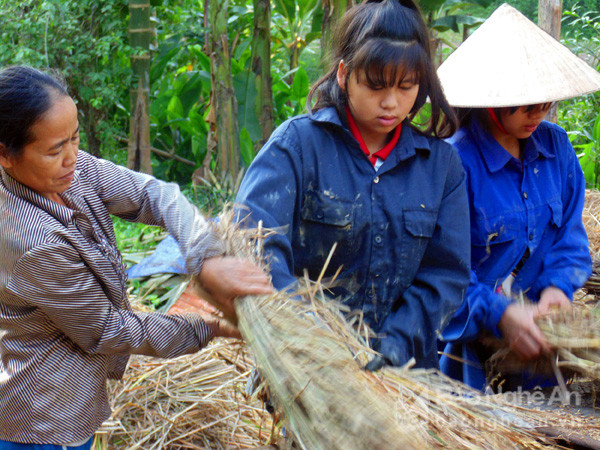 |
| People in Team 3, Thanh An commune (Thanh Chuong district) thresh rice. Photo: Huu Vi |
To be honest, I felt a great sense of relief returning to this small village with its still very difficult transportation.
Today I suddenly remembered that this is my first time visiting during harvest season. I arrived at the edge of the village quite early. The sun was just beginning to rise over the rolling hills near Cau Cau Lake. Yet, several ox carts carrying rice were already heading back to the village. The threshing machines rumbled loudly. The pile of straw discarded by the machine along the roadside was already half the height of a betel nut tree.
On the road leading into the village, the scent of freshly harvested rice wafted through the air. A group of young women, wearing straw hats and masks covering half their faces, were harvesting rice in the fields, their hands and arms wrapped in cloth socks. Another group, without sickles, had their hands and arms completely covered in cloth socks. This group simply went to the fields to collect the rice and load it onto trucks to take home, as their families had hired combine harvesters. This type of farming equipment was not unfamiliar to farmers in the lowlands, but it had only recently been introduced to the villagers.
After passing through two alleys, we arrived at Mr. Suu's two-story house. Seeing me appear from the entrance, he kept complaining, "Oh my God, I told you to call me to come pick you up. Why walk so far?" Mr. Suu was small and dark-skinned, with kind eyes, but his demeanor was as quick and agile as when he was a soldier. He was a veteran who fought on the Vi Xuyen - Ha Giang front in 1984-1985. In many conversations with me, the veteran occasionally recalled those battles. For months, he and his comrades held a high point called "Zone 4 Tunnels." During lulls in the fighting, they could hear the enemy talking from the other side of the tunnel. "That was the moment when we loved life the most," he once confided. That's why, upon returning to everyday life, this veteran, who is also a Catholic, cherishes the bountiful harvests even more. It was no coincidence that he invited me to "come visit" during the harvest season. A successful rice crop is a source of pride not only for Mr. Suu but also for the entire poor village in this semi-mountainous region.
"This spring, our family harvested over a ton and a half of rice," Mr. Suu said, stopping his threshing work to welcome me into his house. His family was probably one of the few in the village still using a small electric threshing machine. It was a sign of mechanization, making the work less strenuous for his hands and feet.
In the small courtyard in front of the house, countless golden grains of rice tumble down in a flurry of turning rice husks. With a large family, always seven or eight mouths to feed, this farming family had a hard life. "If everyone came home, this house would have over a dozen people, almost a platoon," Mr. Suu joked. His years in the military, though short, had left a deep impression on the character and lifestyle of this Catholic man.
A man in his sixties emerged from the courtyard and hurried into the house. It was Mr. Tran Van Ban, Mr. Suu's older brother. "You're here again. It's been so long!" Mr. Ban extended his hand to me. He had just returned from the rice fields. Sweat streamed down the wrinkles on his cheeks. He looked at me and laughed heartily, his graying hair shaking with his hearty laughter.
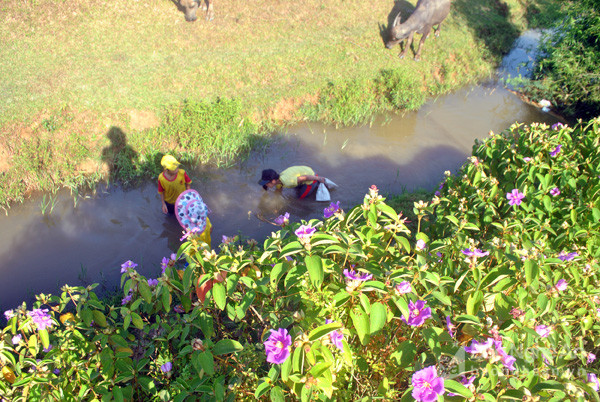 |
| Summer day for children in Team 3, Thanh An commune (Thanh Chuong district). Photo: Huu Vi |
Like his younger brother, Mr. Ban also served seven years in the military in the South. After the war against the US ended, he continued working in the army until his discharge in 1982. Since then, he has been deeply connected to his homeland.
After a puff of his pipe, Mr. Ban pointed to the pile of rice accumulating in his younger brother's yard and said, "This season can be considered promising. The estimated rice yield is about 650 kilograms. My family also had a good harvest. The straw stack this year is bigger than last year."
The sun grew increasingly intense. On the village lane, people were returning from the rice fields. From the path leading to the house, past the rattan fence, I caught a glimpse of a young couple entering. I recognized Mr. Suu's daughter, who had just turned twenty. Her name was Nga, and she and her boyfriend were walking home hand in hand after the harvest. I asked, "When are you two getting married?" The girl shyly lowered her head. The young man smiled gently and replied, "Nga will get married at the end of this year after she finishes her marriage preparation course."
The girl took off her straw hat on the porch and removed her mask. A fleeting, relieved smile appeared on her delicate face, like that of a schoolgirl fresh out of school, as she took a glass of water from her boyfriend's hand.
In the quiet midday, over a freshly brewed pot of tea, the two veteran brothers told me stories about their village and the changes it had undergone. Now, the younger generation is gradually moving away from traditional agricultural methods. They are bringing machinery and mechanization to the fields, focusing on making the rice grains fuller and more abundant. They are discussing planting tea and raising livestock to improve their income. Poverty still exists, but changes are beginning to emerge.
Listening to their story, I suddenly thought: In some places, people still chase after unrealistic ambitions, but life here remains very simple. More than anyone else, these parishioners, who have experienced war like Mr. Ban and Mr. Suu, know how to cherish the peaceful life in this semi-mountainous countryside.
Huu Vi
| RELATED NEWS |
|---|


