
How much air should you put in your car tires?
One of the most common questions drivers have when driving is how much air pressure is enough to safely inflate their car tires.
Car tire pressure
First, we need to understand what car tire pressure is. It's a measurement of the air pressure inside a tire. Incorrect tire pressure can affect safety, performance, fuel efficiency, and tire lifespan, so it's crucial for proper vehicle care and maintenance.
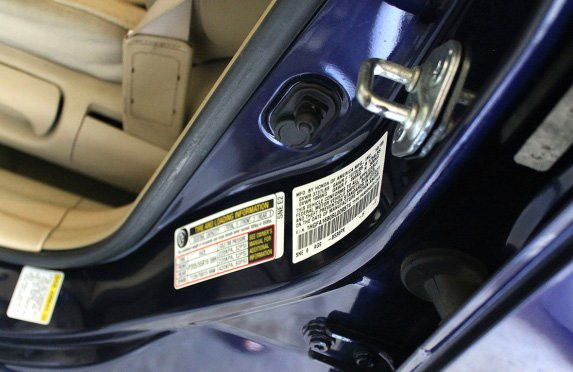 |
| Note that you should not inflate the tires beyond the pressure indicated on the door panel. |
More specifically, inflating tires to the correct pressure allows the vehicle to roll on the road with the entire tire surface in contact. This ensures even contact, maximum contact, and uniform wear across the tire surface. In addition, it offers direct benefits to the user such as optimal ride comfort, stable cornering, shortest braking distance, and fuel efficiency.
How much air should I pump into my car tires?
There are two units of pressure measurement used in England:
- The first and perhaps most common measurement is PSI (1 kg/cm² = 14.2 Psi). A typical tire has a pressure of 30 psi.
Another unit used to measure tire pressure is the bar. A bar is the atmospheric pressure at sea level. The typical tire pressure is 2.1 bar, equivalent to 30 psi.
Underinflated tires increase the contact surface with the road and increase friction, leading to the engine having to work harder, reducing fuel efficiency, and causing tire surface deformation such as warping, bulging, or uneven wear. It also significantly affects tire lifespan.
Some people mistakenly believe that inflating tires to the highest pressure is better for the car. However, doing so reduces the friction between the road and the tires, making it much easier for your car to skid in situations requiring sudden braking. Therefore, the harm outweighs the benefit.
Furthermore, on hot days, driving long distances with overinflated tires can severely damage them. Specifically: High road temperatures combined with significant friction during driving will cause the tires to heat up rapidly. The heated air creates high pressure within the tires. While new tires might be manageable, older tires could easily burst. In addition, your life is also seriously threatened. Therefore, you should inflate your tires to the correct pressure, neither over-inflated nor under-inflated.
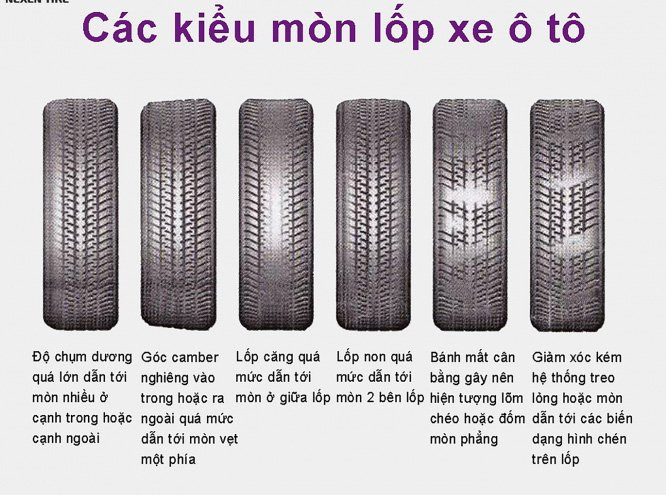 |
| Check which of the above tire wear conditions your tires fall into. |
Identifying tire pressure status
When tire pressure changes, the shape of the tire also changes:
- Overinflated tires will be round, like bicycle tires, and will not make much contact with the road surface.
- A flat tire will have a slightly concave shape, the center of the tire will not make effective contact with the road surface, and it will also cause wear on the sidewall of the tire.
For Nexen car tires, the raised logo on the sidewall indicates the location of the tire wear indicators at each main groove of the tire tread. Tire wear warnings are small raised bumps at the bottom of the tread grooves. If the rubber surface is within this range, the tire has almost reached its safety limit. You can purchase a device to measure the depth of the tire treads in the same way that technicians usually do.
Using worn tires increases the risk of tire damage and, in wet conditions, can cause the tires to suddenly lose traction. In most countries around the world, it is completely illegal to drive with tire tread depth less than 1.6 mm.
Helpful tips for checking tire wear:
One useful trick Americans often use is to check if their tires are too worn. Of course, you need a US coin to do this. Alternatively, you can use tire tread depth gauges like the ones shown below to determine the condition of your tires.
How to inflate car tires to the correct pressure.
It's best to use your own pump because many people use the pumps at gas stations without maintenance or servicing. Most of these pumps are good, but some won't give accurate results. Attach the pump's nozzle to the same valve that has been previously tested with a pressure gauge. The pump will run from the 12V power outlet available in your car, making it easy and efficient to inflate your tires to the right pressure. Alternatively, using a standard foot pump is also a way to inflate your tires.
According to VNN
| RELATED NEWS |
|---|


