
Things to keep in mind when inflating car tires.
To ensure your vehicle operates properly and safely, car owners must pay attention to how to inflate tires correctly.
Tires play a crucial role in the operation of a car and ensure the safety of the vehicle owner. This is why car owners need to pay special attention when inflating their tires.
Check your tire pressure regularly.
Most users often skip checking tire pressure during maintenance. However, this step is crucial because it ensures safe driving and optimal fuel efficiency. According to experts, tire pressure should be checked once a month, and the frequency should be increased if the vehicle travels long distances.
Use a standard tire pressure gauge.
Using an inaccurate tire pressure gauge will lead to incorrect tire pressure readings. This can cause dangerous situations. Therefore, equipping yourself with a high-quality pressure gauge is essential.
In reality, very few people use this tool. Instead, many people use their hands to feel the softness and decide when to inflate their tires. This is completely wrong. Because using your hands to feel the underinflation of a tire only reveals it when the tire is already significantly softer than the recommended pressure.
Do not over-inflate or under-inflate your tires.
On hot days, avoid over-inflating your tires while driving, as this can negatively impact them. High road temperatures and friction will cause the tires to heat up quickly, creating excessive pressure that directly affects them. If the tires are new, the vehicle may still function normally. However, if the tires are old, they could burst.
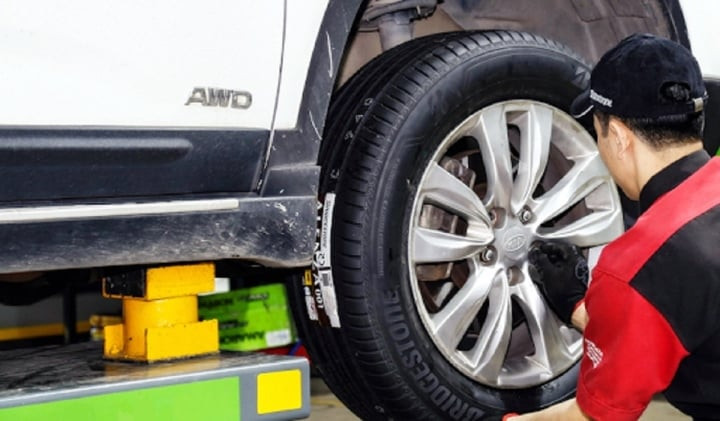
Meanwhile, underinflated tires also have a negative impact by increasing the contact surface with the road and increasing friction. The car's engine has to work harder, wasting fuel and causing tire deformation.
Read tire specifications.
Each tire has standard specifications recommended by the manufacturer printed on it. Understanding how to read car tire specifications helps vehicle owners know the safe inflation level.
P: is the symbol for passenger vehicles such as 5-seater and 7-seater cars. Additionally, LT is for pickup truck tires and T is for temporary replacement tires.
185: the width of the tire, which is also the contact surface of the tire with the road.
75 represents the ratio of tire sidewall thickness to tire tread width.
R: Indicates the radial structure of the tire. Additionally, there are rarer structures on the market such as B, D, or E.
14: This represents the rim diameter.
82S: This indicates the maximum permissible load and speed; exceeding these limits could lead to a tire blowout.
760 kPs (110 psi): This is understood as the standard tire pressure. The actual pressure depends on the vehicle's load, including passengers and cargo, so an adjustment of 10-15% is necessary.
Pay attention to the tire inflation time.
"How often should I inflate my car tires?" is a question many people are interested in. Experienced drivers say that car tires should only be inflated about every 4 months if they are new and every 2 months if they are old. At this frequency, you won't have to worry about underinflated tires.


