
Hoang Mai in the regional economic space
(Baonghean) - By April of this year, Hoang Mai will be considered to have turned 5 years old. 5 years old, according to the important milestones of a person's life, is the first pivotal age. At 5, it's time for Hoang Mai to say goodbye to the period of learning to walk, stumbling and getting back up, and begin a journey of self-reliance, overcoming challenges, accelerating, and... reaching the finish line.
The right time, the right place, and the right people.
Hoang Mai is a name that evokes poetry and music, with the clear blue Mai Giang river winding and depositing alluvial soil to create prosperous and charming villages in the northernmost part of Nghe An province. But amidst the gentle mountains, vast rivers, and sea—advantages for developing agriculture, forestry, fisheries, and especially tourism—the young town of Hoang Mai also bears the responsibility of being an industrial town, one of the three growth poles of Nghe An province.
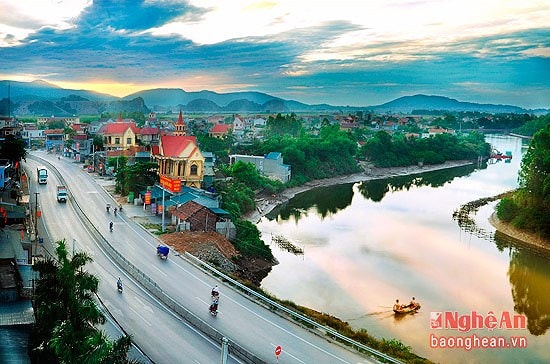 |
| Sunrise in Hoang Mai Town. Photo: Cao Dong |
Located on the North-South highway, Hoang Mai is a crossroads between two major cities: Thanh Hoa and Vinh, bordering the Nghi Son economic zone, Phu Quy region, and Quynh Luu district. If Nghe An is considered a microcosm of Vietnam, then Hoang Mai is a microcosm of Nghe An. As a region encompassing all three ecological zones – coastal, lowland, and mountainous – few towns boast such convenient transportation links as Hoang Mai.
The road transport system, including National Highway 1A, the North-South Expressway, the Nghi Son-Cua Lo route, National Highway 48D connecting western Nghe An, and the railway system, creates connections within the province and with regions throughout the country. The town is surrounded by the Mai Giang River (part of the Nha Le canal system dating back to the Le Hoan era), flowing into the sea through two estuaries, creating favorable conditions for the town to develop a fishing port in Quynh Phuong ward and is currently promoting investment in the Dong Hoi deep-water port.
The Nha Le River, flowing through Hoang Mai town and connecting the capital Hoa Lu to Deo Ngang Pass, is considered the first waterway in Vietnam. Hoang Mai is also a region that possesses all the distinctive cultural elements of the North Central region in general, and Nghe An in particular.
The vicissitudes of life and the ups and downs of history have left their mark on numerous tangible and intangible relics, attracting tourists from all over to visit and admire them. The Cờn Temple in Quỳnh Phương, known as "Nghệ An's first of the four sacred temples," is famous throughout Vietnam, enough to write a tourism story steeped in traditional spirituality. As a highlight contributing to Hoàng Mai's blend of ancient charm with scattered temples and shrines, and modernity with newly opened roads and towering skyscrapers in urban areas, the pristine and enchanting Quỳnh Phương beach will provide impetus for the development of tourism in Hoàng Mai.
Located next to Quynh Luu district in Nghe An province and bordering Thanh Hoa province with an abundant young workforce, Hoang Mai offers investors not only favorable conditions for recruiting and training labor but also the ability to save on labor costs, while enjoying convenient services at reasonable prices.
With favorable timing, location, and human resources, Hoang Mai possesses significant potential and has been planned for economic development with a focus on industry, commerce, and tourism.
Industry as the foundation
It is well known that without promoting industry and services, development and poverty reduction are impossible. However, how to industrialize correctly, rationally, and with a long-term vision is a matter that needs careful consideration. This is also a challenge that Hoang Mai must address, at least in the next five years. Because, unlike traditional sectors such as agriculture, forestry, and fisheries, where production can rely on generational experience, industry requires not only experience but also many other factors, a comprehensive and synchronized approach with a different mindset, in order to create something unique.
To date, Hoang Mai district has three industrial parks that are already in operation: Hoang Mai Industrial Park, Dong Hoi Industrial Park, and Can Bong Industrial Park. With its advantages in stone and clay quarries, Hoang Mai has the potential and is prioritizing the development of the construction materials industry.
Currently, the area has the Hoang Mai 1 Cement Plant with a capacity of 1.2 million tons/year, and is promoting investment in the Hoang Mai 2 Plant with a capacity of 4.5 million tons/year. The quarry here also supplies the Nghi Son Cement Plant. Besides cement, there are other factories producing white limestone powder, tunnel bricks; Hoa Sen Steel Sheet Factory, Vinatex Garment Factory; and the Muong Thanh 4-star hotel and mixed-use commercial complex, all operating effectively... The advantage of being located in a rapidly developing industrial economic zone, from a certain perspective, also presents challenges that must be considered and overcome.
In close connection with Nghi Son, Phu Quy, and Quynh Luu, Hoang Mai town needs to find its own path and make its own choices to create its own unique identity and a point of comparison for shared development.
The unique path that Hoang Mai has chosen and defined is to combine traditional technology with modern science to accelerate urban agriculture; each locality should develop and strongly promote at least one high-quality, safe, branded product on the market. Examples include turmeric from Quynh Vinh, fish sauce from Quynh Di, peeled shrimp from Quynh Lap, mackerel from Quynh Phuong, and clean vegetables from Quynh Lien...
 |
| Produced at Hoa Sen Steel Factory in Nghe An (Dong Hoi Industrial Park, Hoang Mai Town). Photo: Thu Huyen |
To develop the economy in general, and the industrial economy in particular, regardless of the chosen path, the investment environment remains the most important factor. In the past, the concept of "rolling out the red carpet" was often used to describe attracting investment.
However, in the current trend, investment promotion cannot simply be about creating favorable conditions and opening doors to welcome investors; it must also consider effectiveness, ensuring mutual benefit for both businesses and localities. This means that investment promotion now is not about attracting investment at all costs or approving every project, but about making a selection. Choosing which investors to select, assessing their capabilities, and considering other factors such as sustainability, commitment to employing local labor, and willingness to transfer technology are crucial.
This orientation will guide adjustments in attracting, seeking, and soliciting investors, especially foreign investment, to suit the town's natural and business environment. With a coastline of over 3,000km, Vietnam has many beaches that have become scenic spots; many towns and cities have developed coastal tourism very well. This poses a challenge for Hoang Mai, a relatively new town, to create differentiation in its overall planning and landscape. In particular, coastal tourism services linked to spiritual culture is a promising direction, creating tours that connect unique cultural "specialties" only found in Hoang Mai.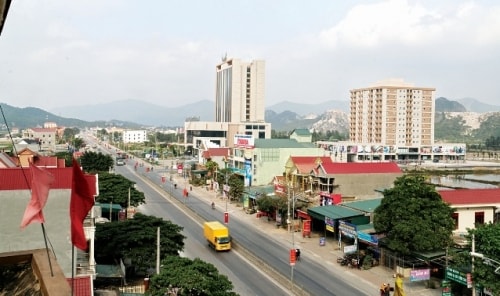 |
| A view of Hoang Mai town today. |
Industrialization and modernization are inevitable trends and the trends of our time, but not every locality succeeds in implementing them. For a newly established town, with virtually no infrastructure, the difficulties are even more overwhelming.
Therefore, to achieve all the aforementioned orientations and goals – creating a unique identity for Hoang Mai in the regional economic map – the town needs more than ever a long-term, comprehensive, and cautious plan, yet decisive in each specific step: systematically investing in infrastructure; developing high technology; reforming administrative procedures; building a civilized urban lifestyle; creating an open investment environment with a strategic vision...
The foundation of an industrial and service town cannot rely solely on factory chimneys or even grandiose urban areas. The foundation of an industrial and service town must be consciousness—the consciousness of building industrial civilization in each citizen. Every ordinary citizen needs a revolution within themselves, a renewal of thinking and lifestyle, to adapt to the needs and demands of a modern industrial society.
Only then will Hoang Mai be in a position to achieve its strategic goals, living up to the trust and expectations of the Party Committee and the people of the province.


