
Towards sustainable agricultural development.
(Baonghean) - From the establishment of the Department of Agriculture in 1946, after 70 years of construction and development, the Department of Agriculture and Rural Development is now formed on the basis of merging the fisheries, irrigation, and forestry sectors; the joint efforts of generations of "agricultural workers" in the province have brought about great results, affirming the very important role of this sector.
In the early period (1945-1975), the agriculture and rural development sector of Nghe An province made an extremely important contribution to the victory of the resistance wars against French and American aggression, restoring peace and national reunification. During the difficult years of post-war national reconstruction (1975-1985), Nghe An's agriculture overcame difficulties, found new directions, and achieved remarkable growth, especially in food production, significantly contributing to stabilizing the lives of the people and the province's economy; many products increased 2-3 times compared to previous periods, creating a foundation for the province's agriculture to transition to a period of general reform. Over the past 30 years, Nghe An's agriculture and rural areas have continuously achieved great and comprehensive achievements.
 |
| Tomato harvesting in Quynh Luong commune (Quynh Luu district). Photo: Quang Dung |
During the period 2010-2015, the value of agricultural, forestry, and fisheries production in Nghe An province is estimated to have increased by 4.65%; the internal economic structure of the sector has undergone positive and correct transformation; specialized commodity production areas have been formed and developed according to market demands; productivity and output of crops and livestock have increased rapidly, enhancing added value per unit area. The New Rural Development program has become a widespread movement throughout the province; it is projected that by the end of 2015, 114 communes and Thai Hoa town will have met the New Rural Development standards, exceeding the set target. In 2015, the total export value of agricultural, forestry, and fisheries products of the province is estimated to have reached over 130 million USD, contributing to the national agricultural sector's efforts to make Vietnam one of the world's largest exporters of agricultural, forestry, and fisheries products.
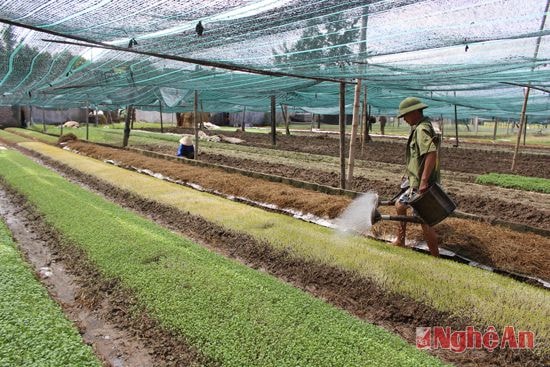 |
| Caring for vegetables in Hung Dong commune (Vinh City). Photo: PH |
Rice yields have continuously increased; by 2015, rice yield was estimated at 52.8 quintals/hectare, with a total rice production of 971,150 tons; meat production reached 212,000 tons; forest cover reached 55%; total production of exploited and farmed aquatic products reached 147,500 tons; and salt production reached 91,000 tons. The province has 4,000 hectares of cassava, yielding approximately 160,000 tons, sufficient to supply the two cassava starch processing plants in Thanh Chuong and Yen Thanh; 20,000 hectares of peanuts yielding approximately 46,000 tons; and 30,000 hectares of sugarcane yielding approximately 2 million tons, sufficient to meet the capacity of the three sugar processing plants in the area. Along with that are areas producing long-term industrial crops such as 8,000 hectares of tea, yielding up to 120 quintals of fresh tea leaves per hectare, with an estimated production of 75,000 tons...
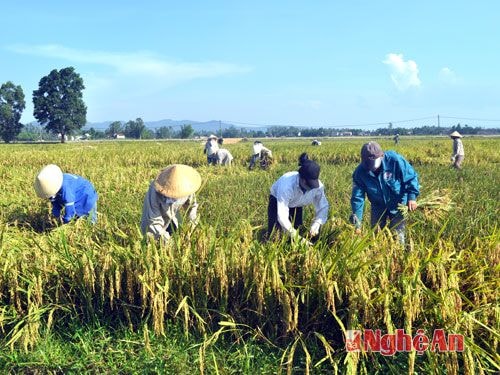 |
| A bountiful spring rice harvest in Yen Thanh. Photo by Phu Huong. |
Production organization forms have developed strongly; the province currently has 640 cooperatives (of which 458 are agricultural cooperatives operating effectively), and over 3,000 farms and family farms.
Along with ensuring national food security, the province's agricultural sector participates in the export of several agricultural, forestry, and aquatic products with increasing quantities and values. Many concentrated commodity production areas have been formed, creating a large volume of goods as raw materials for processing industries and exports. Many agricultural, forestry, and aquatic products have high competitiveness and occupy an important position in domestic and international markets, such as tea, rubber, seafood, and various forest products. In addition, through the effective mobilization of resources, especially projects from the central government and ODA, the construction of infrastructure systems for irrigation, river and sea dikes, and rural water supply has met the requirements of agricultural production development and improved people's lives. Thousands of irrigation works have been built and upgraded over the past 70 years, including many large-scale and modern projects such as: the Vach Bac - Song Bung irrigation system, the Nam Dan, Ben Thuy, and Nghi Quang sluices, the North irrigation system, the South irrigation system, the Vuc Mau, Song Sao, and Ban Mong reservoirs, etc.; hundreds of other reservoirs and dams along with pumping stations, and thousands of kilometers of canals, dikes, and embankments have been formed, representing a tremendous achievement for the province. Thanks to the development of production, the lives of rural people have continuously improved, enriching their cultural and spiritual lives; most rural areas throughout the province have been and are experiencing very rapid development.
Acknowledging the achievements of Nghe An's agriculture and rural development sector over the past 70 years, Provincial Party Secretary Ho Duc Phoc stated: In the new development phase, especially with the successful implementation of the goals of the 18th Provincial Party Congress Resolution, alongside opportunities and advantages, the province's economy continues to face many difficulties and challenges. The agriculture and rural development sector needs to continue to build upon the achievements of 70 years of construction and development, leveraging its potential and strengths to build a comprehensively developed agricultural sector towards modernization and large-scale commodity production; promote the application of science and technology and restructure the sector towards increasing added value and sustainable development, improving the material and spiritual lives of people in rural areas.
To continue upholding the traditions of the sector and making a worthy contribution to the overall development of the country, in the coming years, the Nghe An Department of Agriculture and Rural Development will continue to strive to build a comprehensive and sustainable agricultural sector; improve the efficiency of land use, water resources, labor, and capital; and raise the income and living standards of farmers, fishermen, salt producers, and forest workers. The goal from now until 2020 is to achieve an annual growth rate of 4.5-5% in the value of agricultural, forestry, and fisheries production; an internal economic structure comprising 77% agriculture, 9% forestry, and 14% fisheries; forest cover reaching 57%; 85% of rural residents using standard drinking water; and over 50% of communes (more than 216 communes) meeting the criteria for New Rural Development.
According to Mr. Ho Ngoc Sy, Director of the Department of Agriculture and Rural Development of Nghe An province: To achieve that goal, the department has identified the following priorities: continuing to promote the restructuring of crop production, large-scale production linked to preservation, processing, and consumption of agricultural products along the value chain; rapidly introducing scientific and technological advancements into production; developing concentrated raw material areas linked to processing and export; forming high-tech agricultural production zones to increase productivity, quality, efficiency, and adapt to climate change; developing post-harvest technology in a modern direction; rapidly developing livestock farming in both quantity and quality, shifting from small-scale to concentrated and high-tech farming. The department encourages the organization of closed-loop production and linkages between stages in the value chain to reduce costs, increase efficiency and added value, and ensure food safety and hygiene.
Strengthen investment in the construction and upgrading of agricultural and rural infrastructure in a comprehensive manner. Continue to vigorously implement the National Target Program for building new rural areas, innovate forms of production organization in agriculture, and create a favorable environment for businesses to invest in the agricultural and rural sectors.
Phu Huong
| RELATED NEWS |
|---|


