
Stories about people from Nghe An living abroad.
(Baonghean) - It can be said that you can find people from Nghe An all over the world now. Everyone knows that the people of Nghe An have a very strong spirit of solidarity and mutual support. Far from home, that spirit is even more strongly promoted by the children of Nghe An.
I eagerly made arrangements to go on a trip to Taiwan invited by my daughter. My writer friend, Pham Duc Long, heard his son say he was craving mung bean cakes, so he sent me two packets to take to his nephew. His son is working in Taiwan. The problem is, Mr. Long is from Nghe An, so his nephew is naturally from Nghe An too. He just brought his wife over to live with him, so there will surely be another generation of Nghe An residents in Taiwan with the surname Pham Quynh Luu.
And when I went to Taiwan, I met many more people from Nghe An there.
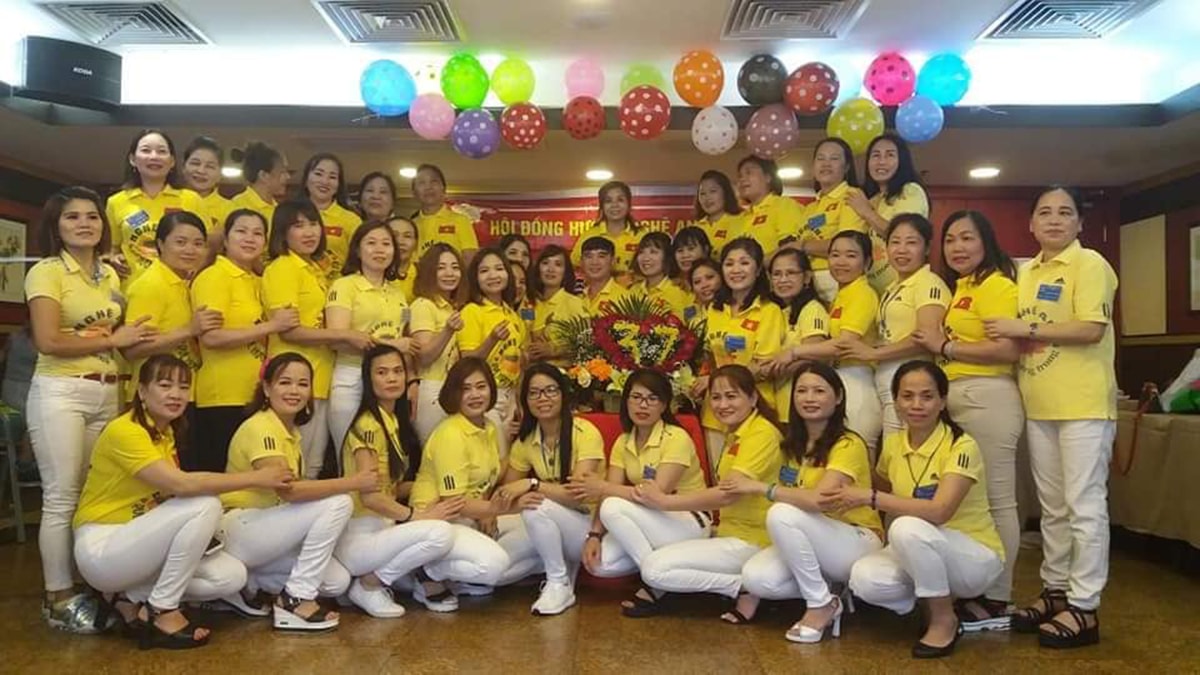 |
| Meeting of the Nghe An expatriate community in Macau. Photo: Nguyen Nga |
Wandering around Taiwan, I mostly used the subway. On the first subway line, I immediately spotted a bench with four young people sitting and speaking... Nghe An dialect. The most bewildered one was Chiến, who had only been there for three months. She took four subway lines on Sunday to visit her older brother, who was on his second term working here. Each term lasts three years, after which he returns to renew his application.
Chiến said, "I really enjoy working overtime because it allows me to earn money quickly to pay off my debts. I have to send money back to my parents to pay off the loans I took out to travel abroad before I can save up."
Chiến recounted that she worked at a leather factory, while the others worked for an electrical and electronics company, costing them $4,000-$5,000. Their salary ranged from $800-$1,000 per month, with higher pay for overtime.
I laughed at the word "okay." Chien said he really liked working overtime because it helped him pay off his debts faster. He had to send money back to his parents to pay off the loan he took out to go abroad before he could save up. Usually, the first three years only provided enough money for food and debt repayment; only later could he save up. When asked how the employer treated him, he said, "Very good, sir. The employer provided food and accommodation in the factory, and occasionally organized outings and group activities for the Vietnamese workers."
I also pretended to be knowledgeable about economics, telling Chien that it probably wouldn't take more than 3 years, because let's say his salary is 800, and he only spends 300, sending the remaining 500 home. 500 a month would only take 10 months to save 5,000. He argued: "But there's interest too, Uncle, and besides... it really won't take 3 years." I told him I was just asking to congratulate them, and to rest assured, I'm not a tax officer, so there's nothing to worry about.
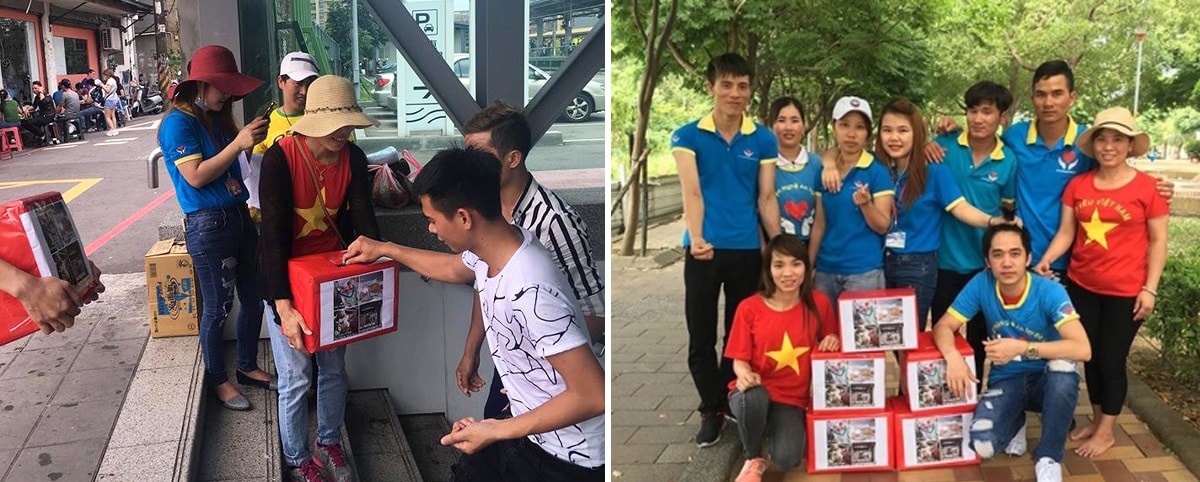 |
| People from Nghe An province living in Taiwan are organizing fundraising efforts to help impoverished individuals and those suffering from serious illnesses in their hometown. Photo: Pham Hoang |
Most people who go to Taiwan to work later bring their siblings and relatives over to work. The four grandchildren I met here all had older or younger siblings who worked there before they brought them over. Every Sunday they visit each other, cook meals, and then take the train back home, sometimes living hundreds of kilometers apart. Besides, nowadays they communicate with each other online, and parents at home can talk to and watch live videos of their children and grandchildren regularly...
The other day, while I was in Thailand and wandering around the Kanchanaburi tourist area, I heard someone speaking in the Nghe An accent. I thought they were tourists, but it turned out they weren't. It was some young people working there, taking advantage of the lull in customers to chat in their mother tongue. I was delighted to hear them, so I went over to strike up a conversation. They've been working here for several years, and their jobs seem stable and progressing well.
It's safe to say that wherever you go in the world, you'll encounter people from Nghe An. Everyone knows that people from Nghe An have a very strong spirit of solidarity and mutual support. Wherever they go to work, if they find a good opportunity, they'll tell their relatives, neighbors, and fellow villagers to sponsor each other to come and work there. They'll do business anywhere, as long as they live well and send money back home. That's the Nghe An way of supporting each other.
One of the longest-living people from Nghe Tinh (Nghe An and Ha Tinh provinces) I know is Professor, Doctor, and poet Nguyen Huy Hoang.
Mr. Hoang had just arrived in Pleiku, and we called each other and met up. I had previously posted on my page about the heartbreaking case of his daughter. She went missing in Sochi when she was 13 years old; if she were still alive today, she would be over 40. Mr. Hoang has dedicated his entire life, from the time she went missing until now, to searching for and waiting for her, refusing to return to Vietnam.
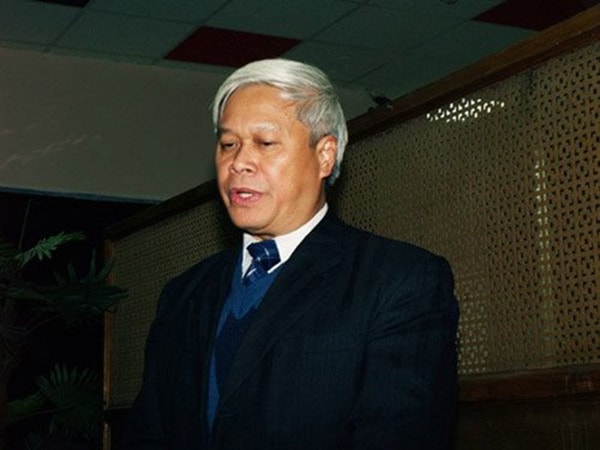 |
| Poet Nguyen Huy Hoang. Photo: Sputnik |
Despite trying everything, including consulting the world-renowned prophet Vanga, his granddaughter remains missing without a trace, and he patiently waits. His hair has turned white since her disappearance, and even now, his grief and longing to find her never cease. Although the glimmer of hope seems to be fading, he still believes that one day she will return to him. And so, in that large Nghệ An community abroad, the name of Quỳnh Nga, the daughter of Professor, Doctor, and poet Nguyễn Huy Hoàng, will continue to be remembered.
"The Song of the Homeland River" completely captures the feelings, souls, and entire lives of the people of Nghe An, it is their very blood and essence. If that's the case at home, imagine what it's like abroad, far from home.
Two years ago, the poet Le Huy Mau made a trip to Europe. He intended to stay for about half a month, but ended up staying for several months. Simply because he was the author of the lyrics to "Song of the Homeland River," which became popular among the Nghe An community there, like a passing ball.
Almost all people from Nghe An consider the song "Song of the Homeland River" to be... the provincial anthem. More than just a provincial anthem, because while a provincial anthem might only possess rational elements, "Song of the Homeland River" captures the emotions, the soul, the entire life, the very blood and essence... of the people of Nghe An. If that's the case at home, imagine what it's like abroad, far from home. Thus, it has become a unique expression, a way for people from Nghe An living far from home to express their love for their homeland. It becomes a place of camaraderie among fellow countrymen, homeland among homelands, Nghe An among Nghe An – a concentrated, quintessential, and fragrant form of camaraderie, homeland, and Nghe An...
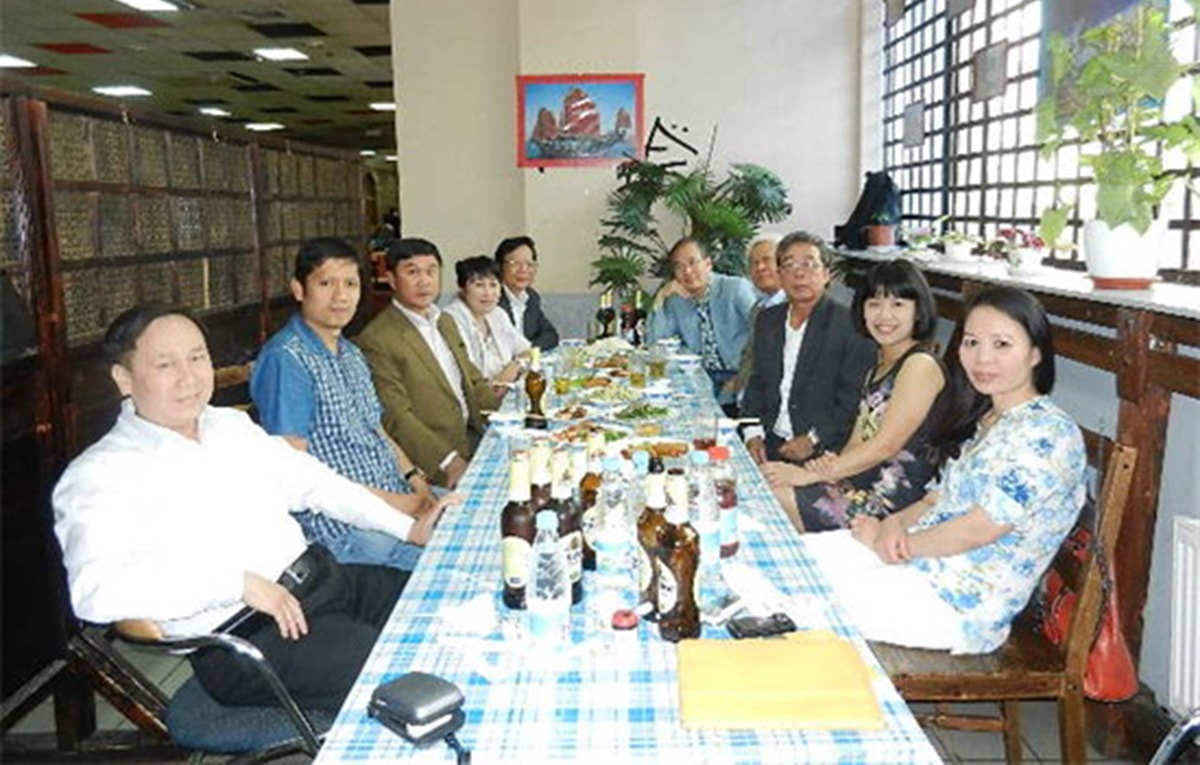 |
| A friendly gathering between poet Le Huy Mau (third from the right) and his fellow countrymen from Nghe An province in Moscow (Russia). Photo: Vo Hoai Nam |
My Văn family, over 600 years ago, originated from Hoàng Mai, Nghệ An. Now, the ancestral tomb of the Văn clan in Mai Hùng ward, Hoàng Mai town, has been recognized as a provincial-level historical site. When he was alive, Professor Văn Như Cương, one of the quintessential Nghệ An natives, joked with me: "Our family has produced quite a few talented people abroad, like Văn Gốc, Văn Bát Ten, Văn Nít Tơ Roi, and so on..."
But who knows? Who would have thought that, hundreds of years ago, the Ly family of Vietnam had migrated all the way to Korea to establish such a powerful lineage in the Land of Kimchi today?


