
Key milestones of the August Revolution
(Baonghean.vn) - Under the wise leadership of the Party, within just 15 days, the uprising to seize power broke out and achieved victory throughout the country.
Late 1944, early 1945The international situation was undergoing rapid changes, and the revolutionary movement within the country was developing widely. Based on this, the National Congress of the Party, held in Tan Trao from August 13th to 15th, 1945, concluded: "The conditions for an uprising in Indochina are ripe," therefore, it was necessary to "act promptly, not miss the opportunity," and urgently "seize immediately those places where victory is certain, regardless of whether they are cities or villages, and establish people's committees in those places under control," all for the goal of: "Vietnam's complete independence."
At Tan Trao, Ho Chi Minh instructed that a national congress of delegates be urgently convened. At that time, the anti-Japanese national salvation movement was surging from the South to the North. The whole country was awaiting a revolutionary provisional government of an independent Vietnam.
The National Conference of the Party, held in Tan Trao, decided to launch a nationwide general uprising to seize power before the Allied forces entered Indochina, and that very night the Provisional Command Committee of the Liberation Zone issued the order for the uprising.
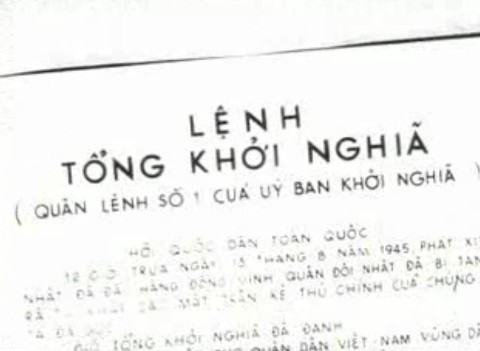 |
| Military Order No. 1, a decision of the Insurrection Committee. |
The Insurrection Committee also issued Military Order No. 1, declaring, "The hour of the general uprising has arrived! This is a unique opportunity for the Vietnamese army and people to rise up and seize the independence of our country… we must act quickly, with utmost courage and utmost caution!… Complete victory will certainly be ours."
August 16, 1945:The Viet Minh Front convened a National Congress in Tan Trao. The Congress decided: to approve the Party's order for a general uprising; to establish a National Liberation Committee headed by President Ho Chi Minh; to define the national flag and national anthem; and to name the country the Democratic Republic of Vietnam.
Afternoon of August 16, 1945A unit of the liberation army, commanded by Comrade Vo Nguyen Giap, advanced from Tan Trao to liberate Thai Nguyen town, marking the beginning of the August Revolution.
August 18, 1945:The people of Bac Giang, Hai Duong, Ha Tinh, and Quang Nam were the first in the country to seize power in their provincial capitals.
Morning of August 20, 1945Comrade Vo Nguyen Giap commanded a military unit that advanced from Dan Pagoda into Thai Nguyen town, surrounding and attacking the Japanese fascists to liberate the town. That same afternoon, a large rally took place at the town's stadium, where the Uprising Committee officially declared the abolition of the enemy's administrative apparatus and the establishment of the Provisional Revolutionary People's Committee of Thai Nguyen province.
 |
| The Vietnam Liberation Army Propaganda Team. |
August 17, 1945The liberation army attacked the provincial capital of Tuyen Quang. The Japanese fascists put up fierce resistance, but faced with the overwhelming momentum of the revolutionary army, they had to request negotiations, and by August 21st, the provincial government had fallen into the hands of the Viet Minh.
August 18, 1945The people of Bac Giang, Hai Duong, Ha Tinh, and Quang Nam provinces rose up and successfully seized power in their provincial capitals – these were the four localities that seized provincial power earliest in the country.
August 17, 1945The General Association of Civil Servants of the puppet government organized a large rally at the Hanoi City Theater Square with tens of thousands of participants to support the "Provisional Government" of Tran Trong Kim.
Under the leadership of the Northern Regional Party Committee and the Hanoi City Party Committee, the revolutionary masses seized the platform of this rally: our cadres informed the people that the Japanese fascists had surrendered, briefly presented the Viet Minh's policies and strategies for national salvation, denounced the pro-Japanese puppet government, and prepared to participate in the uprising.
August 19thHundreds of thousands of revolutionary masses from the inner and outer areas of the city, armed with sticks, knives, guns, and machetes, marched towards the City Theater Square to attend a rally organized by the Viet Minh.
The rally began at 11 o'clock. After a ceremonial gun salute and the sound of the "Marching Song," a representative of the Revolutionary Military Committee read the Viet Minh's call to arms for the uprising.
The rally quickly escalated into an armed demonstration. The protesters divided into numerous groups, including self-defense units, advancing in various directions and occupying the institutions of the puppet government: the Governor's Palace, City Hall, Police Station, Security Guard Barracks, etc.
Faced with the surging momentum of the popular uprising, the Japanese, despite having over ten thousand troops, could do nothing. The puppet soldiers and police were also powerless and eventually sided with the revolution. Power completely passed into the hands of the people.
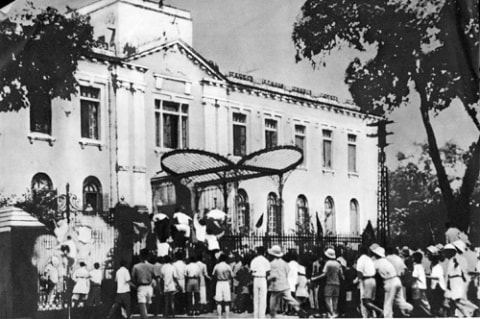 |
| Rally in Hanoi on August 19th. |
The victory of the uprising in Hanoi (August 19th) quickly resonated throughout the country, strongly encouraging other provinces and cities, exacerbating the crisis within the enemy's ranks, and creating favorable conditions for the general uprising.
August 20, 1945The uprising was victorious in the provincial capitals of Thai Nguyen, Bac Ninh, and Ninh Binh.
August 21, 1945:The uprising was successful in the provincial capitals of Cao Bang, Tuyen Quang, Son Tay, Kien An, Nam Dinh, Nghe An, and Ninh Thuan.
August 22, 1945The uprising continued to achieve victories in the provincial capitals of Hung Yen and Quang Yen.
August 23, 1945:The provincial capitals of Hue, Bac Kan, Hoa Binh, Ha Dong, Hai Phong, Quang Binh, Quang Tri, Gia Lai, Binh Thuan, Lam Vien, Tan An, and Bac Lieu launched uprisings and seized power.
August 24, 1945:The uprising took place in Phu Tho, Ha Nam, Phu Yen, Dak Lak, Binh Thuan, Go Cong, and My Tho, and was victorious.
August 25, 1945:The uprising to seize power was successful in the provincial capitals of Son Lang and Kon Tum. On the same day, the people of Saigon and most provinces in the South, such as Cho Lon, Gia Dinh, Soc Trang, Vinh Long, Long Xuyen, Tay Ninh, Tra Vinh, Chau Doc, Sa Dec, Ben Tre, Ba Ria, Thu Dau Mot, and Bien Hoa, rose up in successful uprisings.
August 26, 1945The people of Son La, Hon Gai, and Can Tho successfully rose up to seize power.
August 27, 1945The uprising to seize power in Rach Gia was successful.
August 28, 1945:The uprising was quickly victorious in Upper Dong Nai and Ha Tien.
 |
| President Ho Chi Minh read the Declaration of Independence, giving birth to the Democratic Republic of Vietnam at Ba Dinh Square on September 2, 1945. |
Thus, in just 15 days (from August 14th to August 28th, 1945), the oppressive rule of the imperialists (France and Japan), built up over nearly a hundred years, and the reactionary autocratic monarchy that had existed for thousands of years were completely overthrown by our people. For the first time, the government of the entire country truly belonged to the people.
Afternoon of August 30, 1945:At Ngo Mon Gate, tens of thousands of people in the ancient capital of Hue, under the red flag with a yellow star, witnessed Bao Dai – the last emperor of the Vietnamese feudal regime – read his abdication speech and hand over the royal seal and sword to the revolution. Representatives of the Provisional Government of the Democratic Republic of Vietnam declared the abolition of the monarchy in Vietnam.
September 2, 1945:At the historic Ba Dinh Square, before a massive rally of nearly 1 million people, President Ho Chi Minh, on behalf of the Provisional Government, solemnly read the Declaration of Independence, proclaiming to the nation and the world: The Democratic Republic of Vietnam was born.
The Declaration affirms: "The entire Vietnamese nation is determined to dedicate all its spirit and strength, its life and property, to safeguarding that freedom and independence."
The Declaration of Independence is a momentous historical document, and September 2nd, 1945, will forever be recorded in Vietnamese history as a great national celebration – the day the Democratic Republic of Vietnam was declared established.
Peace
(Synthetic)
| RELATED NEWS |
|---|


