
Vote of confidence and the selection of ministers
Hopefully, the results of this confidence vote will make a truly positive and beneficial contribution to the appointment of leadership personnel for the coming years, especially for the upcoming 13th Party Congress.
Next is the low confidence rating. The three official ratings are high confidence, confidence, and trust.
Low approval ratings. The lowest approval ratings were for the Minister of Education and Training, followed by the Minister of Transport. This assessment by the National Assembly deputies seems to align with the majority of public opinion.
The third point to note is the relative consistency in the ratings. If you rank low in the high confidence category, you also rank high in the low confidence category. The Ministers of Education and Training, Transport, and Culture, Sports and Tourism are in this top group.
|
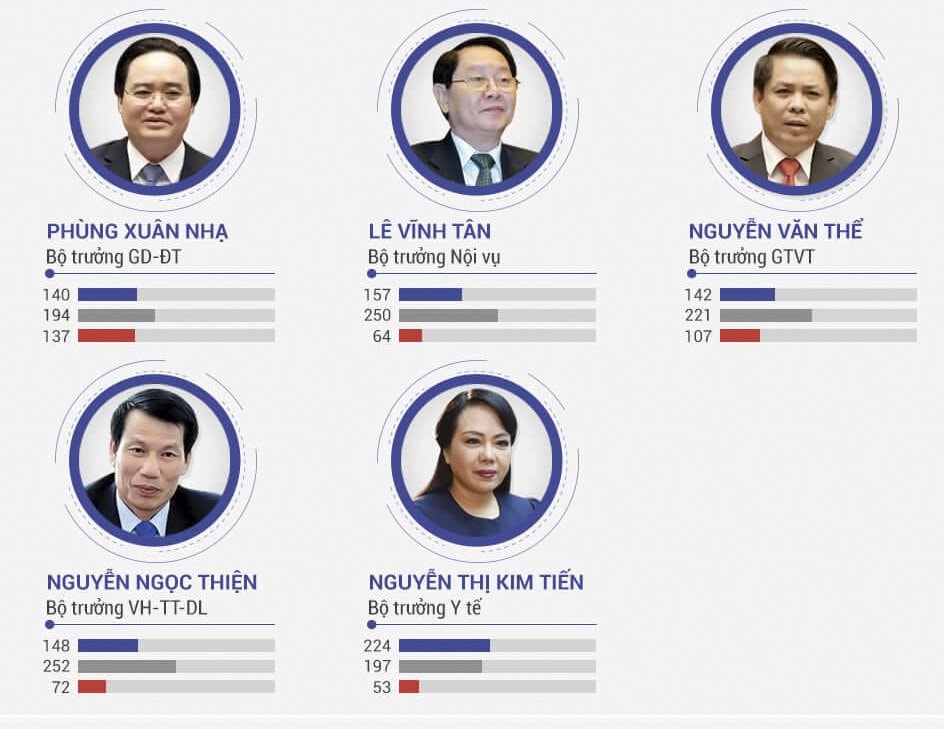
A crucial question arises: were these results entirely objective and accurate? The answer is probably only relative. Relatively objective, relatively accurate.
The criteria used to assess trustworthiness include performance results, political and moral character, lifestyle, adherence to the law, signs of moral decay, self-degeneration, and self-transformation, assets, and income. Unless something unexpected happens, most criteria are generally considered met. Therefore, ultimately, the assessment relies primarily on the performance of assigned tasks. At least, this is the most easily observable and perceptible aspect of the evaluation.
As the head of the sector, what policies and recommendations have you made that are right and appropriate for the industry or field, or have you been completely passive in this matter? Once policies and regulations are established, how well are they monitored and checked for implementation? These are points that are often considered in evaluations.
Even so, the "personal" element of the evaluator still plays a role in the confidence vote. Therefore, while the first, second, and even lower confidence ratings might be good, there might still be points in the low confidence category. That's a high confidence rating, yes, but personally, I don't have a very positive feeling towards it, so I still put it in the low confidence category. Theoretically, some positions shouldn't have any points in the low confidence category, and for others, the points in the low confidence category should be even higher to be considered appropriate.
Are there sets of difficult and easy questions?
Finally, there's the story of the effect of the confidence vote. Certainly, the results for each position will provide encouragement. A high ranking in the "high confidence" category is clearly a sign of appreciation and thus an encouragement for the evaluated individual to continue performing well in the future. Then there's the cautionary effect, a reminder for those whose overall confidence vote results are not good.
However, another aspect of confidence votes is using the results to improve the placement of future leaders. Several confidence votes have shown a near-regular pattern: the ministers of Education and Training, Transport, Culture, Sports and Tourism, and Interior Affairs tend to receive lower scores in the confidence vote.
The question arises whether there are difficult and easy ministries, and whether there are ministries that manage sectors and fields that are too sensitive or too complex, such as education or healthcare. Based on the answers to these questions and the aforementioned patterns, we must consider appropriate appointments of leaders for these sectors in the future.
Perhaps there are no easy or difficult tasks; every minister must confront the responsibility of managing their sector or field nationwide, and must advise on appropriate and effective institutional and policy frameworks.
Is the Ministry of Planning and Investment a difficult or easy ministry to manage? In the 2014 confidence vote, Minister Pham Quang Vinh received 351 votes in the high confidence category and 20 in the low confidence category; this time, Minister Nguyen Chi Dung received 162 votes in the high confidence category and 97 in the low confidence category. Clearly, the issue is finding the right person to lead and command each ministry. "Right" refers to the competence, qualifications, and leadership skills of the heads of these ministries.
Hopefully, the results of this confidence vote will make a truly positive and beneficial contribution to the appointment of leadership personnel for the coming years, especially for the upcoming 13th Party Congress.


