
Khanh Son Commune (Nam Dan District): Strongly aiming for the "new rural" goal by 2018.
(Baonghean) - Over the past five years, thanks to the joint efforts of the Party Committee, the government, the Fatherland Front, mass organizations, and all strata of the people, Khanh Son commune has achieved significant economic growth, creating momentum for comprehensive transformation; the material and spiritual lives of the people have improved, with an average per capita income of 24.8 million VND/year…
To date, the total value of production in 2015 is estimated at 203.79 billion VND, with an average annual growth rate of 7.8%. Of this, agriculture, forestry, and fisheries accounted for 102.38 billion VND; handicrafts and construction for 64.7 billion VND; and services and trade for 36.7 billion VND. This achievement is due to the shift in crop structure in agricultural production towards increasing value per unit area, actively applying scientific and technological advancements, especially new varieties that yield high economic efficiency. Total food production reached 6,581 tons (achieving 86% of the target set in the congress resolution); many successful economic models are being replicated, such as safe vegetable farming, watermelon, green squash, hybrid chili pepper cultivation, home garden and field garden models, etc. Farm-based economy is developing, with 23 farms in the commune, including 3 integrated livestock farms that generate considerable income. Aquaculture and fisheries resource exploitation have been carried out effectively, with the cultivated area increasing from 39.0 hectares (in 2010) to 42.0 hectares (in 2015).
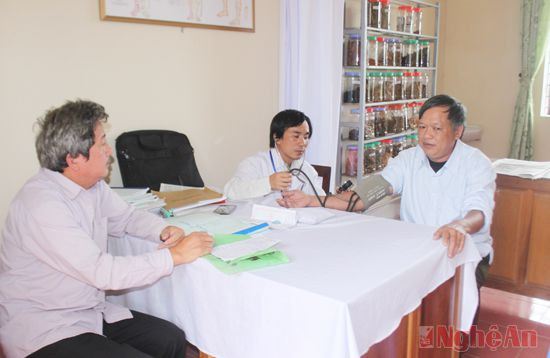 |
| Providing medical examinations for the local people at the Khánh Sơn commune health station. |
The industrial and handicraft sector has developed quite rapidly in terms of quantity, scale, and types of businesses. Many establishments have attracted and created jobs for workers and achieved efficient production, such as tunnel kiln brick making, sand and gravel mining, garment manufacturing, and food processing. Currently, there are 88 handicraft production facilities providing employment for 115 workers. The trade and service sector has developed quite rapidly and diversely. The number of commercial businesses has increased, reaching 185 establishments to date, with an estimated revenue of 7.2 billion VND in 2015.
The New Rural Development movement has received enthusiastic support from the people, with the entire commune investing 53.3 billion VND, of which the people contributed 3 billion VND. Many households have voluntarily demolished fences and trees, and donated land for the construction of new rural areas. The goal is for the commune to achieve 12 out of 19 New Rural Development criteria by the end of 2015.
During the past term, the socio-cultural sector also received attention from the locality. The quality of comprehensive education has improved; the quality of universal primary and lower secondary education has been maintained and enhanced, and preschool education for 5-year-old children has been completed. Two primary schools have achieved national standards. The quality of mass education is over 99.3% annually, with 21% of students achieving excellent grades. The enrollment rate of children in kindergartens reached 67% (from 374 children in 2011 to 460 children in 2015); the enrollment rate for 5-year-old children reached 100% (in 2015). The number of students who passed entrance exams to universities and colleges over the 5 years (2010-2015) was 385 (an increase of 8 students compared to the previous term). The work of promoting learning and talent, and building a learning society has been given attention by organizations, sectors, the commune and village education promotion associations, and some family clans. Over the past five years, the Community Learning Center has raised 79.34 million VND, awarding prizes to more than 702 teachers and students who achieved high academic results and passed entrance exams to colleges and universities. The activities of the Community Learning Center have initially proven quite effective.
Public health care and disease prevention and control have been prioritized, preventing major outbreaks. The commune has achieved National Health Standards Phase 2; national health programs and the expanded immunization program have been implemented effectively, with 100% of children under 6 years old receiving free medical examinations and treatment; 73% of the population has health insurance cards, a 20% increase compared to 2010. Population and family planning work has been effectively implemented through various combined measures. Many hamlets had no births of a third child or more during the year... The natural population growth rate reached 11.3%.
The movement for national unity in building a cultured way of life is becoming increasingly profound and effective; cultural practices in weddings, funerals, and festivals are being given attention and directed for implementation; the percentage of households achieving the status of "cultured family" is 82.5%; and the percentage of units, blocks, and hamlets achieving the status of "cultured" is 84.7%.
Social policies in the commune are implemented in accordance with regulations. The "Gratitude and Repayment" movement, "Humanitarian Charity," and contributions to the "For the Poor" Fund are consistently promoted and effectively implemented. Over the past five years, 290.65 million VND has been donated to the Charity Fund, 133.238 million VND to the Fund for the Poor, 115 million VND to flood relief efforts, and 197.45 million VND to the Elderly Support Fund. Loans from the Social Policy Bank have been successfully implemented to help poor households develop their economy, contributing to a reduction in the poverty rate to 5.3% by 2015 (a decrease of 245 households compared to 2010). The care and protection of mothers and children are effectively implemented annually. Vocational training is given greater emphasis, with 50% of the workforce having received training. It created jobs for 2,405 workers (exceeding the congress's target by 160.3%), including 700 workers who went to work abroad.
Entering the 2015-2020 term, with the goal of building Khanh Son commune into a comprehensively and sustainably developed area, the Party Committee, government, and people of the commune have set specific targets: The average annual growth rate of basic value in the area during the 2016-2020 period is 7.7-8.0%; of which: agriculture, forestry, and fisheries increase by 2.6%; industry and construction increase by 13.9%; services increase by 10.1%; average per capita income: 47-50 million VND/year; local budget revenue reaching 3.5-4.0 billion VND; total food production reaching 6.6-6.7 thousand tons; striving to achieve the status of a new rural commune by 2018. Regarding culture and society, the goal is to reduce the poverty rate by 2-3% annually; and for the workforce to receive training and education to reach 70%. Creating an average of 250-300 jobs annually; 85-88% of families achieving the title of "Culturally Advanced Family"; 75-80% of hamlets and 85-90% of agencies achieving the title of "Culturally Advanced"; 100% of hamlets having cultural and sports facilities that meet national standards…
Cao Thanh Yen
(Secretary of the Party Committee of Khanh Son Commune)


