
Eliminate weaknesses and reduce the number of "blank spots" in village Party branches in special areas.
(Baonghean)Based on the current state of the political system's performance in special regions and the risk of the resurgence of Party branches, on August 10, 2016, the Nghe An Provincial Party Committee issued Project No. 01-DA/TU on "Building Party branches and developing Party members in blocks, hamlets, and villages at risk of no longer having Party branches in the period 2012-2020" with many comprehensive solutions.
The central objective of Project No. 01-DA/TU issued by the Nghe An Provincial Party Committee (hereinafter referred to as Project 01) is to focus on improving the quality of Party branch activities, in conjunction with effectively training and developing new Party members, gradually reducing the number of hamlets without Party branches or local Party members. It also aims to build a team of cadres and Party members with sufficient qualities, capabilities, and responsibility, who are united and closely connected with the people, proactively identifying and promptly and effectively resolving difficulties and obstacles arising at the grassroots level.
Comrade Nguyen Quoc Khanh, Deputy Head of the Provincial Party Committee's Organization Department, stated: To effectively implement Project 01, the Provincial Party Committee's Organization Department advised the Provincial Party Standing Committee to establish a steering committee for the project, issue guiding documents for its implementation, and organize the dissemination of the project's contents. Specific tasks were assigned to Party committees, government agencies, departments, and mass organizations within the political system; a provincial-level conference was also organized to disseminate the project's contents. Simultaneously, inspection teams were established to monitor the implementation at various units. To date, many localities have developed specific implementation programs and plans, flexibly adapting them to local realities based on previously implemented projects.
Choose the weakest areas to focus your efforts on.
In Tan Ky district, with its unique characteristics of having both Catholic residents (accounting for 0.38%) and ethnic minorities (accounting for 21.07% of the total district population), the District Party Committee Standing Committee has always identified building a strong and comprehensive political system as one of its key tasks. Along with mobilizing 37 sectors, units, and agencies to register to assist communes using the "compensate for weaknesses" approach, the district has issued numerous decisions, projects, and plans to build model projects with specific methods.
Tan Huong is a particularly disadvantaged commune in the Catholic community, selected by the district as one of the pilot units for focused guidance in building a strong political system. Besides deploying district officials to serve as the commune's chairman, the Tan Ky District Party Committee also directed the commune's Party Committee to reorganize 100% of its mass organizations and transfer 12 officials and Party members to six weak and understaffed Party branches to strengthen leadership and core groups in carrying out the political tasks of these branches. The deployment of officials to participate in activities at rural Party branches has created significant changes, contributing to the consolidation of the grassroots political system in Tan Huong.
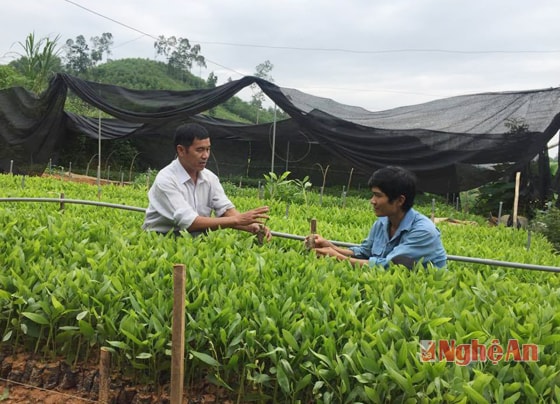 |
| Mr. Tran Van Thu, Secretary of the Party branch of Hamlet 7, Tan Huong Commune, guides the people in planting acacia seedlings. |
The membership rate of youth organizations and associations is increasing (veterans reached 97.13%, up 2%; youth union members reached 64.5%, up 15%); socio-economic conditions have improved positively, with average per capita income in 2015 reaching 15 million VND/person, an increase of 3.5 million VND compared to 2013. The poverty rate has decreased by over 2% per year.
Several pressing and prominent issues at the grassroots level, such as electricity, environmental pollution, land issues, and policy-related problems in villages and hamlets, were addressed, building trust among the people. The quality of Party branch activities improved, and the political role of the Party branch and the sense of responsibility of Party members were enhanced. After being selected as a pilot area, Tan Huong admitted 9 new Party members, including 3 from the Catholic community. Currently, only 2 out of 12 hamlets with Catholic residents are at risk of having no Party branch again: hamlets 11 and 12.
Mr. Phan Van Giap, Permanent Deputy Secretary of the Tan Ky District Party Committee, said: Based on the implementation plan of Project 01-DA/TU of the Provincial Party Committee and Conclusion No. 84-KL/HU of the Tan Ky District Party Committee, the district continues to build the grassroots political system with the motto "comprehensively strong, sustainably effective". The goal is to have over 80% of grassroots Party organizations, government agencies, the Fatherland Front, and socio-political organizations successfully complete their tasks or better by 2020, with no weaknesses, and to sustainably eliminate Party branches at risk of becoming inactive again.
Do a good job in personnel management.
Imbued with President Ho Chi Minh's teaching, "the quality of the cadre determines the quality of the movement," Yen Thanh district has identified the core issue in consolidating the political system as cadre work. According to the Standing Deputy Secretary of the Yen Thanh District Party Committee, Comrade Nguyen Viet Hung: To have good cadres, we must identify, nurture, and cultivate a pool of talent from the grassroots. First and foremost, we need to focus on identifying, nurturing, and training local cadres, "using our own strength to liberate ourselves."
In fact, over the past period, Yen Thanh district has focused on training and developing cadres from the grassroots level. As a result, the quality of commune-level cadres in Yen Thanh has improved significantly. Overall, out of a total of 413 full-time commune-level cadres in the district, 192 have university or college degrees; 132 have intermediate-level qualifications. In terms of political qualifications, 49 have bachelor's or advanced degrees; and 273 have intermediate-level qualifications.
Specifically, at the commune level, the 2015-2020 term had 585 committee members, of which 362 had university degrees, accounting for nearly 62%. Regarding civil servants, out of 458, 236 had university or college degrees, and 220 had vocational degrees; 2 had political science bachelor's degrees and 137 had political science vocational degrees. In conjunction with training, Yen Thanh also focused on strengthening the ranks of capable and highly responsible cadres from the district to hold key positions in some localities with weak movements or a shortage of capable cadres. Since the 26th District Party Congress, 2015-2020 term, the district has transferred two district cadres to leadership positions in two communes in Catholic areas.
Regarding Cong Thanh commune – where 46% of the population is Catholic, including 7 exclusively Catholic hamlets – according to the Party Secretary of the commune, Comrade Nguyen Van Thuan: In areas where religious leaders and officials have good awareness and know how to harmonize the work of the parish pastoral council with local affairs, the activities of the political system at the grassroots level will be smooth, and vice versa. Therefore, the challenge for the Party committee, government, and political system in these areas is to strive to improve their skills in all aspects, including work skills, propaganda skills, and persuasion skills; and maintain good relationships with religious leaders and officials to work together towards the common goal: "A better life and a more beautiful faith."
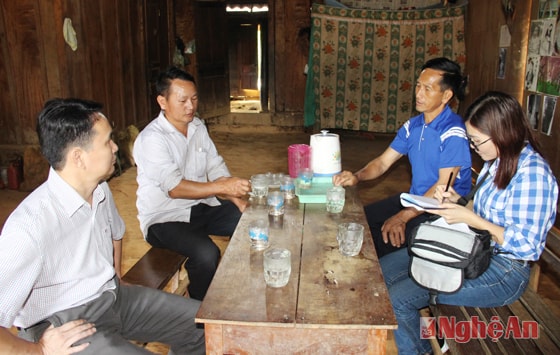 |
| The head of Huoi Chao village in Nam Can commune (Ky Son district) held a discussion with district Party committee officials and reporters. |
Comrade Hoang Van Bo - Standing Deputy Secretary of the Quynh Luu District Party Committee - one of the three units selected by the Provincial Party Committee as pilot areas for implementing Project 01 (along with Nghi Loc and Hung Nguyen districts) - also stated: Currently, the most important thing in building and consolidating the grassroots political system is developing local Party members so that every hamlet has Party members and establishing independent Party branches, ensuring the leading role at this level. This is linked to the consolidation of hamlet leadership boards and branch associations; the renewal of the content and methods of operation of the Fatherland Front and other mass organizations, creating movements to attract members to participate, thereby identifying and nurturing potential candidates for Party membership.
Based on practical experience, Comrade Nguyen Danh Hanh - Secretary of the Party Branch of Hamlet 12, Bao Thanh Commune (Yen Thanh District) raised the issue: To strengthen the quality of the grassroots political system in special areas, it is not only about improving the capacity and effectiveness of the organizational structure and cadres, but also about innovating the leadership and guidance methods, the working style of cadres, and effectively managing the relationship with the people. Each cadre and Party member within the grassroots political system needs to continue to strengthen the people's trust through actions that "match words with deeds"; they must be truly close to the grassroots, understand the people, respect the people, and promote the people's right to self-governance. Because these are the people and organizations closest to the people...
Agreeing with this viewpoint, Comrade Hoang Van Phi, Secretary of the Hung Nguyen District Party Committee, stated: The district regularly focuses on nurturing and developing a core team of Party members and key officials to assist the people in correctly implementing the Party and State's policies and guidelines. To date, the entire district has 120 Party members who are religious believers, spread across 16 out of 23 communes and towns with religious communities. Experience shows that in villages and communes with strong, dedicated Party members and unified leadership, the Party branches and mass organizations play a central role in fostering unity, guiding people towards lawful religious activities, and minimizing violations.
Therefore, doing a good job in mass mobilization, maintaining good relationships with religious leaders and officials; and building good models and factors to replicate are among the solutions that the Hung Nguyen District Party Committee has been implementing in building and consolidating the political system in special areas, with a focus on Party branches in areas with a large number of religious followers. Thanks to this approach, Hung Nguyen now only has 4 Party branches at risk of becoming "empty" again: Bac Phuc Long, Ke Gai, Hung Thinh 3 (Hung Tay) and Hamlet 8 (Hung Trung)...
| Besides focusing on nurturing key personnel in religious areas and influential figures among ethnic minorities, Project 01 also clearly states: Developing a policy of prioritizing the attraction and recruitment of commune-level civil servants and public employees, including preschool, primary, and secondary school teachers, and medical staff at health stations who meet the standards and have permanent residency in localities with villages without Party branches or localities at risk of villages becoming without Party branches again, in order to train them, create a source for recruiting new Party members, and plan for the recruitment of key commune-level officials. |
Promoting socio-economic development
Along with building, strengthening, and enhancing the capacity and fighting strength of Party branches and promoting the role of organizations and associations, many opinions suggest that Party committees and governments at all levels should pay attention to investing in socio-economic development in areas with religious communities and ethnic minorities, focusing on exploiting the strengths of each locality; mobilizing all resources to effectively implement social welfare policies. This will improve the living standards and income of the people, ensure a prosperous and stable life, and strengthen people's trust in the Party's leadership.
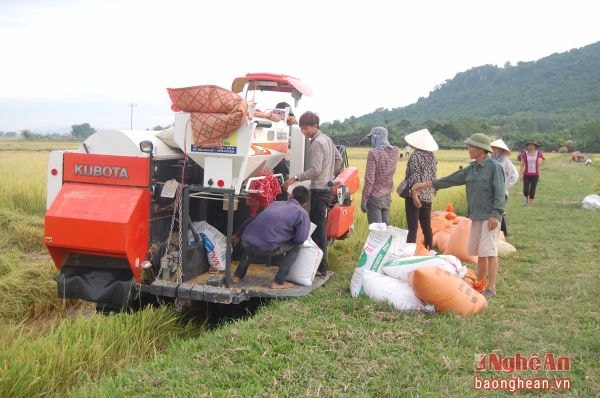 |
| Introducing mechanization into agricultural production in Yen Thanh |
In Project 01, the Provincial Party Committee also assigned responsibility to the Party Committee of the Provincial People's Committee to direct the issuance of criteria, mechanisms, and resources for building new rural areas in the province's Catholic and disadvantaged hamlets. Initially, the focus will be on 168 hamlets that do not yet have Party branches or Party members… However, for the project to truly take root and be effective, it requires the synchronized, long-term, and flexible participation of all sectors, levels, and localities. This includes focusing on recruiting new Party members, enhancing the political acumen of cadres and Party members, and strengthening the fighting capacity of Party branches in these special areas.
The target set for Project 01 is to strive for the following by 2020: - Over 50% of hamlets have no Party members, and no Party branches have admitted new members; reduce the number of hamlets without Party branches by 50% and the number of hamlets at risk of no longer having Party branches by 50%. - 100% of hamlets have been reorganized and strengthened, and have established youth union branches, women's associations, and farmers' associations. - Over 90% of the heads and deputy heads of political and social organizations at the commune, ward, and town levels, and 60% of village heads are Party members. |
Reporters' Team
| RELATED NEWS |
|---|


