
The Truong Bon photograph, 1968.
(Baonghean.vn) - In February 1968, after graduating from Course 7 – the reporter training class organized by the Vietnam News Agency (now Vietnam News Agency) in coordination with the Central Propaganda Department and the General Department of Information, I was assigned by the editorial board of the Vietnam News Agency to be stationed in Nghe An province as a war correspondent.
The Vietnam News Agency branch office was assigned by the Nghe An Provincial Party Committee to share a common location and operate alongside the Provincial Propaganda Department. Initially located in Thuong Son commune, it later moved to Hien Son commune in Do Luong district, a semi-mountainous area. At this time, the US intensified its air attacks on North Vietnam, particularly in Nghe An province.
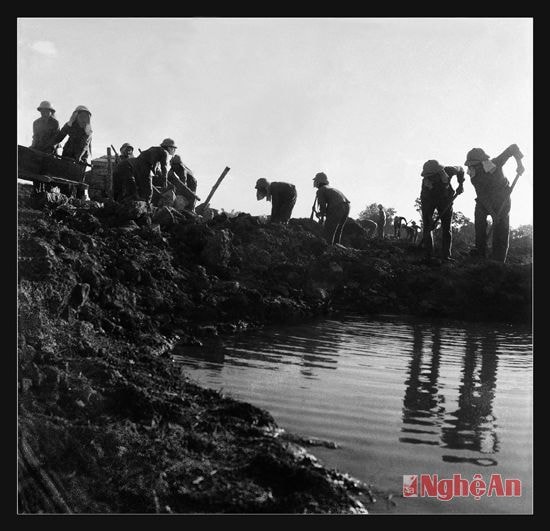 |
| The Truong Bon Steel Squad is urgently filling in bomb craters to clear the road and allow traffic to resume at the Truong Bon strategic point. |
Hien Son commune (where we evacuated) is only about 3 km as the crow flies from the Truong Bon strategic point in My Son commune, Do Luong district. It must be said that not a single day or hour passed without the roar of American planes in the skies over Nghe An, especially at the Truong Bon intersection. The word "Truong" in the local Nghe Tinh dialect means a mountain pass or slope (similar to Pha Din Pass or Lung Lo Pass). Truong Bon, considered a strategic point, a "bombing pocket," a "gateway to death," is 15 km from Do Luong town, bordering the two districts of Do Luong and Nam Dan in Nghe An province. This is a single-lane road, about 5 km long, on Highway 15A, the route connecting North and South, the most important lifeline for the North's rear, supplying all kinds of supplies to the Southern battlefield.
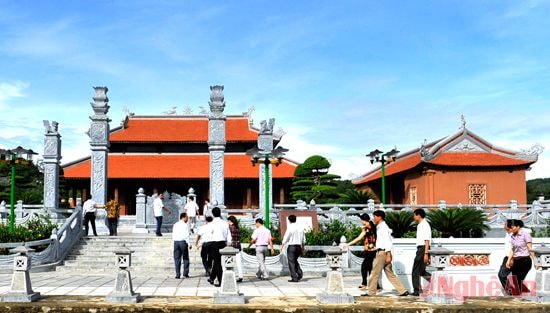 |
| Today, Truong Bon has been restored and designated as a historical site for educating future generations about patriotic traditions. (Archival photo) |
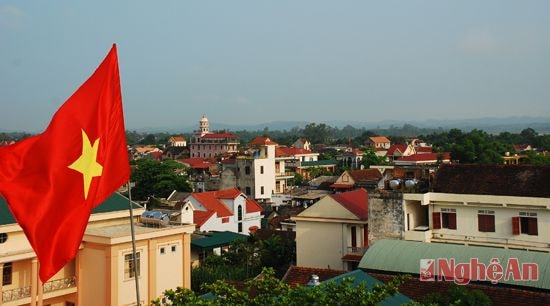 |
| A view of My Son commune (Do Luong district) today. |
Truong Bon Pass is situated between two hillsides, with some sections bordered by hills on one side and rice paddies on the other, resembling a fortified pass easily buried or blocked, making it impassable when hit by American bombs. At the Truong Bon strategic point, there was hardly a day (day and night) without the sound of American bombs. Here, along with nearly 1,300 Youth Volunteer soldiers and other traffic maintenance forces, Squad 2, later known as the "Steel Squad," belonging to Company 317 of the 300th Youth Volunteer Team of Nghe An province, held its ground day and night to ensure traffic flow with the motto "Live clinging to bridges and roads, die bravely and resolutely."
By October 31, 1968, the entire platoon had achieved outstanding accomplishments, receiving a flower basket from President Ho Chi Minh and a Nguyen Van Troi flag from the Central Committee of the Youth Union. Many soldiers were awarded the title of "Emulation Soldier" and admitted into the Vietnam Labor Party... At this time, the entire platoon had completed its mission and was preparing for discharge. Some of the women had received acceptance letters to universities or vocational schools, and some had found their significant others right in the unit, just waiting for the day to return home to hold their weddings, such as Ms. Nguyen Thi Tam from Hop Thanh commune, Yen Thanh district, and Mr. Cao Ngoc Hoa from Dien Loc commune, Dien Chau district...
I had visited twice to write reports and take photos of Squad 2, nicknamed the "Steel Squad." On October 31, 1968, because I knew them beforehand, I went alone. That day, when I arrived at Truong Bon, I saw the soldiers of Squad 2 busily filling bomb craters at the end of the valley, where there was a low hillside and on one side, abandoned rice paddies. Without yet gathering any information and with the scene already bustling, I immediately began my work. While taking photos, I listened for any activity. After taking ten shots with my RolleiFlex camera, and seeing that the material was sufficient, I told Squad Leader Tran Thi Thong to gather the whole squad so I could take a commemorative photo. Everyone in the squad wanted to be photographed, but Squad Leader Thong hesitated. Thong thanked me and gave two reasons why a commemorative photo shouldn't be taken at that moment: firstly, they had to quickly fill the bomb craters to allow traffic to resume, and secondly, she wanted to ensure my safety.
That day, at 4 a.m., 14 soldiers of the "Steel Squad" received orders from their superiors to rush to the scene to fill in the bomb craters left by the American bombing during the night in the northern part of the valley. Only one soldier remained to guard the camp. They entered the battle (no one thought it would be their last) with high determination and cheerfulness as usual, determined to get the road open before dawn. After two hours of strenuous work, the bomb craters were basically filled. They only needed to add more boulders to the wet areas where the vehicles might slip before returning to the camp to rest.
But at that very moment, at just after 6 o'clock, a group of American planes suddenly swooped down and dropped bombs incessantly on the position where the unit had just been working. Squad leader Tran Thi Thong (with a rifle slung over her shoulder) only had time to shout, "All squad members, take shelter in the bunker!" before a barrage of enemy bombs hit the squad's formation. When the smoke from the bombs cleared, rescue forces from a friendly unit arrived at the scene, only to see a network of bomb craters and an eerie silence. The rescue team fanned out to search and dig everywhere, but found no one. Fortunately, someone discovered a gun barrel protruding next to a bomb crater. Everyone quickly dug and pulled out a female soldier who was nearly suffocating. They administered first aid and immediately took her to a nearby field hospital. The soldier who was saved was Squad Leader Tran Thi Thong – the hero of the heroic steel squad.
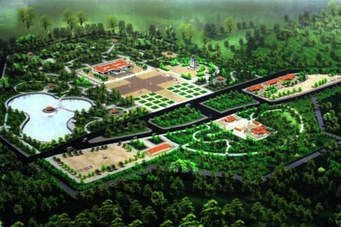 |
| A panoramic view of the Truông Bồn historical site. |
Although the film (6x6 size) was speckled with mold and scratched in a few places, I was overjoyed to the point of tears, because it was my only memento of the heroic steel squad. I also consoled myself that when this photo is published and featured in some media outlets, it will be as if I have repaid my debt to the heroes in the legend of Truong Bon. Moreover, this is perhaps one of the rarest and most precious types of film I've ever seen in my career as a journalist and in my 44 years behind the camera.
Tran Hai
(Recorded from photographer Phùng Triệu)
| RELATED NEWS |
|---|


